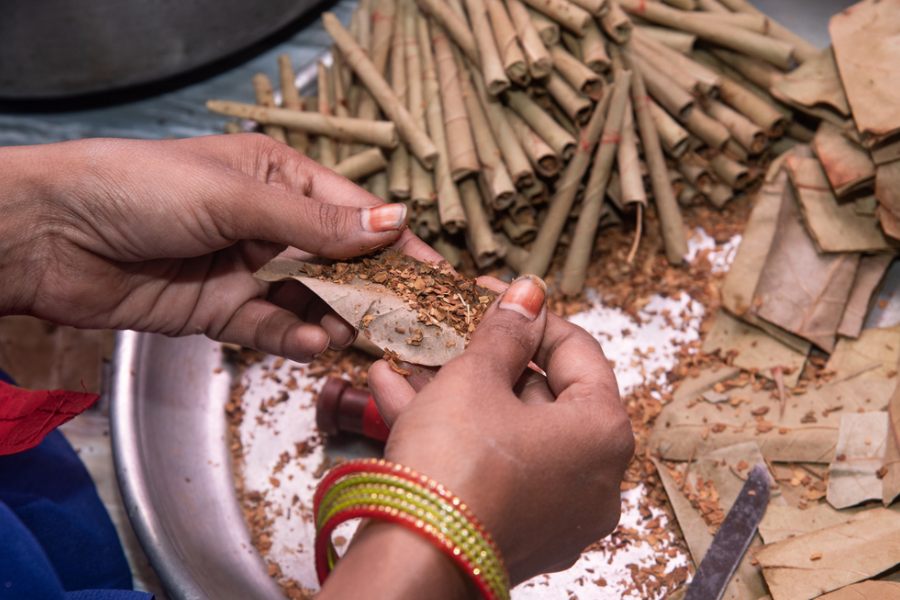
Ruksana Khatun, 12, sits cross-legged on the mud floor of her house in Suti in Bengal’s Murshidabad, around 280 km from Kolkata, rolling tobacco into tendu leaves before leaving for school.
Her mother, Rahima Bibi, works at a frantic speed beside her, a pile of nearly 600 bidis in a corner near them. They still have 400 more to make before noon. The child is not officially a worker. On paper, she is only helping her mother.
But in Murshidabad's sprawling bidi belt -- stretching across Suti, Samserganj, Dhuliyan, Jangipur and Lalgola -- thousands of children help their families meet impossible daily targets.
Local contractors who control the bidi trade also wield enormous influence over village politics.
Nearly a quarter of the country's bidi workers are concentrated in Murshidabad, where the industry forms the backbone of the local economy.
"If she doesn't help me, we cannot finish 1,000. Then they cut our payment," Rahima said. For every thousand beedis rolled, the family earns between Rs 160 and Rs 180.
Murshidabad is home to nearly 25 lakh people linked to the trade. In villages around Jangipur, Lalgola, Aurangabad and Dhuliyan, almost every house doubles up as a workshop.
Women sit for hours in dimly lit rooms with piles of tobacco around them. Children help them before and after school hours; often instead of school.
"In Murshidabad's bidi belt, childhood ends when the fingers become fast enough to roll tobacco. Many girls stop attending school after class 5 or 6. Some are married off, but many begin helping their mothers full-time," said a schoolteacher in Samserganj.
Workers said the local contractor or munshi decides everything -- whose bundle will be accepted, who will get an advance before Eid, who will receive a bidi worker's card and who will get provident fund or hospital benefits.
"If you anger him, work stops. And if work stops, how will we eat?" Hasina Bibi asked.
Several workers accused the contractors of being closely linked to political leaders and using that influence during elections.
In 2026 Bengal Assembly polls, there are prominent bidi factory and company owners who are contesting elections, such as TMC members, Jakir Hossain from Jangipur and Bayron Biswas from Sagardighi, and CPM candidate, Haji Shahabuddin from the Karandighi constituency.
"During polls, they tell us which meeting to attend and which party to vote for. Nobody says it openly. But everyone understands. If you are seen with the wrong party, next week there may be no work," said a woman in Jalangi.
The issue briefly erupted into the open in September 2025, when around 10,000 beedi workers from villages in Lalgola block launched a protest demanding higher wages.
Led largely by women, the agitation spread across Pathan Para, Bishwanathpur, Chama Para and Fakir Para. Their wages had remained stuck at Rs 165 per 1,000 bidis. After days of protests, the rate was raised to Rs 190.
Jamili Khatun, 58, of Lalgola, has been rolling bidis for 43 years. She has no provident fund account.
"We are exploited to the core. I earn around Rs 5,000 a month. There are 12 people in my family. My daughters and daughter-in-law also bind bidis, but our combined income is not enough," he said.
Doctors in Samserganj and Dhuliyan said women who spend years rolling bidis suffer from chronic cough, asthma, back pain and eye problems.
"Children exposed to tobacco dust from an early age also develop breathing problems," said a doctor at a rural health centre in Samserganj.
Because most women work from home rather than in factories, they remain outside labour laws and social security.
"The law bans the employment of children in hazardous occupations. But here, since the work happens inside houses it is passed off as helping the family. The system survives because everyone benefits from pretending that child labour does not exist," said a member of All India Bidi Workers Federation (AIBWF), Murshidabad unit.
The ruling Trinamool rejected allegations that it protects the contractor network.
"The exploitation of bidi workers is the legacy of decades of Left rule. Our government has given Lakshmir Bhandar [dole for women], ration and health insurance," TMC MP Abu Taher said.
The BJP accused Bengal’s ruling party of using the bidi industry as a political machine.
"Most contractors and many company owners are close to the TMC. They exploit women, use children and then convert that dependence into votes," said BJP district president Gouri Shankar Ghosh.
Congress leaders said both the Trinamool and the BJP had ignored the plight of workers.
"The BJP and the TMC want to fight this election on the narrative of Hindu and Muslims. But the real issue is that lakhs of women are surviving on Rs 180 a day, children are dropping out of school," Congress leader Nazme Alam said.
Murshidabad's bidi belt barely figures political in speeches. Leaders talk of infiltration, NRC, religion and borders. But in the lanes of Samserganj and Lalgola, the real issues are lower wages, sickness, debt and children dropping out of school.
In Murshidabad, which will go to the polls on April 23, the battle may be over identity, but the deepest wound lies inside the bidi workers' homes. Here, survival depends not on the vote, but on the contractor who can give work -- or take it away.