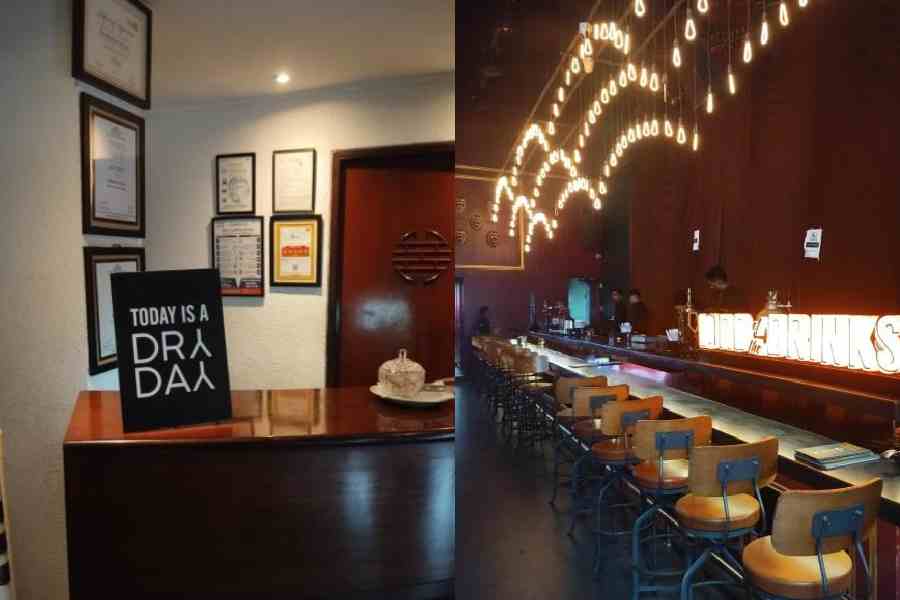
Nearly 36 hours after liquor sales and services were halted across Calcutta and its neighbouring districts in the name of ensuring “free and fair elections”, the poll panel said it had not ordered any such ban.
Late on Tuesday evening, Bengal’s chief electoral officer (CEO), Manoj Agarwal, told reporters he was unaware of the clampdown that had come into effect early Monday morning. His statement followed a barrage of questions over the restrictions.
The curbs, however, continued through Wednesday in the absence of any formal notice reversing the earlier directive. Business owners, facing mounting losses, took to WhatsApp groups to express frustration over the uncertainty.
Under the order, all retail establishments selling liquor in Calcutta and adjoining districts were to remain shut from April 20 to April 29, and again on May 4 — counting day — with a window of one-and-a-half days between April 24 and 6pm on April 25. Calcutta and neighbouring areas vote on April 29, and the standard practice is a 48-hour shutdown ahead of polling and on counting day.
Many viewed the extended ban as an overreach. Conversations with election officials suggested efforts to roll it back.
“The CEO on Wednesday sought an explanation from the finance secretary regarding the excise commissioner’s notice enforcing the state-wide shutdown,” an official said.
Although the excise department operates under the finance ministry, all state departments have been reporting to the Election Commission since the poll schedule was announced on March 15. “The CEO has asked on what basis the prolonged restriction was ordered. There is a possibility the ban may be revoked,” the official added.
The excise commissioner did not respond to calls or messages from this newspaper.
Industry stakeholders said the confusion had come at a steep cost. A leading retailer with more than a dozen outlets across south Bengal called the situation “bizarre”.
“If the EC has not ordered the shutdown, then who has? The state government must seek clarification, because it is the state’s coffers that are taking a hit,” the retailer said.
Rough estimates suggest the state is losing over ₹60 crore a day in excise revenue because of the ban. The liquor industry employs around 2.8 lakh people in jobs ranging from manufacturing and packaging to retail and hospitality. For many of these workers, no work means no pay.
The Bengal Association of Hotels and Restaurants has written to the excise commissioner seeking a rollback of the restrictions in areas voting in the second phase.
“Elections have been held for a long time, but such a prolonged ban is unprecedented. We have requested the authorities to reconsider,” said Suborno Bose, the association’s president.
Restaurants with bars reported a sharp drop in footfall over the past two days. “Many families come to eat, but some in groups order a beer, a glass of wine or a few drinks. That option is important. If there is a ban on liquor, many don’t eat out altogether,” said a Park Street restaurateur.
As the dry spell continued, retailers reported a surge in inquiries. “I have received at least 100 calls in the past 24 hours requesting a bottle at a premium. I have had to refuse all,” said a south Calcutta shop ow