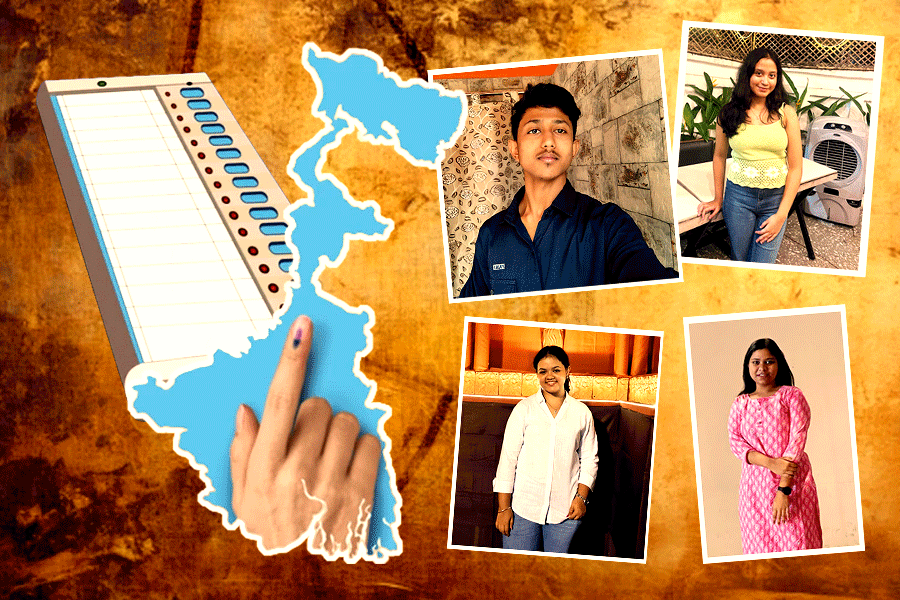
For a section of Bengal’s first-time voters, this Assembly election is not just about choosing a government but about deciding whether to stay or leave.
Across constituencies, young voters aged 18 to 21 speak with a sense of doubt that cuts through the campaign noise.
Jobs are scarce, trust in institutions is low and many – if not most – say they are already planning their way out.
In Kolkata’s Behala Paschim, 21-year-old Srija Das is clear about her plans.
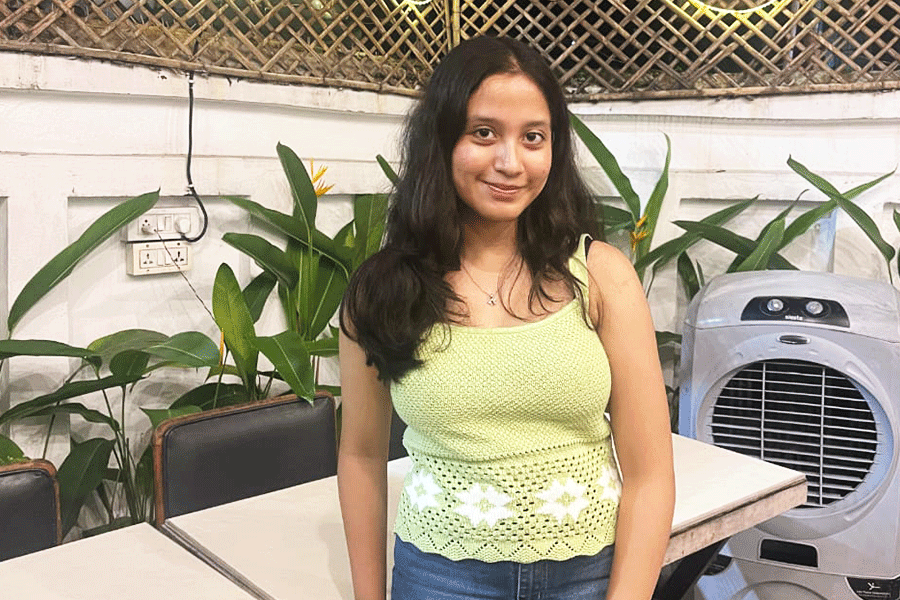
Srija Das (Image sourced by the correspondent)
“I don’t think I see myself staying here after graduation in the near future,” she says.
“The lack of opportunities, nepotism and corruption – all of it adds up to a very hostile environment for employment. I plan on moving away for five to 10 years; perhaps more if there is no change in the regime.”
Her concerns do not stop at employment.
“While I do think the employment crisis as well as the decline in education quality is very concerning, for me the most important is the lack of safety of women in this state. The constant whitewashing of criminals and bringing them back into society with no consequences and the abuse of power by the government are grave concerns.
“Women can't be living with fear every single day,” she says. “It impairs our right to life and liberty to some extent and is a borderline human rights issue that is being heavily neglected.”
Nearly 300 km away, in Purulia, 18-year-old Santanu Sen sees the problem as deeper than one party or one term.
“Honestly, I don’t see a very clear future in the current situation. It’s not just that one government is failing – the entire political system seems stuck in short-term politics and populism.”
He points to uncertainty at every level.
“There is no policy consistency, institutions are becoming weaker, and decision-making is slow and fragmented. This creates uncertainty; and when there is uncertainty, development doesn’t happen and the confidence of the youth also declines.”
At the same time, he – like many of his peers – is conflicted about what the alternative looks like.
“Sometimes I feel that countries with centralised leadership, where there is one clear direction and ideology, are able to grow much faster. But at the same time, there is less dissent there and freedom gets compromised. So, I feel conflicted. I want efficiency, but I don’t want to lose democracy.”
For him, unemployment is only one part of the picture.
“For me the biggest issue is not just unemployment, it’s a deeper structural problem. There is no proper economic ecosystem, there is policy instability, and investment isn’t coming in. Corruption has also become quite systemic; many times, merit doesn’t matter, connections do.”
He says this election is a test of delivery, not promises.
“I’m not just looking at promises, I want to see who can actually deliver long-term governance and rebuild institutions.”
He echoes the confusion many of his age group feel when they see a system meant to be of, for and by the people throw up only bad things.
“At the end of the day, I believe in democracy. But, honestly, today’s democracy often feels dysfunctional. If it cannot provide efficiency, fairness and opportunity, then people will naturally start thinking about alternatives.
“Ideally, we need a system where both efficiency and freedom exist together. This election, for me, is not just about choosing a party, it’s about whether the system can fix itself or whether people like us, the youth, will slowly start losing faith.”
In South 24 Parganas’ Bishnupur, around 140 km north-west of Kolkata, 20-year-old Madhusri Mondal points to what she sees around her.
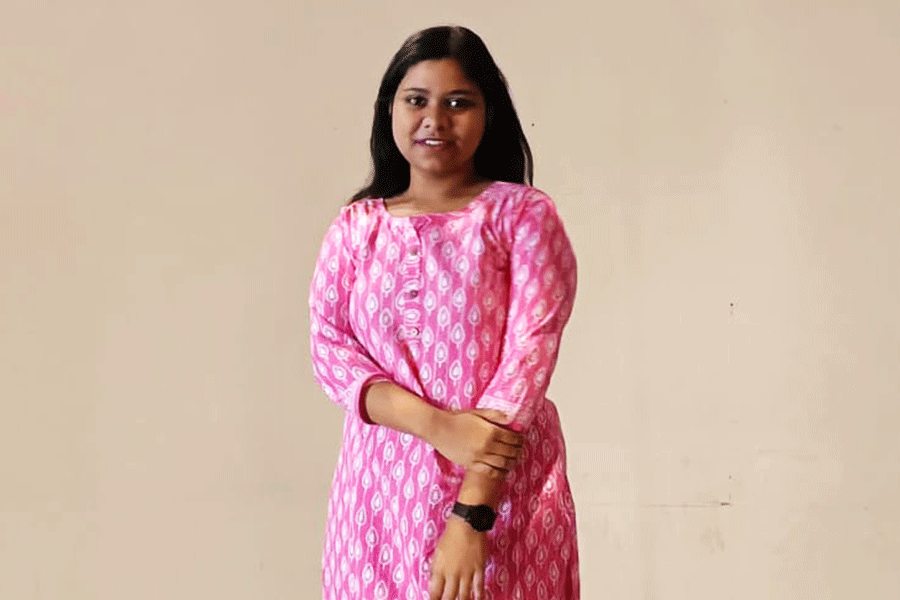
Madhusri Mondal (Image sourced by the correspondent)
“In the current situation in this state, the future of our youth appears almost bleak. Even after taking job exams, educated but unemployed young men and women are sitting at home without jobs.”
The slowdown is visible, she says. “Businesses are shutting down one after another. Employment opportunities in the state are shrinking and unemployment is steadily increasing.”
Her concern is about something more basic. “In this election, the biggest problem at the moment is being able to vote freely and properly. Those in power are influencing ordinary people using their authority and money. Because of this influence and pressure, it has become difficult for common people to express their opinion and go to polling booths without fear.
“It is often seen that many people are unable to even reach the polling stations, which prevents voting from taking place in a fair and proper manner,” she says.
From Berhampore, the Murshidabad district headquarter town 208 km north of Kolkata, 19-year-old Debangshu Ghosh has little faith in what he hears during campaigns.
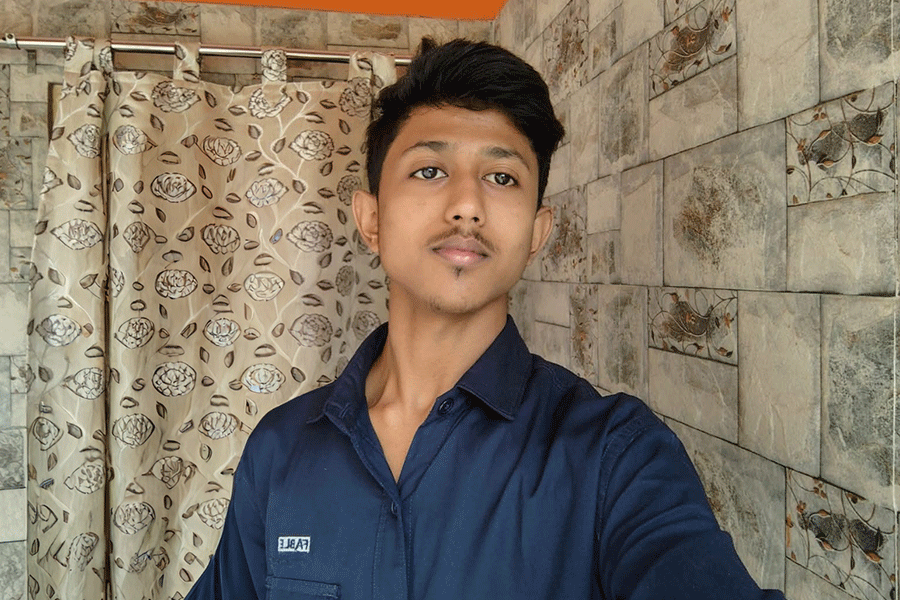
Debangshu Ghosh (Image sourced by the correspondent)
“I don’t see my future in this state. Government jobs are full of corruption, misleading claims and fake promises. Every time, parties promise to build more hospitals and schools in villages and rural areas; but this is just a way to get votes from the public.”
For him, the biggest issue in this election is the special intensive revision (SIR) of electoral rolls.
“It raises serious questions about voter inclusion and the integrity of the electoral process. That’s why I see this election as a turning point, not just for Bengal but for the country as a whole,” he says.
In Birbhum’s Bolpur, 162 km north of Kolkata, 20-year-old Madhusha Ganguly is already preparing to leave.
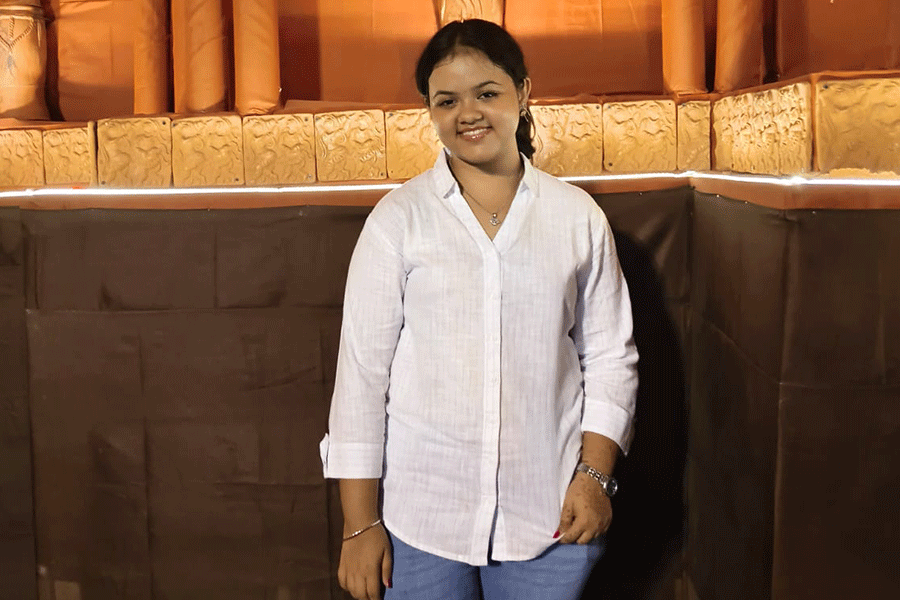
Madhusha Ganguly (Image sourced by the correspondent)
“I am doing my undergraduation in this state to stay close to my family, but I will surely go to another state for my postgraduation. I have seen my seniors getting jobs after they moved out of this state. There is no guarantee of a government job and even if you get one, it’s not good enough compared to other states. So, no, I don’t see my future in this state.”
For her, the issue is straightforward. “I think the most important issue in this election is unemployment and lack of job opportunities. Many young people are struggling to find stable jobs and this is directly affecting their future.”
She draws a clear line between promises and outcomes. “In my opinion, development is meaningful only when it creates jobs for people. Even though political parties talk about welfare schemes and other benefits, long-term economic growth and employment are more important. People want opportunities to earn and become independent rather than depend only on government support.”
She also raises concerns about the voter list.
“Another important issue in this election is the voter list controversy. This is because it directly affects who can vote and who cannot. If genuine voters’ names are removed, then the whole election process becomes unfair.”
Across districts, the message is consistent. Many first-time voters are not just deciding who to vote for. They are deciding whether the state still works for them.
For some, the decision is already made. They will vote, and then they will leave.
The desperation to move out is not new to Bengal; but, perhaps it has never been so widespread, pronounced and all-pervasive.
Complete coverage – Poll drums: Bengal Assembly elections 2026