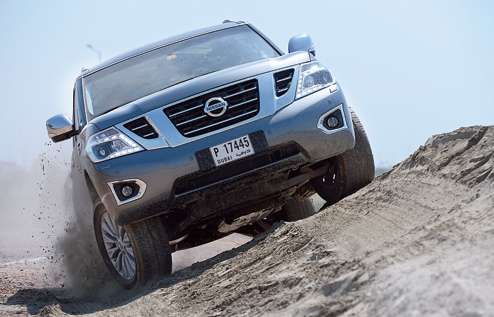

I was a bit puzzled, to say the least, to be invited to the Formula 1 racetrack in Greater Noida to drive the seventh-generation Nissan Patrol. What on earth was one supposed to do with a three-tonne beast of an SUV that stands about a foot off the ground on a super-smooth racetrack? Well, Nissan was actually taking us just behind the track. Here the earth is soft and sand is abundant. Besides, slopes had been created and ditches dug to take the Patrol through its paces.
This is a big machine. It is 5m-long and 2m-wide and seats seven. Nissan India Operations president Guillaume Sicard says he is likely to bring it to India in the near future. So he let Graphiti and some others chuck around a couple of left-hand drive vehicles shipped in from Dubai (the right-hand drive model is sold in Australia).
Remember the Jonga, which used to be made at the Jabalpur works of the Indian Army? That was essentially the fairly rudimentary second-generation Patrol being made under licence. But in the five intervening generations the Patrol has grown bigger and way more sophisticated.
The cabin we were sitting in was very plush indeed with excellent leather upholstery and wood veneer trim. Adjustments for the seats and outside mirrors are powered. The wide, well-cushioned soft-feel leather seats are supportive and comfortable with acres of legroom, except in the third row. There’s lots of space for maps, bottles and knick-knacks and the flexible loading space can be expanded up to 3,140 litres with two rows of seats folded down.
.jpg)
From outside, the Patrol looks impressively big and butch with its chromed front grille with Nissan’s V design and twin-headlamp clusters. The height off the ground and the wide tyres give a sense that it is capable of climbing 45-degree gradients as Nissan says it can. And though there are chrome strips along the sides, surrounding the glass area and at the back to convey a sense of luxury, the simple slab-sided shape and a tell-tale towing hook indicate that there’s more to it than looks alone.
Where the Patrol is similar to the Jonga is that it too has a big petrol engine under the bonnet. Its 5.6-litre V8 is good for 400hp, a good 100hp more than its competition, and 560Nm of torque. Old-fashioned grunt is delivered evenly through a seven-speed automatic gearbox to all the wheels at all times. Traction, therefore, is excellent and so is the growl when the engine is pushed up the rev range. Combined driving cycle fuel consumption for the Australian model is is 14.5 litres per 100 km under test conditions.
Ride is commendable in most situations with Nissan’s Hydraulic Body Motion Control (HBMC) technology. This system is connected to all the wheels and stiffens and softens the suspension at each wheel when it senses that the SUV is tilting to keep the vehicle as close to horizontal as possible. Not only does this work to keep the wheels in contact with the ground while crossing offroad obstacles, it also reduces chances of the SUV turning turtle on bendy roads.

While it is good and quick on tarmac, the Patrol really comes into its own when taken off the road. Apart from the HBMC, buttons on the console let the driver to set it to Sand, Rock, Snow and On Road to suit those driving conditions, as well as high- and low-ratios for tackling sharp gradients. A differential lock option keeps the SUV from slipping on muddy terrain.
In Sand setting and low-ratio, the Patrol climbed up steep, soft slopes with consummate ease while Hill Descent Control kept descent on loose earth slow and steady without driver inputs. Along a steeply inclined strip of earth, the on-board computer stepped in to check slides and hold the SUV in line. As for slush, did it exist? This is an impressive piece of kit with a full complement of luxury.
Sicard says a fully-built imported Patrol will cost above Rs 1 crore in India. That would put it smack against the diesel-engined Toyota Landcruiser, the Patrol’s traditional rival, in a market that is skewed against petrol SUVs. Nissan, however, claims that over the life of the vehicle it is cheaper to run than a diesel. What does tilt the scales towards the Patrol, however, is a quiet cabin and the big grin that can only come from pushing a big petrol V8 to its limit.
THE SUV IN NUMBERS
- Length x Width x Height (mm): 5,140 x 1,940 x 1,995
- Kerb weight: 2,830kg
- Engine: 5.6-litre, V8 petrol
- Max. power: 400hp@5,800rpm
- Max. torque: 560Nm@4,000rpm
- Transmission: 7-speed automatic
- Tyre size: 265/70 R18
- Ground clearance: 283mm
- Max. speed: 200kmph
- Load capacity (litres): 550/1,490*/3,140#
*With Row 3 seats down; #With Row 2 & 3 seats down