FAST FASHION
It is what some high-street brands do. The collection you see on the ramp is in no time converted into ready-to-wear. They already have stock fabrics, so it is like mass manufactured and then shipped to stores overnight across the world. And because such trendy straight-from-the-ramp clothes are available in the quickest forms in these stores, young girls and people who want to dress up keeping with the times, follow that and wear that.
Maybe the person who is showing the collection on the ramp had put in some thought, but when it is converted for these stores, there is not a lot of thought that goes into it. Every time you go, you see a new display. The shelf life is very short and the life of that product in your wardrobe is also very short. The fashion is going to be changed in three months in the very store where you bought it from, so how much are you ready to pay for it first of all? So you try and cut corners everywhere, from the fabric that is procured to the quality. You don’t know anything; where does it come from?
What is the content of the fabric? I’m sure it’s not 100 per cent of any pure fabric, like cotton or linen. What kind of dye is used? Where is it converted… in India, Bangladesh, or Vietnam?
So it’s a cycle where everybody is in a hurry. There’s no mindful consumption; there’s no mindful creation. And then, what kind of waste are we creating with those excesses?
AROUND THE WORLD

.jpg)


SLOW FASHION
It’s the buzzword right now. Slow fashion is the process of creating that one particular piece where you have not hurried the process. You are creating very slowly and thoughtfully — right from the design stage, thinking how relevant the design or the colour will be next season when the colour story changes, and how it can be worn in different ways on different occasions.
Spring-summer is always about whites and pastels and autumn-winter is always about more earthy colours. So there might be some tones that are more important this season; say if a green shade is more popular this season, you can always incorporate it by not changing the whole garment, but taking a green stole or a green blouse or a green accessory. So it’s about creating classics.
I don’t mean all that I create is going to last forever, but whatever I create will be worn for a very long time. It is not a part of a fad that will come and go. If it is a sari, people can wear for 10-15 years; or they will pass it on to their daughter. So it’s about staying relevant.
It is very, very important to be very choosy about what you are putting into your wardrobe. You take out your wardrobe every two or three months and just see what you are wearing and what you are not wearing, what you have not worn for several months. So what is it you like so much about the garment that you are not being able to detach yourself from it?
Get it altered or add something to it and reuse it. All you need to buy this season might be just two more jackets or two more scarves. You need to look within to use what you already possess.
Some people ask why is it so expensive. You tell them that the price of the yarn is expensive... the weaving costs, using the right dyes, all of that we tell and people are getting aware. Also since our designs are very simple, no embellishment… that question also comes that why so expensive for a simple garment. So you have to educate; it is very important. You take them through the whole process.
There are certain unforeseen challenges in slow fashion, often due to weather. Like sometimes if there’s too much rainfall in a particular area, the weavers cannot weave. But you cannot weave anywhere else because that’s the cluster you are working in and that’s where you have set the looms for that design. That happens because it’s not made by a machine.
So right now, I am planning much ahead because monsoon is coming and I know those many days there will be no work; the yarn will not dry. The first few years I never used to foresee such things, but now I have started working these things into my process.
If you look at people who had started working with sustainable fashion — like Raw Mango, Indigene or Pero — people who started working with handwoven textiles, you’ve seen them craft a name for themselves. Earlier you would never see such brands on the ramp, or in the fashion circuit or celebrities adorning them and supporting the textiles of India. They were viewed to be fit for a certain look. But with so much happening now, I think young people are inspired.
ETHICAL FASHION
Ethical, as the word says, means that you have not wronged anybody in the process. So when a weaver weaves that sari, he has got his right share. It should not be that you have compressed his wages. It should be that everyone has got a fair share for their work that has gone into making that one product — from the person who has spun the yarn to the person who has woven the sari, the person who has printed it, the people who are working in the stores.
Also, being transparent to the customer that this is what we are delivering and we are putting the right things forward.
It goes beyond wages, to the work environment you have created. Ethics also mean you are not using child labour. Women get maternity leave, their salaries are given on time… all of these small things contribute.
Things are much more ethical now, at least in the handloom sector. Even in the villages, social media and online sales have made it possible for everyone to understand the worth of their work. But maybe there are remote areas which are not connected and people are being wronged in certain ways. You do hear some designer has got their designs developed by a certain cluster, but later shifted the production to another cluster because the prices were high… that’s not ethical. You have to sit at the table and talk to the person and see how you can bring it down if that price point is not working for you.
SUSTAINABLE FASHION
We have been working with linen for the past five-six years. I think that’s sustainability. The brand doesn’t change its voice every season because of the trends going around.
Also, it’s about how you sustain what you have. It is important to sustain the livelihood of the people who are engaged with the brand. All the employment that have been created for my brand right from the beginning has been sustained. We have grown and the clusters have grown with us. I have been working with the weavers in the Phulia region of Bengal year after year. We started with one loom and now the cluster has 100 looms, and we ensure that those 100 looms keep running. You cannot pick and then not work with those artisans from time to time.
If we started working with a printer in Baroda, we have been printing something or the other with him every season. We create designs in such a manner that all the artisans we work with are a part of our collection in some way or the other. That’s constantly on our mind. And before adding someone new, we make sure people who have been working with us have work.

RECYLING / UPCYCLING
Recycling is reusing materials and fabrics that could be easily thrown away and upcycling is creating and making something more beautiful than before by adding design elements. We use a lot of our leftover textiles to create beautiful khatwa (applique) work. Our new handmade toys line incorporates bits and pieces of unutilised textiles and other materials in the workshop and studio.

Weaving linen is not easy, neither is designing with it. The softness of the yarn causes it to break repeatedly when being woven, while in designing the challenge is to deal with the creases. “But then the beauty of linen lies in the creases,” says Anavila.
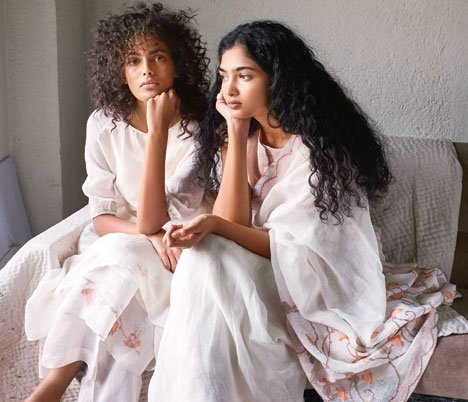
Her personal wardrobe is 80 per cent linen; and almost 80 per cent of every collection she designs is in pure linen, too, with the rest 20 per cent being blends of linen and fabrics like silks and organza.
The understated appeal of the fabric is a big draw for her. “Linen accentuates the person who is wearing it; it doesn’t take away from your look.”

Her extreme love for pastels, evident from the predominant colour palette of her body of work, also stems from her upbringing. “I have never seen my mother wear any make-up and her wardrobe was only pastels… my nani was a Sardarni and her wardrobe, too, was all pastels with white dupattas. The natural colour of linen is beige and cotton is white, so I love these two colours,” says Anavila, who feels pastels bring out the beauty of linen. So most of every collection revolves around muted hues, though a bit of bright tones can be found in her bridal lines.
The only time one would perhaps see dark tones in her label is when she does indigo, a craft she started working with in Vietnam, where her husband’s job took her. “They have so many living crafts in Vietnam. Indigo is a living textile and for me, it has been so much about discovering them and learning so much from them. I also work with hemp, a natural yarn, that I source from Vietnam.”
In India, Anavila works in craft clusters across the country. Her entire range of linen saris, which makes up the bulk of her collection, is done in Phulia. She also works in Bhuj in Gujarat for indigo, block prints and kala cotton, which is a strong, coarse and pure variety of cotton. A group of women artisans in Jharkhand do her embroideries; her block print work happens in Baroda and contemporary Gadwal saris in Hyderabad.
Among the regions she would like to explore are the Northeast, and the Kumaon-Garhwal belts of Uttarakhand. “They have started working with a lot of natural yarns which we have not even heard of, those naturally grow in those areas. I want to explore those,” she says. When that happens, slow fashion will help preserve a few more indigenous crafts of India.