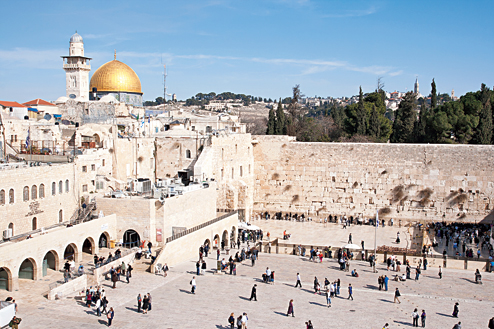

As I stood touching the old limestone wall in front of me, I heard the pretty young girl beside me sobbing quietly as she swayed back and forth, praying fervently. I was at the Western Wall or Wailing Wall in the Old City of Jerusalem, the holiest site for Jews as it represents the remnants of their cherished Second Temple. On either side of us, other women stood or sat, heads bowed to the Wall, praying and slipping in notes filled with wishes into the crevices between its stones.
To our left, beyond a barricaded fence, similar scenes were playing out in the men’s section of the Wall. In front of us, just behind the Wall on the Temple Mount, stood the Dome of the Rock, which enshrines the sacred rock from which Prophet Mohammed is believed to have ascended to heaven and from where, I imagined, equally fervent prayers were being sent forth. Just as, barely minutes ago and a few narrow lanes away from the Wall, I’d seen similar acts of faith inside the Church of Holy Sepulchre.
There, I’d seen tourists lighting candles at the Altar of Crucifixion, which marks the spot where Christ was crucified on Golgotha hill, and also kneeling in prayer with their hands touching the Stone of the Anointing. Christ’s mortal remains are believed to have been dressed for burial on the Anointing stone.


History abounds, as the cliché goes, beneath every stone — even if it’s newly laid — of the Old City. But it was these scenes at the Holy Sepulchre and Western Wall that brought alive for me why it’s the Holy Land, birthplace of Judaism and Christianity, and sacred to Islam.
Of course, the historic also nestles cheek-by-jowl with the modern in Israel. So, I’d app-roached the Old City by walking through the lively Mamilla pedestrian mall — it adjoins the gorgeous Mamilla Hotel — towards the Jaffa Gate. I was part of a group of journalists visiting Israel on the invitation of the Israeli Ministry of Tourism. As we’d passed through Jaffa Gate, Sharon Peleg, our lively tour guide, had brought us up to speed by telling us that the Old City’s current walls are only around 500 years old. They were built by the Ottoman king, Suleiman I, in the 15th century, albeit he copied the architectural style of the 11th-century Crusaders.
It’s complicated alright this many-layered history of this much-fought-over land, I’d realised, as we traip-sed through the Arme-nian quarter and then past narrow alleys towards the Jewish quarter overlooking the Dome and Al Aqsa Mosque.
Only Muslims can enter the Dome, so we couldn’t go there. Instead, we had wound our way to the Holy Sepulchre and then the Via Dolorosa, where we’d retraced Christ’s footsteps on that final walk with the Cross. Fourteen stations dot the souvenir-shop-laden Via Dolorosa, marking out spots along the route that Christ took from his sentencing by Pontius Pilate to his Crucifixion.
I’d marvelled at Station VI, where Veronica had wiped Christ’s face and his image had got imprinted on her cloth. Of course, everyday life goes on in the Old City’s Armenian, Jewish, Christian and Muslim quarters.

Now, the present day impinged again as we headed to the popular Machane-Yeuda food market. I could have been in a colourful Indian bazaar the way the vendors shouted out their wares. One stall-keeper even burst into an old Hindi film ditty, Ichak Dana.
It’s common to see armed young Israeli soldiers in public places but they seem quite unthreatening. So, as we strolled through the market and then dined at the hip Chakra restaurant, we were oblivious that there’d been an attack in the Old City that evening. And there were no indications, barring some police sirens, the next morning either of another attack till we passed the shooting site on our way out of Jerusalem.
Life in Jerusalem goes on amidst the complexities of the Israeli-Palestine conflict — albeit I found it disconcerting to hear one Israeli state, “There’s no Palestine”. Spoken Hebrew is guttural like Arabic. And when it comes to food, there’s no conflict between Arab and Jew with falafels and kebabs integral to the cuisine here.
We headed that morning towards the Judean Desert and Masada, a mountaintop fortress built by Herod the Great, the vassal king of the Roman empire in Judea. Masada was his winter palace and refuge. But more importantly, it became the stronghold of rebel Jews during their Great Revolt against the Romans around 70AD.
The cratered landscape with its barren mountains and salt-crusted white rocks overlooking the Dead Sea had a stark appeal as we took the cable car to the top. We trudged through Masada’s ruins and peered over the cliff-edge at Herod’s three-tiered Northern Palace.
But there’s more to Israel than historic monuments. So we decided to luxuriate in some good old mud therapy at the Isrotel Dead Sea Resort and Spa nearby, where we were staying. I rushed to the hotel’s beach only to realise that the sand was reddish, and not the rich alluvial black that I’d coated myself with across on the plush Jordanian side of the Dead Sea on an earlier trip. Still, I took a mud treatment at the hotel later.

The next day we ventured out to unearth more Israeli treasures. The landscape changed dramatically as we drove northwards via the Jordan Valley towards the verdant Galilee region and Sea of Galilee. Here was Israeli tech prowess at its greenest best. We swept by the Valley of Spring with its flower-decked meadows, and I felt as if I was in the European countryside. We passed by the Mount of Beatitudes from where Jesus is believed to have delivered His “Blessed-are-the-poor” Sermon on the Mount.
It was the perfect prelude to a tranquil afternoon at the Mizpe Hayamim Spa Hotel. I relaxed with a salt scrub massage at this organic retreat before we spent the night at the pretty Tiberias town on the Sea of Galilee overlooking the sweeping Golan Heights.
Israel is dotted with wineries so the next morning, we visited the kosher Tulip Winery. Later, we explored the striking Caesarea Fort on the Mediterranean Sea, a Crusader stronghold, before heading to lively Tel Aviv.
I was swept along by the buzz of this beautiful city. Its residents seem to live life on its long promenade with its many beaches that stretches from Jaffa port in the south to Tel Aviv port in the west. There’s a similar liveliness along its pretty Rothschild Boulevard with its beautiful Bauhaus architecture.
I saw Israel’s moderate face at a lovely music-filled Shabbath ceremony in the reformist Beit Tefilah Israeli Centre. Then, I got a taste of the city’s swinging night life as we went club-hopping — there’s a dance club for every taste in Tel Aviv.
The next morning, we explored the old Jaffa port, a bustling tourist hub that’s filled with art galleries and boutiques. I loved walking through its pretty Zodiac Alleys and visiting the amazing Israeli sculptor, Ilana Goor’s museum.
Then, at the Joseph Bau museum the next day, the famous Israeli animator’s granddaughter, Lisa, recounted the story of her grandparents’ love story in Auschwitz, which was brought alive in Schindler’s List. It made me realise the immediacy of the Holocaust even after so many years. It’s central to the Jewish consciousness but, as I discovered, there’s so much else as well to see and enjoy in Israel.

READY RECKONER
♦ How to get there: You can fly from Calcutta to Tel Aviv on El Al via Mumbai. Jerusalem is less than an hour’s drive away.
♦ Where to stay: The luxury Mamilla Hotel overlooks the Old City’s walls in Jerusalem. Tariffs start from $400. At the Dead Sea, there’s the Isrotel Dead Sea Resort & Spa, the pretty Rimonim Gallei Kinneret Hotel in Tiberias, and the Carlton Hotel in Tel Aviv. Room rates range from $120.