 |
Can Acer shake off its downmarket image? It’s a company that has the capacity to make almost every component in a PC, therefore cost savings come easy. But it’s tough to shake off
the ‘budget’ tag! Fortunately, the slew of full-featured releases — the diminutive Aspire Revo nettop, the long-lasting Aspire 4810 Timeline laptop and the gorgeous 23-in H235H LCD Monitor — are brave but fruitful steps in that direction.
Aspire Revo
 |
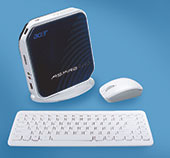
The Aspire Revo belongs to the relatively unheard-of category of nettops (compact form-factor desktops). Yes, they are different from netbooks, but they’re essentially the same hardware in a different skin. Except that with the Revo, Acer has chosen to buck the trend of adding Intel integrated graphics which, quite frankly, are showing their age in the age of high definition content.
Instead, it’s made the move to the much-awaited Nvidia Ion platform to pack in the computational horsepower to deliver smooth high definition playback. So you do get the obligatory Intel Atom 230 (1.6GHz) processor and a standard dollop of 2GB of RAM and a 160GB hard disk. But the Ion powered graphics power this ahead of other nettops and netbooks.
You get dedicated hardware video decoding, which makes it possible to play back Full HD 1080p h.264, MPEG-4 and VC-1 encoded video without dropping a frame — try that on your (insert favourite netbook brand here) netbook! Very impressive, and along with the funky angular lines and ultra-portable chassis, this ensures the Revo’s credentials as a living room media PC, or one for occasional gaming.
And there’s no shortage of options to seal the deal — there’s an eSATA port for your external hard disks, headphone and microphone jacks, a memory card reader, six USB ports, an Ethernet port, and HDMI and VGA to pump out those graphics to a monitor or TV. And if you think this stylish mini-PC shouldn’t be seen or heard, Acer provides mounting options with all Revos, so you can attach the unit to the back of a TV or monitor. The wireless mouse and keyboard, and the USB webcam are neat touches.
The only drawback with the Revo is the choice of operating system installed. While the Ion graphics can handle Vista’s Aero Glass effects, it can’t do anything to help with general performance, and the Atom processor — Vista combination is as sluggish as it gets on netbooks.
Our verdict? Excellent for a home theatre media center PC, but don’t expect much more for serious daily use. Watch out for the updated version of the Revo though, which has been launched with an Atom 330 dual core processor and 4 whole GB of RAM!
H235H LCD Monitor
 |
Now, if you are considering the Revo seriously, and don’t have a nice Full HD LCD TV already, the 23-in wide H235H LCD monitor from Acer is a tempting proposition. At an MRP of Rs 13,000, the H235H includes DVI, VGA, and HDMI connections, and built-in speakers at a very competitive price.
And it’s stylish — the flat, glossy, black bezel goes well with its glossy blue back. Pity then that the H235H does not include any height adjustment options, and there’s no option to rotate or pivot this LCD to use in portrait mode.
The only option is to tilt the screen back by about 25 degrees. The DVI, HDMI, and VGA ports are fairly easy to access once the removable back panel is taken off, and there are grooves on the back to help keep your wires organised. The touch controls are in line with its streamlined looks, but it’s just a shame that the onscreen control navigation is very confusing.
On the specs side, the Acer H235H’s 16:9 aspect ratio supports a “Full HD” native resolution of 1,920 x 1,080 pixels, and the aspect ratio lets high-definition content fit onto a 1,920 x 1,080 pixel screen without distorting the image. The really great part about this LCD is its colour reproduction. Turn it on, and you’re rewarded with rich vibrant colours, maybe a bit too bright.
You have calibration options as well, to turn it down a bit, but I felt the default was perfect for home use. Contrast ratio, at 100,000:1, is pretty decent, and coupled with the 2ms response time prevents blurring or streaking during fast onscreen movement. All in all, a good ‘bang for your buck’ buy if you can overlook the ergonomic and onscreen-display shortcomings.
Aspire 4810 Timeline
And finally, with the launch of the 4810 Timeline, Acer aims to strike a balance between design, portability and longevity. You get a lightweight 2kg form factor with an incredible thinness (a scant 29mm at its thickest) for a 14-in notebook, and a legendary battery life (largely courtesy of Intel’s ultra-low voltage (ULV) U3500 Core 2 Solo processor). Design is largely business, with gunmetal grey and black tones.
While using the Timeline, I didn’t really enjoy the isolation-style keyboard like I’ve done in some other netbooks/laptops, but the multi- gesture-enabled touchpad was a pleasant surprise. The power-friendly CPU is no speed demon, but backed by 2GB of RAM, the 4810T should be perfectly happy running your daily productivity needs. The display, while LED backlit and running a 1,366 x 768 native resolution, is a tad underwhelming, and with the system struggling on full HD content, one gets reminded too often that you’re running a low voltage processor.
You’d tend to forgive and forget most flaws when you look at the battery life, which at eight hours claimed is best of breed, and even while playing a DVD at full brightness, it goes well beyond the four hour mark. Net net, if battery life and portability are priorities, the Timeline is for you. Give it a pass if you need mobile performance over longevity, though.
Quick Specs
• Rating: Aspire Revo 3600: 8/10; H235H: 8/10; Aspire Timeline 4810T: 7/10
• Price (MRP): Aspire Revo 3600 — Rs 25,235; H235H 23-in LCD monitor — Rs 13,000;
Aspire Timeline 4810T — Rs 36,207
• URL: http://www.acer.co.in/
Nokia’s talk fest
 |
Just in case you missed it, Nokia launched a truckload of new devices in the recently concluded Nokia World 2009 at Stuttgart. Not only was the N97 mini made official, but the company’s Booklet 3G netbook was fully detailed and the first two handsets in the X series were also unveiled. But the headlines clearly belonged to the N900, Nokia’s first Internet tablet/handset on the Maemo 5 platform, a clear indicator of the future of Symbian devices. Keep watching this space for more!
• URL: http://www.nokia.com