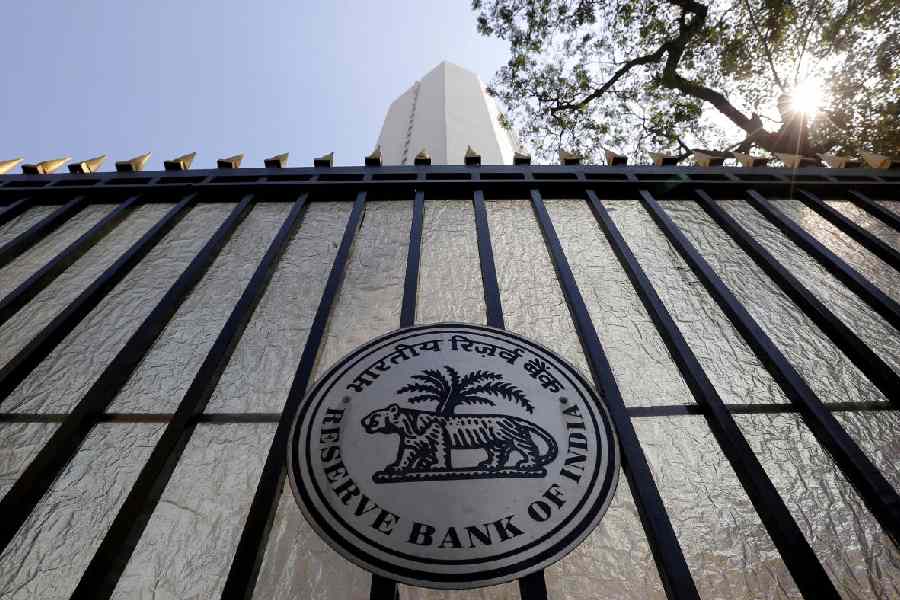
The Reserve Bank of India (RBI) on Thursday left the policy repo rate unchanged at 5.25 per cent after the first meeting of the Monetary Policy Committee (MPC) in 2026, while retaining a neutral stance.
Governor Sanjay Malhotra said interest rates are likely to remain low for a prolonged period as growth holds up and inflation remains within comfort levels.
The MPC voted unanimously to maintain the status quo on rates, citing a supportive domestic growth outlook and manageable inflation, aided by recent trade agreements, rising technology investments and continued fiscal stimulus.
“After a comprehensive review of macroeconomic conditions and the outlook, the MPC is of the view that the current policy rate remains appropriate. The committee has, therefore, decided to continue with the existing rate and retain the neutral stance,” Malhotra said.
Only one member, Ram Singh, reiterated his preference for shifting the stance from neutral to accommodative.
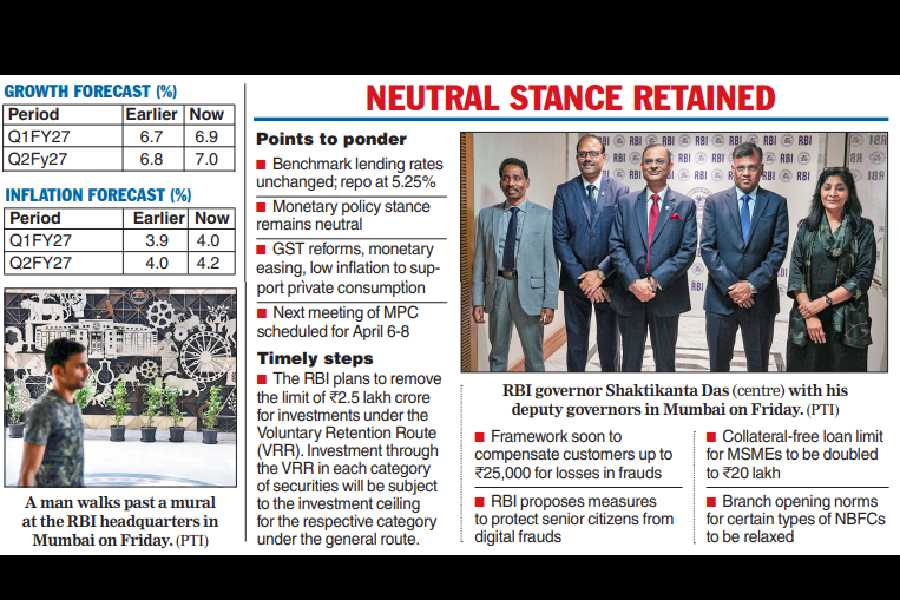
The RBI revised its growth and inflation projections for the first half of FY27 upwards from its earlier estimates, reflecting stronger domestic demand conditions. Full-year projections will be issued after base-year revisions later this month.
Malhotra said economic activity in FY27 is expected to be supported by steady rural demand, sustained momentum in private consumption and a recovery in urban spending following GST rationalisation and the cumulative impact of monetary easing.
Investment activity is also expected to benefit from conducive financial conditions and the government’s emphasis on infrastructure spending.
The governor said a spate of trade agreements will lend support to exports over the medium term, while services exports are likely to remain resilient. “The recently concluded India–EU free trade agreement and the prospective India–US trade deal, along with several other agreements, will support exports. However, spillovers from geopolitical tensions, volatility in international financial markets and shifting trade patterns pose risks to the outlook,” he said.
On inflation, the governor attributed the recent uptick largely to unfavourable base effects and higher precious metal prices. Excluding precious metals, underlying inflationary pressures remain muted and within the tolerance band.
“The upward revision in the inflation outlook is primarily due to an increase in precious metal prices, which contribute around 60–70 basis points. Underlying inflation continues to be low,” Malhotra said.
The RBI governor highlighted steady transmission of cumulative 125 basis points of rate cuts. The weighted average lending rate on fresh rupee loans of scheduled commercial banks declined by 105 basis points between February and December 2025, while the weighted average domestic term deposit rate on fresh deposits fell by 95 basis points over the same period.
The central bank said it will remain proactive in liquidity management to ensure adequate liquidity for productive credit demand and smoother transmission.
“Liquidity management will be pre-emptive, with sufficient allowance for unanticipated fluctuations in government balances, changes in currency in circulation and forex intervention,” Malhotra said.
Addressing concerns over the government’s large gross market borrowing programme, he said budgeted small savings collections are conservative and the use of treasury bills will aid yield curve management.
Economists echoed the RBI governor’s guidance of a prolonged pause. “We see limited room for additional easing on the repo, with the RBI’s focus shifting to ensuring liquidity stability over the year ahead,” said Upasna Bhardwaj, chief economist at Kotak Bank.
“A shock to the growth–inflation balance could reopen the case for a cut, but for now we expect a prolonged hold,” said Garima Kapoor, deputy head of research and economist at Elara Capital.