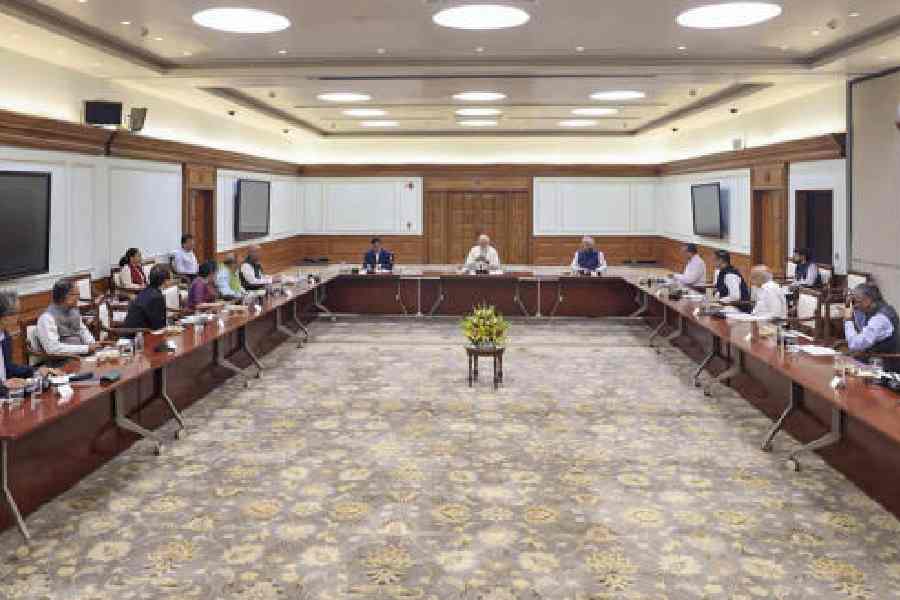
Prime Minister Narendra Modi on Saturday chaired a meeting with members of the economic advisory council to the Prime Minister (EAC-PM) on measures to sustain India’s growth momentum. The meeting comes amid rising global uncertainties, including the ongoing conflict in West Asia.
The members of the EAC-PM have reportedly given their assessment of the impact of the West Asia conflict on India and the world.
“Chaired a meeting of the economic advisory council to the Prime Minister. Deliberated on a wide range of issues relating to India’s economic transformation and long-term development priorities.
“Also shared perspectives on adding more momentum to the reforms journey and ensuring ‘ease of living’ as well as ‘ease of doing business’,” PM Modi said in a post on X.
Finance minister Nirmala Sitharaman on Friday said the government is committed to further drive the ‘reform express’ with decisive policy measures to ensure positive economic momentum amid global challenges.
Challenging situation
The EAC-PM meeting closely follows the Reserve Bank of India’s estimate on Friday of real GDP growth of 6.6 per cent in FY27, 30 basis points lower than its April estimate of 6.9 per cent and 110 basis points lower than the government’s estimate of a 7.7 per cent growth in FY26.
“Going ahead, the rise in prices of energy and other inputs, coupled with supply disruptions, is likely to weigh on economic activity. While import diversification in affected commodities is likely to improve supply, it would come at a higher cost. The full impact, however, will depend on the duration of the conflict, the time taken for normalisation of supply chains and the burden-sharing approach among the stakeholders. The pass-through of higher energy prices to retail products is already evident. Additionally, the projected deficiency in the south-west monsoon will have implications for agricultural production and rural demand,” RBI governor Sanjay Malhotra has said in his monetary policy statement.
The finance ministry’s economic review for May noted that high-frequency indicators such as e-way bill generation, PMI readings and electricity consumption continued to indicate resilience, although indicators including the Eight Core Industries Index and fuel consumption have shown signs of moderation.
Economists expect growth to face multiple challenges in FY27. “In fiscal 2027, growth is set to weaken amid multiple headwinds, including higher prices of crude and other commodities, softer global growth and a forecast of a below-normal monsoon. Global supply chain disruptions are already intensifying cost pressures, and reduced input availability is expected to add to the pressure,” said Dharmakirti Joshi, chief economist at Crisil.