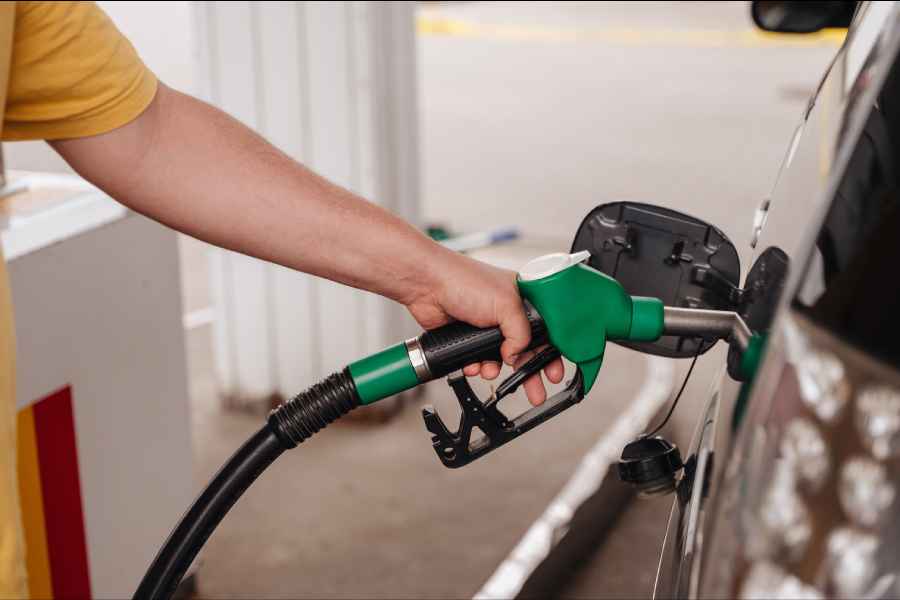
The Modi government has decided to hold on to petrol and diesel rates in the country for now, despite record crude oil prices, urging public sector oil companies to absorb the cost pressure for the time being.
Top government sources told agencies that the Centre is closely monitoring global oil markets, with the focus on maintaining supply by tapping sources outside West Asia.
Retail petrol and diesel prices have been frozen since April 2022. PSU retailers—Indian Oil Corporation (IOC), Bharat Petroleum Corporation (BPCL) and Hindustan Petroleum Corporation (HPCL)—absorb losses when crude prices are high and make profits when rates are low.
The government wants to continue to shield consumers, and the same policy will continue unless there is a huge spike in crude prices (more than $130 a barrel), they said.
“We have seen prices rise to $119 per barrel in June 2022 in the aftermath of Russia’s invasion of Ukraine. That year, they had nominal profits, but in FY24, they posted record ₹81,000-crore profit.”
This year, the three companies have posted a ₹23,743-crore profit in the December quarter alone.
While India has adequate stocks of both raw material (crude oil) and finished products (fuels) to meet requirements for the next 6-8 weeks, the government has tweaked the policy for booking cooking gas refills.
The minimum gap for booking a domestic LPG refill has been increased to 25 days to prevent hoarding and ensure equitable distribution of cylinders.
Sources said that while there is enough crude oil available from alternative sources such as Russia, replacing any loss of LPG supplies is more time-consuming, as alternative sources are largely located in the United States and Canada.
To ensure uninterrupted supplies, the Indian government has ordered refineries
to maximise LPG production
and not use any of its streams to make petrochemical products.
On petrol and diesel, the situation is "very comfortable", one of the sources said.