
New Delhi, Jan. 20: The discussion on demonetisation started in January last year with former RBI governor Raghuram Rajan taking part in those talks and the move to scrap high value notes was not a sudden decision, according to a deposition made by current RBI governor Urjit Patel before the Parliamentary committee on accounts.
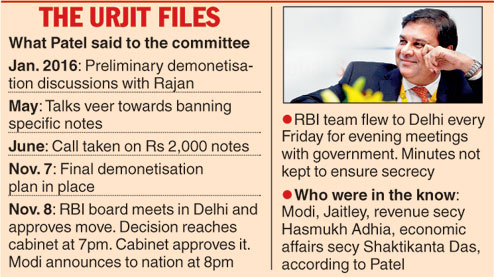
Patel today explained the sequence of events that resulted in the November 8 demonetisation of the notes, stating that the discussions started in January and talks on banning of specific notes were taken up in May.
According to sources the RBI governor tried to shift the "responsibility for the demonetisation decision on to his predecessor by implication".
The RBI chief, who had deposed earlier this week before the standing committee on finance, also informed the parliamentary committee that the central bank and the government had in June agreed to introduce Rs 2,000 notes to replace the demonetised notes. However, the printing of the notes was delayed till Patel assumed office.
Sources said the central bank head told the panel that the RBI chief and a deputy governor would fly down to Delhi regularly to meet Prime Minister Narendra Modi, finance minister Arun Jaitley and a small team of finance ministry officials, who had been handpicked to ensure secrecy.
The meetings, held nearly every Friday after 6 pm, were detailed planning sessions that also tried to gauge and prepare for the consequences of the note ban, sources quoting Patel said, adding that the minutes of the meetings were not recorded to maintain secrecy.
The small team of officials privy to the move included revenue secretary Hasmukh Adhia, economic affairs secretary Shaktikanta Das apart from the Prime Minister and finance minister.
However, sources said Rajan was unsure of the benefits of demonetisation and despite discussions had not agreed to any sudden scrapping of large tranches of currency.
In a surprise move, the government and the RBI scrapped all old Rs 500 and Rs 1,000 notes and introduced a new Rs 2,000 note on November 8, 2016 through a televised announcement by the Prime Minister.
The move, which sucked out 86 per cent of India's currency by value, hit business badly and resulted in a temporary lull in demand. It also resulted in India's growth forecasts being slashed by most agencies, including the IMF.
Patel, however, did accept that the final plans were unveiled only on November 7 and the RBI board agreed to the measure within 24 hours.
On November 8, the RBI board met in the Capital with eight members present. The board meeting was attended by governor Patel, two deputy governors (R. Gandhi and S.S. Mundra), and five directors of the RBI - Nachiket Mor, Bharat N Doshi, Sudhir Mankad, Shaktikanta Das and Anjuly Chib Duggal.
Sources said another director N.S. Vishwanathan (deputy governor) did not attend the meeting as he stayed back in Mumbai to brief the bankers first-hand immediately after the decision on demonetisation was taken. Another director, Natarajan Chandrasekaran was abroad at the time of the meeting.
Around 7pm when the RBI board's clearance reached the PMO, the cabinet, which had been waiting for the decision of the regulator, approved the demonetisation move.