Here are two questions worth thinking about carefully. How many mobile phones are sold in India every year? The answer: about 205 million in 2024. Second: what’s the population of New Zealand? At last count, roughly 5.25 million.
Put those two numbers side by side, and it’s not hard to see why New Zealand has signed a trade deal with India that, at first glance, appears lopsided.
India has often disappointed investors and analysts, but it remains a gigantic market that simply cannot be ignored. For a small, export-dependent economy like New Zealand, it’s getting a foot in the door that matters.
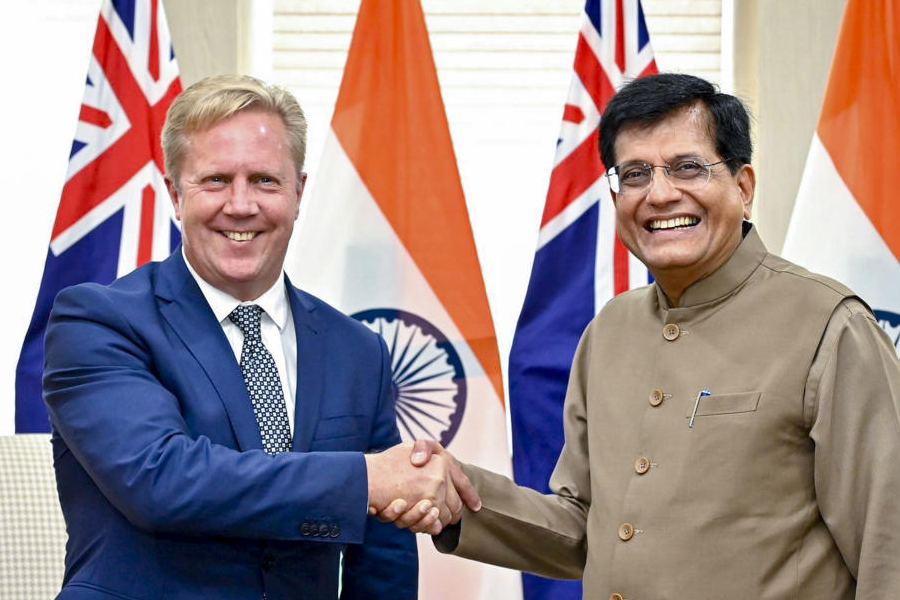
Under the new India–New Zealand free trade agreement, India gains 100 per cent tariff-free access to New Zealand, a $20-billion investment commitment from New Zealand and expanded market access in services, including IT, finance and education.
In return, New Zealand secures broad but carefully phased access to the Indian market for its wool, meat, forestry and other products. Currently, annual two-way trade totals NZ$3.68 billion (US$2.4 billion), though a large chunk comes from travel-related spending by the 292,000 Indian-origin New Zealanders..
New Zealand’s The Post heaped praise on the agreement, writing: “This is unambiguously good news for New Zealand. The sheer size of India’s population, and its messy democratic path to growth, is something worth a small trading nation hitching its wagon to.”
New Zealand is sometimes described as the lifeboat at the end of the world. A glance at a map makes it clear why the phrase sticks.
Now shift to a very different corner of the globe: the United Kingdom, the not-so-small island nation tethered uneasily to the European landmass by just 22 miles at its narrowest point. Why was Britain, the country that once painted the globe red, so eager to sign what also looks like a disadvantageous trade deal with India?
Again, the answer lies in the numbers and in geopolitics. The UK arguably carried out one of the most egregious acts of economic self-harm of the 21st century when it narrowly voted for Brexit. By quitting the European Union, it voluntarily cut itself off from the giant market on its doorstep.
Having tossed itself out of the EU, India, with its vast population and expanding middle class, begins to look like the Promised Land.
New Zealand, at least, has managed to get some agricultural products through the door. Fans of New Zealand steaks have reason to cheer: sheep products are now duty-free, benefiting both wool and meat exports.
New Zealand exports NZ$76 million worth of wool annually to manufacturers in Punjab and other parts of India. Local media also note that the floors of India’s new Parliament building are carpeted with New Zealand wool.
Dairy products have secured a tiny toehold in the India-New Zealand trade basket. Over a seven-year period, tariffs will be eliminated on bulk baby food, peptones, a dairy-derived protein, and albumins, a milk protein product used in baby food.
Indian consumers have also developed a taste for New Zealand fruit. Imports include about NZ$36 million worth of kiwifruit and NZ$79 million worth of apples annually.
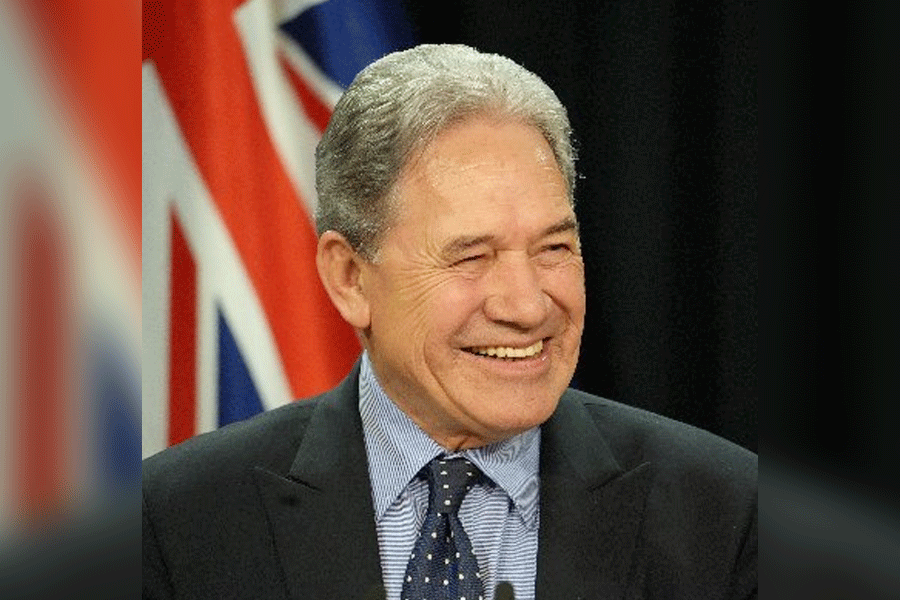
Unsurprisingly, the deal has critics. Opponents argue that India gave away too little on dairy, traditionally one of New Zealand’s strongest export sectors. Foreign minister Winston Peters, leader of the right-wing populist New Zealand First party, dismissed the agreement as “low-quality” and rushed.
“I spent my whole career trying to stand up for a country called New Zealand and this is a deal that does not defend our interests. It favours Indian interests. And that is why, sadly, it is a bad deal,” Peters said.
The country’s dairy industry association has also voiced deep dissatisfaction.
Still, opposition parties are expected to back the deal. New Zealand Prime Minister Christopher Luxon and trade minister Todd McClay are especially proud of having wrapped it up in near-record time, roughly nine months from the start of intense negotiations. The legislation was introduced into New Zealand’s Parliament just ahead of the winter recess.
The government also points to precedent. New Zealand’s free trade agreement with China has delivered substantial economic dividends over time, despite early scepticism.
What about the UK-India trade deal? Here, the flagship product has always been Scotch whisky, of which Indians are the world’s largest consumers by volume. Tariffs have been cut from a punishing 150 per cent to 75 per cent, and will fall further to 40 per cent over the next decade. Scotch producers are under pressure. Gen Z is drinking less, and US tariffs have squeezed margins. India remains one of the few major markets where meaningful growth still looks possible.
Seen in this wider context, India’s recent trade diplomacy reveals a clear pattern: pragmatic, incremental deals with smaller partners are moving ahead, while the biggest prizes remain slow, contested and politically fraught.
Take Oman. Bilateral trade between India and the Gulf sultanate is modest, at just around $10 billion a year. Yet the Comprehensive Economic Partnership Agreement signed last week during Prime Minister Narendra Modi’s visit to Muscat marks a meaningful shift in India’s trade strategy.
Under the deal, Oman will grant zero-duty access on 98 per cent of its tariff lines, covering 99 per cent of India’s exports by value. India, in turn, will eliminate or reduce tariffs on 78 per cent of its tariff lines, covering 95 per cent of Oman’s exports, while keeping politically sensitive sectors such as dairy, coffee, tea and precious metals firmly protected.
Products such as dates, marbles and petrochemicals will be allowed in only through tightly controlled quotas.
On the surface, the numbers are small. But the gains are targeted. Indian exporters of gems and jewellery, textiles, leather footwear, engineering goods and pharmaceuticals will now enjoy duty-free access, compared with earlier tariffs of at least 5 per cent.
That relief comes at a time when Indian exporters are already labouring under US tariffs of around 50 per cent on key categories, adding urgency to New Delhi’s push to diversify markets. Services, currently just 5 per cent of India-Oman trade, are also expected to grow, particularly in professional and technical fields.
Strategically, the deal matters even more. India has long sought a comprehensive trade agreement with the six-member Gulf Cooperation Council, Saudi Arabia, the UAE, Qatar, Oman, Kuwait and Bahrain, but talks have repeatedly stalled.
With bilateral deals now in place with the UAE and Oman, momentum towards a broader GCC agreement has quietly improved.
The same cannot yet be said of talks with Washington. India-US negotiations continue to tread water. Despite regular contact between Prime Minister Modi and President Donald Trump, and a recent visit by a US trade delegation, there has been no breakthrough.
The US wants India to import more American energy and agricultural products. While India is open to increasing energy imports, opening up its farm sector remains a political red line. Indian government officials now privately concede that any India-US trade agreement is unlikely before March at the earliest, and even that timeline looks optimistic.
By contrast, negotiations with the European Union appear closer to a conclusion. Long-running India-EU trade talks, which were revived after years of stagnation, are now described by officials on both sides as being in their final stages.
For India, an EU deal would open markets for goods and services, attract investment, and strengthen supply-chain links. For the EU, it offers access to India’s growing consumer market, better protection for European industries, and strategic influence in Asia.
Put together, the picture is revealing. India is pushing ahead where it can: smaller, fast deals with Gulf states, market access wins with pragmatic countries like New Zealand and a post-Brexit Britain hungry for positive trade headlines. Negotiations with the EU are moving towards the finish line as an agreement is in both sides’ interests.
However, the biggest relationship of all, with the United States, remains frustratingly out of reach, hostage to unrealistic US expectations and, some might say, Trump’s lingering pique over India’s failure to nominate him for a Nobel Peace Prize.