It has taken the country more than 90 years from the day in October 1932 when a young J.R.D. Tata flew a Puss Moth from Karachi to Bombay with a precious cargo of mail, heralding the dawn of commercial aviation in India, to reach a fleet of 800-odd aircraft.
The airlines hope to double that figure by 2033.
And yet only a handful among us might have any appetite to look at the “big picture” at the moment, with the country having just witnessed the worst year in its aviation history.
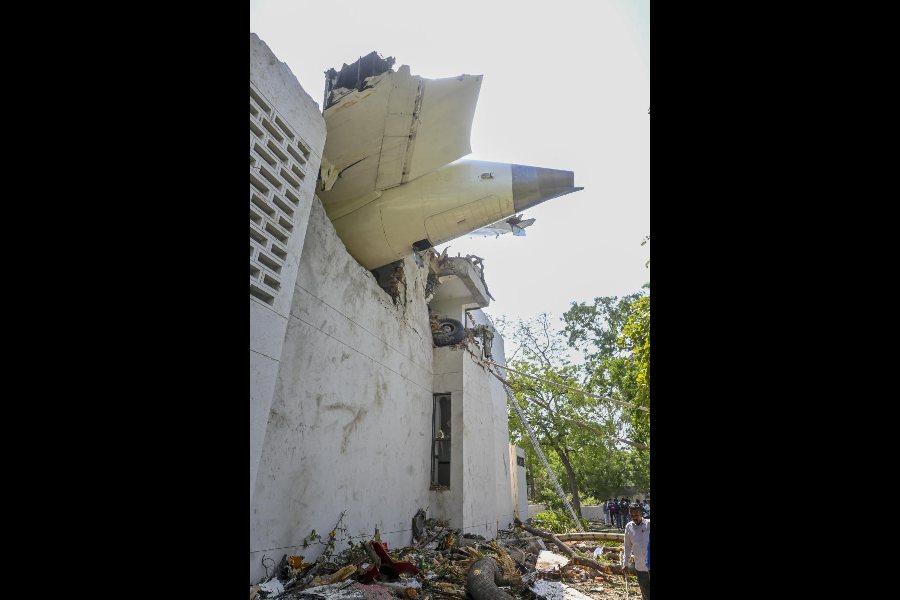
From the Air India Dreamliner crash that killed 260 people in June to the thousands of flight cancellations by IndiGo in December — brought on by the airline’s failure to comply with new crew-rostering norms, 2025 was an annus horribilis for
Indian aviation.
Opinion is divided on where Indian aviation goes from here. And, more important, on whether IndiGo and Air India — with a combined market share of over 90 per cent — are the best bet to handle the explosive growth projected: of the daily number of domestic passengers doubling to 1 million by 2033.
For, in the 95 years since J.R.D. Tata flew solo from Karachi to England via Egypt (in 1930), Indian air travel has been democratised with a “hawai chappal se hawai jahaz” push and how!
Structural issues
Kapil Kaul, CEO and director of the Centre for Asia Pacific Aviation (Capa) India, said the June crash and the December disruptions were manifestations of structural issues.
“Everyone in the system must assess the gap in the system — regulatory, policy and physical — and see how the exponential growth is to be managed,” Kaul said.
He pointed to a shortage of technical manpower: of pilots, engineers, ATCOs, flight inspectors, ground handling staff and even the CISF personnel handling airport
security.
Former railway and civil aviation minister Suresh Prabhu advocated “a proper integrated regulator who will look at all the aspects of regulating the aviation sector”, going beyond mere safety and taking passenger interests intoaccount.
The Directorate-General of Civil Aviation’s (DGCA) role is mainly to ensure safety, by setting standards, licensing personnel, certifying aircraft, overseeing training and investigating incidents.
Civil aviation minister K. Rammohan Naidu has told the Rajya Sabha that the government is strengthening the DGCA’s tariff-monitoring unit to detect and prevent opportunistic pricing during high-demand situations.
Prabhu concurred with Kaul that human resource development should be a focus area to support the growth of the aviation industry.
Profitless growth
Producing talent and retaining it has been a key concern for the industry, which has struggled to make money. According to an estimate by Capa, the Indian aviation sector has lost $22 billion since 2004.
“India is an extremely difficult market to make money in aviation,” a former airline executive said. As a result, the industry has fallen prey to poaching by international players.
According to the industry body International Air Transport Association (IATA), the high demand for air travel and the expected fleet expansion will call for about 37,000 pilots and 38,000 maintenance technicians over the next two decades.
A June 2025 report by the association stressed a sobering fact: Since 2011, the real average airfare (that is, one adjusted for inflation) that Indian travellers have paid, for both domestic and international flights, has decreased substantially barring the pandemic years.
Domestic and international airfares are now about 79 per cent and 62 per cent of their 2011 levels in real terms, the IATA argued.
Industry pundits say 60-70 per cent of the passengers still fly at a rate below cost. It’s the balance 20-30 per cent, which books at the last minute, that compensates for it.
“The cost structure is high and the fares do not adequately compensate,” argued Kapil Kaul, CEO and director of Capa India, an aviation advisory and research practice.
“We have to move away from profitless growth to a profitable growth strategy. The taxes on fuel are about 25 per cent of the cost; this needs to be rationalised.”
An industry veteran said the cost of engine maintenance was double the world average, and that the cost of the engine and its maintenance was higher than the airframe cost over the life of the aircraft.
“Because of dust particles and pollution in the air, engines need an overhaul every three-and-a-half years in India, compared with seven years globally, adding significantly to the opex (operational expenditure),” he said.
Duopoly
The IATA underlined that more than 15 airlines registered in India had failed over the last two decades. And while minister Naidu said India should have at least five airlines and handed over no-objection certificates to three aspirants, experts remained sceptical.
“You need a billion dollars for five years to run a good low-cost airline. And apart from IndiGo, everybody is losing money. There are not enough aircraft or pilots available — it will not be easy,” Kaul said.
Mark Martin, founder and CEO of Martin Consulting LLC, said the government should “absolutely” ensure that a third viable airline came up. “They should talk to big industry houses with deep pockets and if required, give fiscal incentives. We absolutely need it,” he said.
Martin was scathing about the present situation, saying it was “of our own making”. “We could have saved Jet or Go Airlines. But we chose not to. We have shot ourselves in the foot,” he said.
Every time an airline has failed, the cost of leasing aircraft — as opposed to buying them — has gone up, making it difficult for the incumbents to scale up quickly.
“One problem has been consistent throughout airline failures — that the lessors could not repossess the aircraft in a timely manner,” said Mansi Singh, vice-president, Asia Pacific, International Aerospace Women’s Association.
“The aircraft were stuck with operators that were not generating revenue and the bankruptcy laws were such that they could not be leased to another operator. These issues made India seem like a very risky jurisdiction for business.”
A former airline executive offered a radical solution. “Break IndiGo into two, with two different sets of management and shareholders, and let there be three airlines as in the US or China,” he said.
“Because, it’s unlikely that a third is coming. Even the second one (Air India) in the so-called duopoly is struggling to make money, let alone the others.”
Kaul, however, has a different take. He believes there is no demonstrable evidence that the duopoly is hurting the consumers.
“In fact, the number of aircraft the existing players are going to get is so huge that they will compete by the route, by the market and product class. The competition will be intense and market forces will take over,” Kaul said.
Anil Kalsi, vice-president of the Travel Agents Federation of India, suggested a government-regulated price band to protect the interests of the consumers as well as the airlines.
“There should be a minimum and maximum price per sector in economy and business,” Kalsi said.