Banking on a sharp rise in tax collections, higher non-tax revenues and a substantial increase in central grants, the BJP-led Bengal government on Monday unveiled a budget that seeks to balance an expansive welfare agenda with a commitment to fiscal consolidation despite the state’s heavy debt burden.
The state has projected revenue receipts of ₹3,20,484.85 crore in 2026-27, an increase of 11.35 per cent over the estimates presented by the erstwhile Trinamool Congress government in the interim budget and 30.8 per cent higher than the revised estimate for 2025-26.
The revenue outlook is underpinned by expectations of stronger collections from the state’s own taxes and non-tax sources, along with significantly higher transfers from the Centre, reflecting the anticipated benefits of political alignment between the state and the Union government.
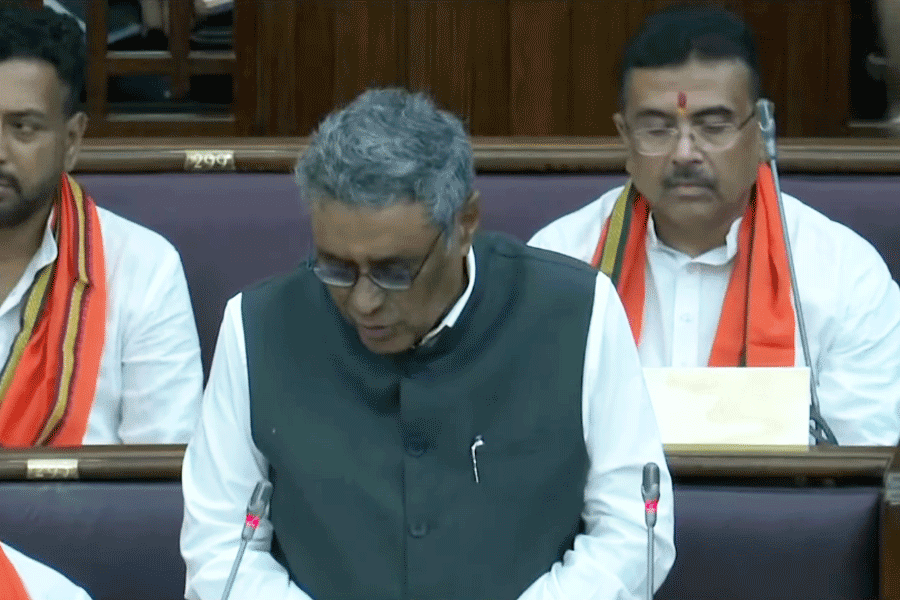
Presenting the final budget for 2026-27, finance minister Swapan Dasgupta projected the state’s own tax revenue at ₹1,30,699.68 crore despite relief measures on professional tax through a higher salary exemption threshold. Non-tax revenue is estimated at ₹8,302.71 crore, aided by increased receipts from interest, dividends and profits.
Grants-in-aid from the Centre have been pegged at ₹71,393 crore, nearly 50 per cent higher than the interim budget estimate and more than two times the revised estimate for FY26.
On the expenditure side, revenue spending has been raised to ₹3,42,469.26 crore from ₹3,09,551.07 crore projected in the interim budget, reflecting higher allocations for welfare schemes and an increased dearness allowance for government employees. Capital expenditure has been maintained at around ₹86,000 crore, broadly in line with earlier projections.
While revenues are expected to rise sharply, the debt burden continues to remain a key concern. Debt-to-GSDP is projected at 37.98 per cent, unchanged from the interim budget estimate.
“Our government has inherited a massive debt of ₹8,15,891 crore as a legacy. This is potentially crippling debt. However, with the support of the government of India and fiscal reforms, we will try to put it on a sustainable path,” Dasgupta said.
The finance minister said key fiscal indicators were expected to improve during the year.
The revenue deficit is projected at 1.02 per cent of gross state domestic product (GSDP), down from the revised FY26 level of 2.07 per cent, while the fiscal deficit is estimated at 2.91 per cent of GSDP compared with 3.4 per cent in the previous year. Debt stock is expected to decline marginally to 37.98 per cent of GSDP from 38.29 per cent.
Industry bodies welcomed the government’s attempt to strengthen public finances while maintaining social sector spending.
“The proposed fiscal consolidation, achieved without compromising welfare spending and with record allocations to key social sectors, is expected to reinforce confidence among industry, trade and investors,” said Naresh Pachisia, president of Bharat Chamber of Commerce.
Merchants’ Chamber of Commerce & Industry said the finance minister had presented a budget that sought to balance fiscal constraints with the state’s growth and development priorities.
“The government’s proposal to increase the exemption threshold will benefit different categories of taxpayers in the state,” said income-tax advocate Narayan Jain.