Book: SHADOWS OF AZADI: WOMEN’S LIVES IN THE CRUCIBLE OF KASHMIR
Edited by: Manisha Sobhrajani
Published by: Yoda
Price: Rs 699
The title of this anthology paints in sombre hues the tension that reverberates across the chapters of this volume. Azadi, a word suffused with longing, resistance, loss and possibility, emerges as a polyvalent symbol imbued with many meanings throughout the anthology and reflects differently valenced experiences within the spaces of conflict in Kashmir. First-hand memories of political upheaval, military turmoil and what Marianne Hirsch calls “postmemory” are inscribed into these narratives.
Andrew Whitehead notes in the Foreword, “Among the currents largely concealed from view is the role of women in shaping the region’s social and political dispensation.” Perhaps it is this seeming absence that masks what is better understood as a tacit presence.
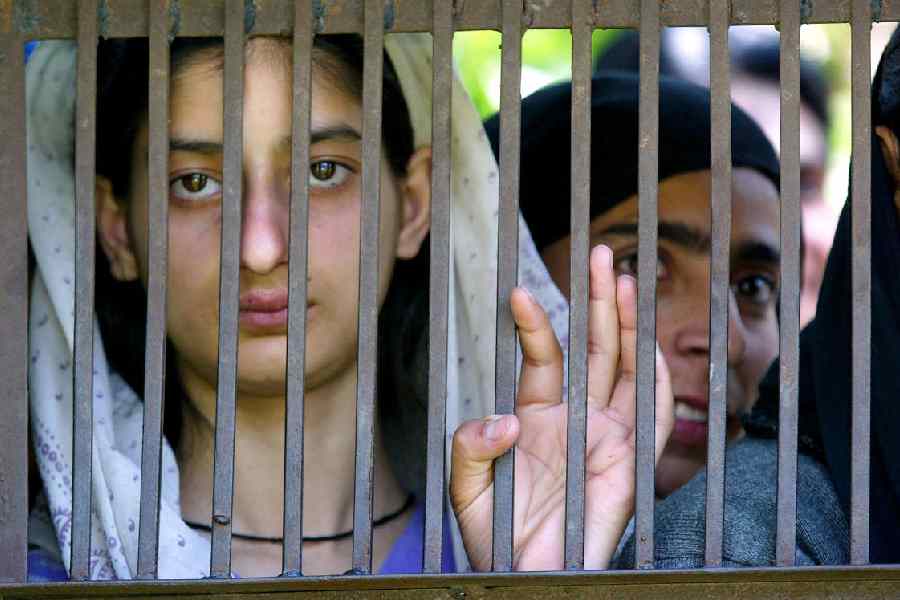
The anthology consists of eighteen chapters that bring together the multiplicity of the voices of women from different walks of life across Jammu, Kashmir and Ladakh. It situates women’s position in Kashmir within a broader socio-political topology and patriarchal hegemony, foregrounding the epistemological violence that structures how their histories and subjectivities are produced and (mis?)represented. A persistent kernel of remembering the women “who sacrificed their kith and kin for the cause of Azadi” is ubiquitous in the intimate vignettes of lives, pre-empting historiographic preclusion.
Each reflective piece conjures a liminal, ‘in-between’ space where the individuals negotiate the interstices of appropriation and Othering. The lucid language colours the lived experiences, creating a vortex of the plurality of the women’s experiences. The narrative, sans any sentimental simplification, perhaps enacts a form of Derridean différance, prompting the readers to mire in hermeneutics, to navigate the gaps, ruses and slippages among personal experience, social expectation and political turbulence per se. The grotesque logic of effacing freedom lays bare how deeply the apparatus of politics infiltrates the intimate sphere, entering homes, relationships and identity itself. A proliferation of lieu de mémoire underpinned by disillusionment and disenchantment is peppered throughout the book at various intervals.
The narratives chart how women are oftentimes turned into interpellated subjects who, convinced of their volition, capitulate to subjugation, nevertheless cultivating a circumspect discomfiture. For instance, in the chapter titled “Emancipation in the Land of Chinar”, Saman Nabi, an advocate at the Jammu and Kashmir High Court, brings forth how the attempts to break the glass ceiling have been egregiously thwarted within the societal paradigms of Kashmir. Similarly, Arshie Qureshi, a social developmentalist, attempts to map in the chapter, “Of Freedom, Feminism and Good Girls in Kashmir”, the changing definition of feminism in a dichotomous space devoid of freedom in its truest sense. She writes, “In Kashmir, as in most South Asian societies, the conservatives have always viewed feminism as a Western import, as a threat to their masculinity and their assumption of the role of ‘guardian’.”
The dominant mood in the anthology is one of malaise, uncanny and discomfort. Pick up the book to encounter the tenacity and the textures of women’s lives where the personal is political.