Book: Colombo: Port of Call
Author: Ajay Kamalakaran
Publication: Penguin
Price: Rs 599
Colombo promises, as Dilip Menon phrases it in his advance praise, “espresso-shot essays”. But the aftertaste it leaves is oddly thin.
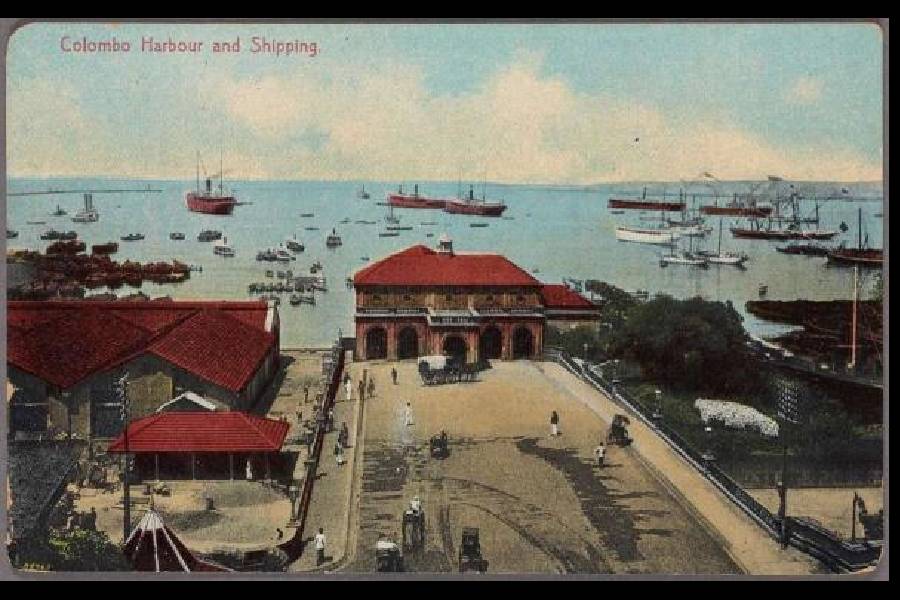
The narrative weaves around international travellers visiting the colonial harbour city of Colombo, reshaped after the Suez Canal’s construction. Skirting around Sri Lanka’s pre-colonial history and the civil war, it tells stories of these visitors through a nostalgic lens, documenting their passing. Among the famous appear Prince Hirohito, Andrew Carnegie, Arthur Conan Doyle, Mark Twain, Don Bradman, Mary Carpenter, M.K. Gandhi, and Anton Chekhov. Around them drift less-remembered travellers: Prince Chakrabongse Bhuvanath, Jules Leclercq, Nicholas Roerich, Jane Sherman, Esper Ukhtomsky, and Urabi Pasha.
In each of the book’s fourteen chapters, Kamalakaran’s prose moves in short bursts, propelled by an abundance of one-line paragraphs that initially suggest urgency but soon reveal structural impatience; what might have unfolded as layered encounters instead becomes sequences outlining the book’s thematic preoccupation. Endnotes overcrowded with ibidem citations hint at how narrow the documentary corridor becomes—history is glimpsed through one or two keyholes, then declared fully seen.
The book’s impact as a time-travel guide for the historically inclined culturati is marred by creative interventions by its editors and typesetters. Who, in the name of Johannes Gutenberg, attaches a leaf of ‘advance praise’ next to a book’s title page? And who decides that a book’s textual appeal is enhanced by black-and-white photographs in 1980s magazine style, sourced uniformly from Wikimedia, and placed with clerical consistency beneath each chapter heading?
The logic of association is also perplexing. Chekhov looks out from the page not as a curious traveller who stayed three days and two nights in Colombo in 1890 but as an ailing man already claimed by haemorrhage of the lungs, living in Yalta in 1900. Prince Hirohito’s 1921 visit to Ceylon is paired not with an image from that journey but with a 1935 photograph of the Japanese emperor in imperial gear, mounted on his white horse, Shirayuki. Contextuality, which once bothered book editors, here becomes an editorial inconvenience, hastily swept aside.
Colombo leaves one pondering the other visitors of the past who faded away beyond the harbour. Tagore sailed to Sri Lanka in 1934 — it was his last sea voyage; C.F. Andrews visited him via Colombo; Nehru visited Colombo in July 1939, advocating for the rights and fair treatment of Indian plantation workers. Yet these individuals and their visits do not figure here. Pablo Neruda, too, is absent: his “Luminous Solitude” phase in Colombo during 1929-30, and the darker confession in his Memoirs — the consul’s exoticised rape of a Tamil latrine cleaner of the ‘pariah caste’ — go unmentioned.
One finishes the book with the uneasy sense that the historical Colombo — the colonial port-city that existed between these famous footsteps — has somehow eluded one’s reading. Historical memory, after all, is not about who visited. It is about the sadness of remembering who stayed behind to cultivate cinnamon and carry tea to the ships, or cleaned the sahib’s latrines.