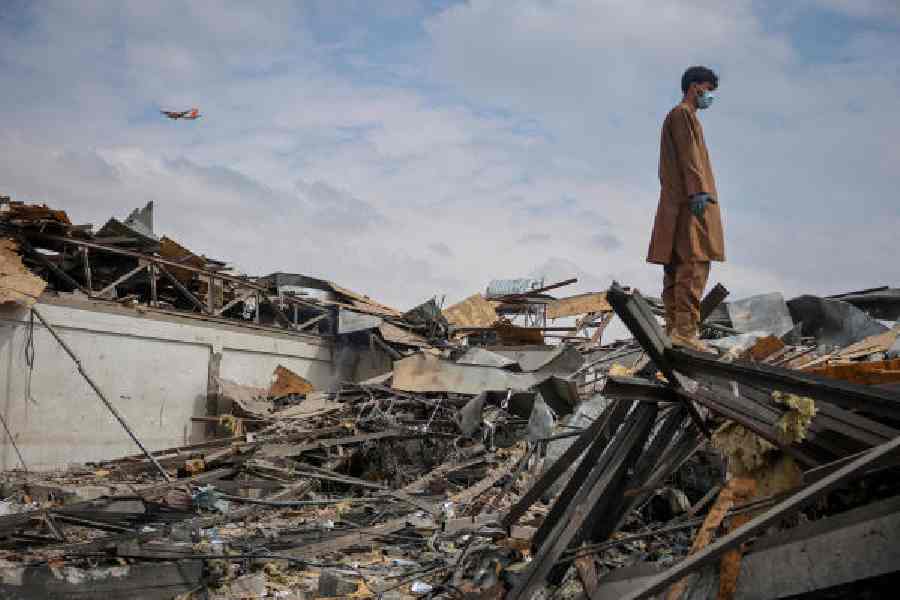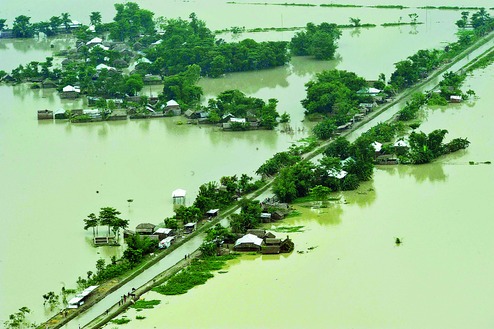

DELUGE AID FOR FARMERS: The Kosi flood of 2008
The World Bank will help farmers of Saharsa, Supaul, Madhepura, Araria and Purnea districts grow and market commercial crops. The districts had suffered huge losses during the 2008 Kosi deluge.
The international financial institution will fund two-thirds of the total project cost of Rs 306 crore, while the state government will foot the rest of the bill. The Bihar Kosi Basin Development Project will be implemented from the 2017-18 fiscal to 2022-23.
Asked why such a project was being launched nine years after the Kosi deluge, agriculture minister Prem Kumar on Friday told The Telegraph: 'One needs to see things in perspective. In the first phase from 2010 to 2015, the state government laid special emphasis on the reconstruction of the Kosi region, which included the construction of damaged roads and bridges as well as damaged houses of people. The economic development works are being undertaken in the second phase from 2016 to 2023.'
He said the agriculture department had sent the project to the World Bank in time but Bangladesh raised some objections before the bank related to sinking of tubewells, which are part of the project, apprehending that groundwater level in its areas adjoining the Kosi region in its territory would dip. Later, the Bangladesh government withdrew its objections paving way for the project.
The Bihar Kosi Basin Development Project will be rolled out in phases. In the first year, the focus will be on identification of beneficiaries and mobilisation of resources. Special emphasis will also be laid on active participation of farmers in all project-related works.
'One of the most interesting aspects of this project pertains to on-farm demonstrations for dissemination of information about improved agricultural techniques,' said a senior agriculture department official. 'It will be evaluated not on the basis of demonstrations made but in terms of adoption of demonstrated technologies by the farmers.'
The officer also pointed out that the project had a separate component for ensuring proper marketing of produce. Farmers' interest groups and farmers' producer companies will be set up using which they will be encouraged to market their produce.
'Moreover, the department on its part will set up agri business centres at the block level in the districts where the project will be implemented,' he added.
The project document talks of a two-pronged strategy - first, to increase overall agricultural productivity and second, to improve post-harvest gate management and marketing so that the project area farmers can become more competitive and be able to get a higher price from customers.
The project assumes special significance for selected districts, as studies carried out prior to its launch had thrown up a grim picture of the region.
'The pre-project study revealed that agriculture productivity level in some of the areas of the selected districts is as low as Rs 17,399 per hectare,' said another official of the agriculture department.
He added that one could take the example of Araria district, where agriculture is mainly rain-fed and the area under fruits and vegetables is merely 4.3 per cent of the total arable land.