
Patna: Chief minister Nitish Kumar on Tuesday stressed on the need to strengthen the internal system of grievance redressal in various government departments so that the people do not have to take recourse to the law.
"The grievance redressal system in government departments needs to be strengthened. The system needs to be analysed so that grievances do not arise. If the internal system improves then the public won't have grievances. People will use the public grievance redressal act only when needed," Nitish said.
"We will have to analyse the internal system in the department and then improve it. Our efforts should be to minimise complaints. The more the administrative system functions in a better and efficient manner, the more people will trust it," he added.
Nitish was speaking at a function to mark the second anniversary of the implementation of the Bihar Right to Public Grievance Redressal Act. Also present were deputy chief minister Sushil Kumar Modi, chief secretary Deepak Kumar, director-general of police K.S. Dwivedi, principal secretary, general administration, Amir Subhani and the additional mission director of Bihar Prashasnik Sudhar Mission Society, Pratima Verma.
The chief minister concurred with Modi that it should be found out why common people were made to run from pillar to post to get their work done at government departments.
The law, in the two years of its existence, has seen 3.27 lakh applications, of which 2.89 lakh applications have been successfully redressed. Around 70 per cent of the grievances are related to five government departments, of which revenue and land reforms and the police departments are at the top.
At present, there are 140 facilitation centres, 161 public grievance redressal officers and over 1,000 support IT officials who are working across the state to make the law successful.
Recalling the complaints that used to come at his Janata Darbar, Nitish said around 35 to 40 per cent of them were related to land disputes.
"Aerial survey of land in the state is being conducted. Once the survey settlement is complete by 2020, we will be able to distinguish between private and government land. This will ease all land related disputes," Nitish said.
The chief minister also talked about the many complaints that were related to inflated electricity bills. He recounted that during one of his yatras he came across a poor person who used a couple of electric bulbs in his house, but was handed over a bill of Rs 30,000 by the energy department.
"Hearing was conducted on his grievance and the bill was reduced to Rs 600. Problems related to electricity bills happened because the energy department engaged private companies for billing work. The situation is now improving," Nitish said.
Principal secretary Subhani signed an MoU with Development Management Institute, Chandragupt Institute of Management Patna (CIMP), and Birla Institute of Technology extension branch Patna to study, assess, and analyse the impact of the law.
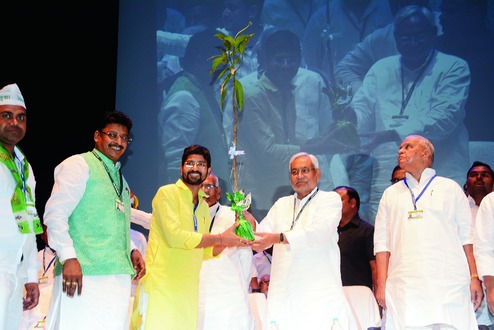
District public grievance officers - Manan Ram (Sheohar), Kanhaiya Prasad Srivastava (Banka), Yashaspati Mishra (Kishanganj), general administration department administrative officer Manoranjan Kumar, procurement officer Kumar Vijendra, and officer on special duty Satish Ranjan Sinha were awarded by the chief minister for their good work.
Sub-divisional public grievance redressal officers - Rajesh Jha Raja (Madepura Sadar), Sushil Kumar (Birpur), Suranjita Sinha (Danapur), Dipak Kumar Sah (Benipur, Darbhanga) and Krishna Kanhaiya Prasad Singh (Tekari, Gaya) were awarded by Modi.