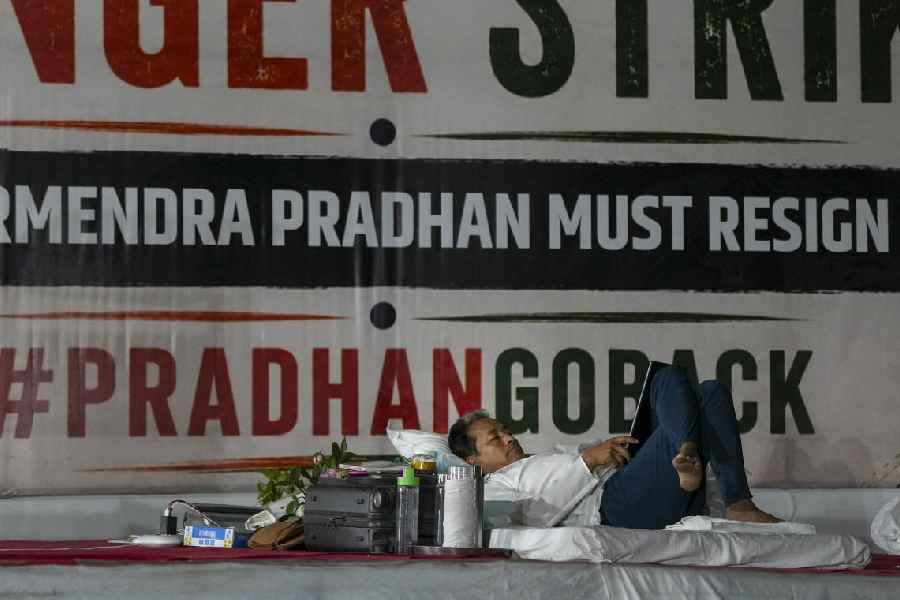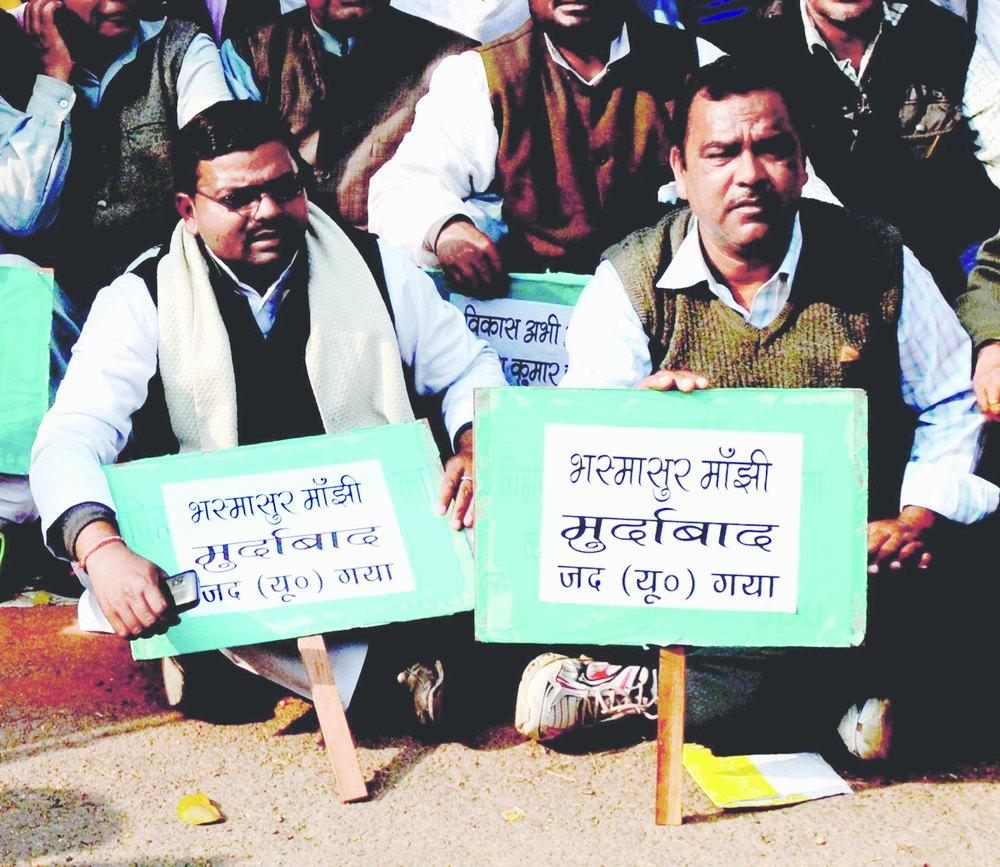

JDU supporters sit on dharna outside Nitish Kumar's 7 Circular Road residence in Patna on Saturday. Picture by Ranjeet Kumar Dey
'Bhasmasur Jitan Ram Manjhi murdabad' - so read the numerous posters JDU workers supporting Nitish Kumar's return to power were seen holding today.
The posters euphemistically tried to show that chief minister Manjhi has done to his mentor Nitish Kumar what the Hindu mythological character, Bhasmasur, had done to Lord Shiv.
Lord Shiv, being omnipotent, blessed Bhasmasur with the power to reduce anyone whose head he touched to ashes. But Bhasmasur pouncing on Lord Shiv first to experiment with his power. Similarly, Nitish loyalists allege, Manjhi has played all possible tricks to obliterate everything Nitish stood for.
'My regime was known for susashan (good governance), nyay ke saath vikas (growth with justice) and deployment of able officials in key position to deliver the goods. I helplessly watched him (Manjhi) systematically knocking down everything that we had built so painstakingly,' Nitish told The Telegraph, adding with a sense of desperation: 'I was unable to figure out why he was speaking the language hurtful to people and doing the things that were hostile to the principles of the JDU.'
Unlike Nitish who resorted to economy of words, Manjhi was utterly voluble and verbose. Nitish, owning moral responsibility for the party's debacle in the May 2014 general election, had chosen Manjhi as his successor. However, Manjhi began taking the liberty with words during the August 2014 by-elections - the JDU-RJD-Congress alliance's first fight against the BJP after losing so heavily in the general election three months back.
In an embarrassment to Nitish and also all others supporting the Manjhi government, the chief minister alleged that a temple in a Darbhanga village was washed after he offered prayers to prove that the upper castes were still practising untouchability on him because of his Dalit roots. Rural development minister Nitish Mishra, who is on Manjhi's side today, came down heavily on the chief minister for such a comment hurtful to the upper caste priests and others.
Manjhi eventually was proved wrong with the inquiry headed by Darbhanga commissioner failing to corroborate what he had alleged.
It was just the beginning of an era with Manjhi's words. A few days after heaping the temple-washing slur, Manjhi, speaking at a function in Valmikinagar, described the upper castes as 'foreigners' and SCs/STs as 'aboriginals'.
Even as the controversy over the description of 'upper castes as foreigners' was raging, Manjhi cast aspersion on the character of women who had their husbands working in other states while speaking at Gopalganj. There was no stopping of Manjhi as he went on to say that there was no harm in drinking liquor moderately, accepting small amount in bribe, doctors not doing their duty properly should have their hands chopped off - so on and so forth.
Lately, he had begun asserting in almost all the public meetings he addressed that a Dalit would be the next chief minister as the Mahadalit and Musahars were numerically strong to control the state's politics. He advocated for the Mahadalits to breed more children - almost in conformity to what the likes of Sakshi Maharaj and Niranjan Jyoti.
Simultaneous with speaking what was anti-thesis to Nitish's ways, he replaced at least 18 senior IAS officers, deployed by Nitish in key positions, by his 'own' set of officers apparently on the basis of their Dalit genealogy. He followed it up by doing the same with the IPS officers.
Be it at the prodding of the BJP or else, Manjhi irked and defied Nitish and his new-found friend, Lalu Prasad, too on several occasions.
On and off, he praised Prime Minister Narendra Modi - the symbol of hostility for both Lalu and Nitish. Moreover, Manjhi got cosy with the rebels/leaders who were 'irritants' for Nitish and Lalu both. For instance, he developed his closeness with the likes of Gyanendra Singh Gyanu and other JDU leaders who had voted against the JDU's official nominees during the Rajya Sabha polls. He also got cosy with the RJD MP, Pappu Yadav, and Lalu's estranged brother-in-law Sadhu Yadav who have consistently irked Lalu.
In the process, the governance suffered with susashan and growth with justice that used to be the buzzword during Nitish's era becoming history and the state slipping into hands of lawlessness. 'I was greatly pained to the see the newspapers' headlines these days. I was unable to figure out why he was doing all these things,' Nitish said.
'After demitting chair for him, I turned my attention from the government and went among the cadres addressing Sampark Yatra meetings in 36 districts. But the workers started questioning me about Manjhi's style of functioning and also holding me responsible for what he was doing. The allies too put pressure on me saying it was hard to confront the BJP with Manjhi in the chair,' Nitish said.
But even if Nitish succeeds in getting the mantle back from Manjhi, he already stands 'devoured' off the moral and political authority he once stood for by Manjhi. The BJP will come down heavily on him for 'humiliating' the first Musahar chief minister and using Manjhi to rope in the Mahadalit vote bank, which ironically Nitish had assiduously built.
Nitish also knows the tough days head: 'The challenge has grown. It is not easy to clean the mess and get ready for the polls in such a short period of time.'