
Patna: The economy of Bihar blooms irrespective of who is in power: the Grand Alliance or the NDA.
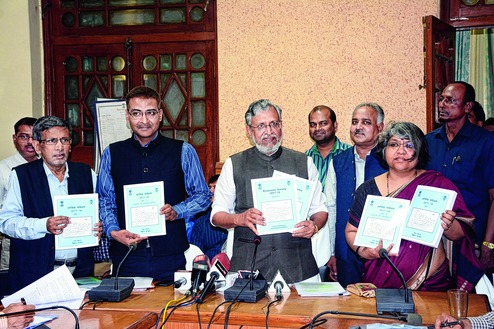
The economic survey for the financial year 2017-18 tabled by deputy chief minister Sushil Kumar Modi - who holds the finance portfolio - claims a 10.1 per cent growth rate with the deficit kept below three per cent of the Gross State Domestic Product (GSDP) and better expenditure on infrastructure.
However, most of the figures quoted are from 2016-17 - the period when the Grand Alliance government was in power.
Modi, though, refused to give credit to his predecessors. "The economic consolidation in Bihar began after 2005 when the NDA came to power. It has been built on a strong foundation put up by us. Even if some government had wanted to slow it down, it would have taken more than five years. Luckily, they (RJD and Congress) could not remain in power for such a long period," he said.
The economic survey points towards increase of GSDP in Bihar from 7.5 per cent in 2015-16 to 10.3 per cent in 2016-17. The revenue surplus rose from Rs 5,101 crore in 2012-13 to Rs 10,819 crore in 2016-17 and is projected to be over Rs 14,500 crore in 2017-18. The drivers of growth continue to be mining and quarrying, manufacturing, transport, storage and communication. From 2012-13 to 2016-17, development revenue expenditure increased by 79 per cent in the last five financial years which ends in 2016-17.
In the agriculture and allied sector, production of maize increased from 25.17 lakh tonnes in 2015-16 to 38.46 lakh tonnes in 2016-17, a jump of over 52 per cent. There has been impressive rise in production of rice and wheat in the corresponding period. At 142.42 lakh tonnes, Bihar ranks first among all states in vegetable production. The production of milk and eggs has also gone up.
The survey points out that out of 3,530 factories in Bihar shown in 2014-15, 2,942 were operational and percentage wise it was higher than the national average. It has pointed out that the 11 sugar mills in the state were producing 11 per cent more sugar in 2016-17 than 2015-16.
In infrastructure, the survey said the road density per 100 square km was 289km - behind Kerala and Bengal but above the national average of 139.1km. Similarly, the total number of registered vehicles in Bihar has increased by 11 per cent every year between 2011 and 2017. In the energy sector, availability of power in 2011-12 was 1,712 MW which increased to 3,769 MW in 2016-17, a growth of 120 per cent in the last six years. The peak deficit is currently around 14 per cent, down from 30 per cent in 2012-13.
This was the 12th Economic Survey tabled in Bihar after it was introduced immediately after NDA 1 came to power. This time there are two volumes instead of one. While the first volume gives an economic overview, the second provides details of some recent government achievements - seven resolves, prohibition, etc.
In prohibition it claims a drop in crime rate and says that money saved by the people was spent on milk, processed food and food items. It takes into account consumption figures of 2011 when there were 44 lakh alcoholics in the state and assumes that each one of them spent Rs 1,000 per month on liquor. The survey works out a figure of Rs 5,280 crore saved by the people of Bihar since prohibition was imposed.