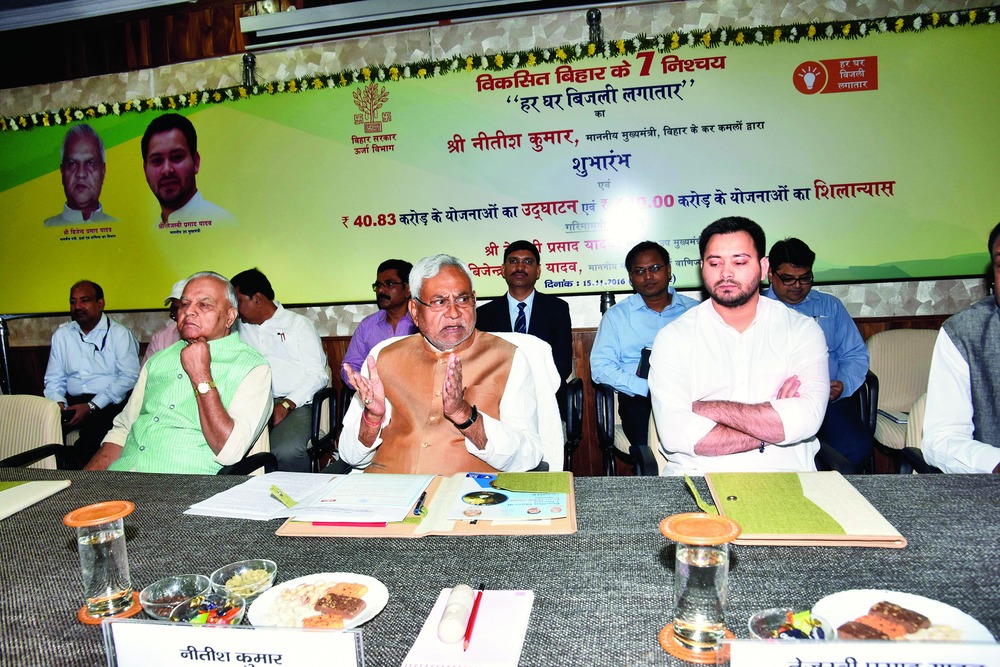

Chief minister Nitish Kumar on Tuesday started the implementation process of the scheme to provide continuous electricity to every household in the state.
He fixed December 2018 as the deadline for completing the drive - the last of his "Saat Nishchay" or seven resolves for a developed Bihar.
Under the scheme, the state will spend Rs 1,858 crore on ensuring metered power connection to Above Poverty Line (APL) households that have hitherto been without electricity. A survey is being conducted to assess the number of such households, though estimates put it around 50 lakh.
Below Poverty Line (BPL) families living in rural areas are already being given free electricity connections under Centre-sponsored Deen Dayal Upadhyaya Gram Jyoti Yojana.
"The rural electrification work is going on strongly in the state. There's a scheme to provide electricity connections to BPL families, but APL families had to apply for connections and pay the fee for it besides facing several problems. So, we thought why not give connections to them, too, and it became part of our seven resolves," Nitish said.
Nitish added that connections to the APL households will be provided for free and the emphasis will be on providing continuous uninterrupted power. "But people will have to pay for the power they consume. Our promise is to provide continuous electricity, not free electricity."
Deputy chief minister Tejashwi Yadav, energy minister Bijendra Prasad Yadav, chief secretary Anjani Kumar Singh, principal secretary Pratyaya Amrit, managing directors of various state government power companies - R. Lakshmanan, Sandeep K.R. Pudakalkatti and several other officials were present on the occasion.
Emphasising on the need for improving the billing system and resolving micro-level issues like overbilling, faulty billing and late billing, the chief minister said complaints of overbilling used to come to him at his janata darbars.
"Poor people used to get electricity bill of Rs 4,000. Some of them used to get bills even without connections. Now, such complaints are being successfully resolved under Bihar Right to Public Grievance Redressal Act. I witnessed one such complaint in East Champaran during the first phase of my Nishchay Yatra. A youth had received electricity bill of Rs 25,000 when it should have been Rs 12,000. However, spot billing has been introduced and such complaints will come down," Nitish added.
Hitting out at the Centre, the chief minister said Bihar was not being given its share of electricity under central quota (which comes to around 3,000 MW) because of which it was forced to buy from the open market.
Nitish added that the state has linked thermal power plants with a low plant load factor (PLF), which is a measure of the output of a power plant in comparison to the maximum output it could produce. He added that majority of the big, under-construction thermal power plants in the state were yet to start production.
Highlighting the progress made by the state in the field of electricity, Nitish said per-capita-per-year power consumption in the state was 70 units in 2005, the year he took charge as chief minister, and it rose to 120 units in 2012 and 258 units in 2016.