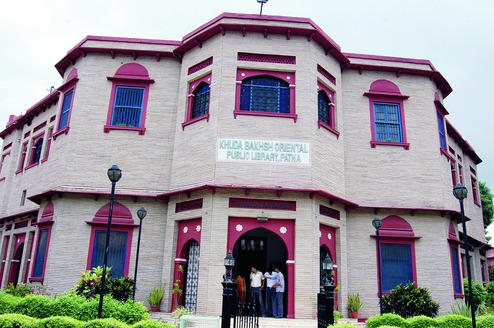

Patna: Khuda Bakhsh Oriental Public Library, one of the most prestigious libraries in India, is headless for the past three years.
At present its affairs are looked after by Patna divisional commissioner Anand Kishore, though the library is under the Union ministry of culture.
The lack of a chief poses a question mark on government claims of preserving the rich historical, cultural and educational heritage of the country.
The library was declared an institution of national importance through an Act of Parliament in 1969. It is also a designated manuscript conservation centre (MCC) by the National Mission for Manuscripts.
The library has invited applications for the post of director. However, officials of the establishment refused to disclose the number of applications received and the number of shortlisted candidates.
"By the end of 2018 there will be less than 30 employees to run the library of international importance," said a source in the library. "The shortage of staff is a serious problem. There is no effort to recruit new employees and the existing manpower is retiring rapidly. The officials are required to seek approval of the commissioner even to purchase dustbins.
"How can Kishore do justice to the library when he is already overburdened by the additional responsibilities of many departments? He is an IAS officer whose immediate control lies in the hands of the state government," the source added.
The annual report of the library for 2015-16 states that the total number of employees were 57. The report also states there has been no increase in the number of employees for 25 years. It received over Rs 3 crore grant from the central government in the same year.
The library is an autonomous body, fully funded by the Union ministry of culture and governed by a board with the governor of Bihar as its ex-officio chairman. The last director of the library was Imtiaz Ahmed, who retired in mid-2014.
The library has 21,136 rare manuscripts and over 2.5 lakh printed books.
It is known for its rare collection of Arabic, Persian, Urdu, Turkish and Pashto manuscripts.
A reader, Jayesh Thakur, said: "There are no educational events, seminars, workshops and debates organised at the library. The library journal is no longer published."
The National Mission on Libraries, a programme launched by the Centre in 2014, had a budgetary allocation of Rs 400 crore.
The policy talked about making qualitative and quantitative changes and capacity building of all the existing libraries of national importance. But the results are yet to be seen.