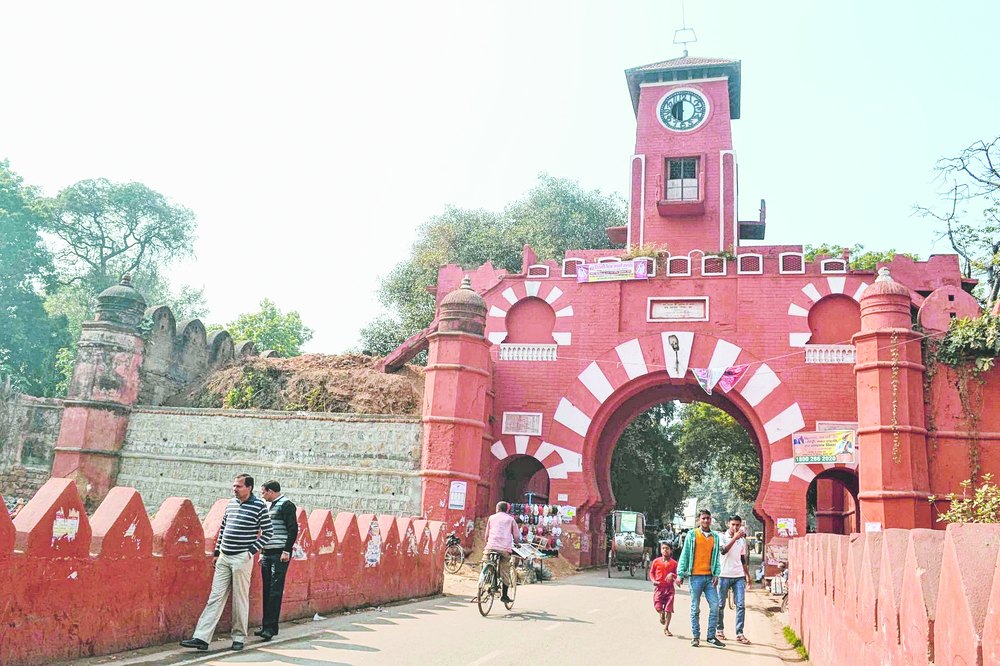

Renovation has begun at the historical red fort on the banks of the Ganga to preserve its archaeological heritage.
"The state government has given Rs 3 crore to the Munger district administration for undertaking conservation and repair work of the fort," state archaeology director Atul Kumar Verma said, adding that more funds would be provided to the district administration for completing the work.
The funds have been received from the Centre as per the 12th Finance Commission recommendation.
R.P. Bharati, executive engineer, building division, said: "The building division of Munger has spent about Rs 55 lakh on the construction of the new walls - 140 metres in length - of the Munger Red Fort so far. The other work, including repair and painting of all three main gates of the fort - eastern gate, western gate and northern gate - is going on quite fast too."
Even the fort clock, which has remained non-functional for years, is all set to tick again after repairs. The fort is spread across 222 acres and it has 4ft thick inner wall and its outer walls are 12ft thick. A gap of 14ft lies between the outer and inner walls which has been filled with soil. There are four entry points to the fort with rampart.
The historical account of this building dates back to 1330 AD during the rule of Muhammad bin Tughlaq of Delhi. Some experts trace its origin to a Hindu kings. A stone inscription of Chandragupta Maurya also mentions about presence of the fort. Some historians believe it to have been constructed by Pala kings in the 9th century AD.
According to the Munger District Gazetteer, inscriptions reveal that repairs were carried out to the Munger red fort during the reign of the Prince Danyal of Bengal (son of Bahlol Lodi) who held the post of the governor of Bihar. It is also stated that the Prince Danyal of Bengal built the shrine of Sufi Saint Shah Nafah within the south gate of the Munger red fort in 1497.
Dutch physician Nicholas Graft, who was brought to Munger as a prisoner in the early 17th century, also left an account of the fort. Graft wrote that the massive walls and bastions of the Munger fort impressed him much. The arrangements for fortification were quite adequate for those times. The fort, though not as well maintained, had its attraction to all visitors and continued to hold a strategic role.
What Graft observed in the 17th century still holds true even today. At least 300 tourists from the US, England, France, Australia, Germany and other countries visit Munger by river and see the fort every year. They are usually part of a cruise launched a few years ago from Bengal to Bihar.
Mahadeo Nayak, captain of the cruise, which had 40 such tourists from Germany and Switzerland who visited Munger on February 10, said: "All the tourists praised the spot."
Guide Sumit Bhattarcharya, accompanying the tourists, revealed that the tourists were impressed with the architecture of the fort and its location on the Ganga.
Interestingly, state tourism department officials are not much interested in developing this fort as a hot spot.
"For now, we have no plan to develop the fort as a tourist attraction. If any proposal from the district administration comes, we may consider it," tourism department additional secretary Ram Kishore Mishra said.
District magistrate Amrendra Prasad Singh only said: "We only know that the renovation work is going on."