 |
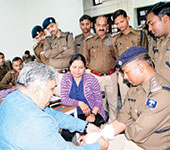
Around 30 deputy superintendents of police on Monday participated inh the workshop organised by Jai Prakash Narayan All India Institute of Medical Sciences (JPNAIIMS) to sensitise police about the techniques of handling disaster victims. JPNAIIMS director GK Singh presided over the function on the inaugural day of the three-day workshop and delivered tips on how to handle victims of road accidents, electrocution, earthquake, fire and others. Singh said: “Commuters and police reach the spot of accidents and disaster first. But in most cases, they hardly know to tackle the injured. One needs to keep in mind certain techniques while lifting an injured person. If wrong method is used, the injury might get severe. If the injured is given first aid at the right time, his/her condition would not become critical.” He gave a demonstration on how to drape a compression bandage in cases of fracture. “Draping a compression bandage involves a special technique. Neither it should be heavy, nor it should be light. The timing is equally important. It should not be draped for more than one-and-a-half hours, or else the injured might develop problems in his/her upper or lower limbs. It should be removed for five minutes before draping it again,” Singh said. The workshop also taught the cops how to remove helmet of a person injured in road accident. “The helmet should be removed as soon as possible, otherwise the person might get paralysed. While removing the helmet, there should not be any movement in the chin and the stomach of the injured as it might cause spinal injury,” Singh added. Anand Kumar Pandey, a subdivisional police officer (SDPO) at Hathua, said: “I learnt how to help a person with breathing problems. I also learnt how to drape a compression bandage and how to check pulse and looking forward to share this information with my juniors.”
Text by Shuchismita Chakraborty, picture by Jai Prakash