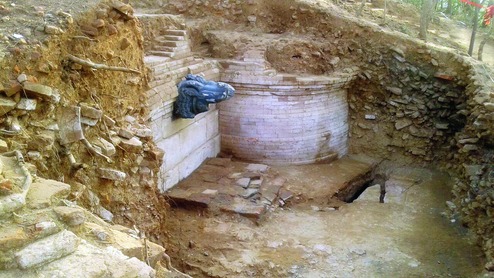

Lakhisarai: The Archaeological Survey of India (ASI) headquarters, New Delhi, has summoned professor Anil Kumar, head of the department of ancient Indian history culture and archaeology, Visva-Bharati, who has been heading the excavation team at Jainagar Lali Pahari for a presentation on the basis of findings so far at Lakhisarai.
Anil is scheduled to give his presentation on the findings on May 3, mainly on the antiques and sculptures so far recovered from the site besides his claim over the half-excavated part of a Buddhist monastery being a 'nunnery' at Lali Pahari.
Anil proceeded for New Delhi on Wednesday, carrying all documents and photographs of the exhibits that were excavated from the site of Lali Pahari. He is scheduled to display the photographs of rare idols dating back to the Pala period and other items like pottery. "It's a routine work. During any excavation, reports and presentation related to the site is mandatory and that's why I was summoned to the ASI headquarters. On the basis of my report and presentation, the ASI could further renew licence for the site," he said.
"I have prepared the report with all corroborating facts and findings and I am carrying it with me to convince the persons concerned," he said.
He claimed that the structure was a nunnery on the basis of recovering two security watch towers on the southeast and northeast directions in the excavation site at Lali Pahari. "At places like Vikramshila or Sripur, the existence of a security cell was recovered. We believe such security cells could be found in other two directions at least when the entire excavation would be concluded," he hoped.
Anil has taken help from the findings of Joseph David Beglar, an Armenian-Indian engineer, archaeologist and photographer working in British-India and reporting to the Archaeological Survey of India, in the late 19th century.
Joseph had identified a black stone statue of Avalokiteshvara Singhanada which was found at Lali Pahari (presently kept at State Hermitage Museum, St Petersburg, Russia) with some inscriptions mentioned in the statute. "On the basis of that inscription, we can claim that the monastery was a nunnery," he said.
Anil has also pointed out topographical evidence to justify his claim that this monastery was a nunnery. "We so far recovered closed designed cells with lime-made structures and all are inter-connected, the rooms for the Bhiksuni here in this nunnery. There are also evidences of doors at each of the cells," he said.
He also claimed the evidence of another monastery at Bicchway mount, hardly 1km north of Lali Pahari which was exclusively for Buddhist monks as separate structured cells were found there. In between the two monastery, the much described Chaliya mount is located where Gautam Buddha spent three consecutive rainy seasons, as mentioned in Buddhist texts, he pointed out. He said there is the evidence of a large stupa inside the mount which would also be excavated soon.