
Far from the heat and dust of the no holds barred campaigning on the ground, the battle for Bihar was steered from the war rooms of the political parties. This is where the backroom generals - many of them professionals and alumnus of globally renowned institutions including Harvard University, the IITs and the IIMs - burnt the midnight oil to brainstorm on itineraries for rallies of the star leaders, where reports from the ground were analysed, where strategies were devised and tweaked to maximise the impact of the high-decibel outreach to voters.
The war rooms were the electoral think-tanks for the parties and decisions taken there at times superseded even veteran leaders in the party concerned.
The Telegraph presents the working of the war rooms of all the four major parties - the BJP, the JDU, the Congress and the RJD - in the high- stakes Bihar elections: BJP
The BJP had two war rooms, one at its state headquarters on 2 Beer Chand Patel Marg and the other at Fraser Road. While the main war room at the BJP headquarters was dedicated to the entire electioneering, the one at Fraser Road mainly looked after the social media and booth-level campaign management.
The war room at the party headquarters was directly under the control of senior-most leaders including Bihar election in-charge Ananth Kumar, Suraj Nandan Kushwaha and state party president Mangal Pandey. Party president Amit Shah also used to monitor the war room whenever he visited the party headquarters.
Ravish Kumar, a master's degree holder in botany from Gaya, said that the war room boys would start their day as early as 8 in the morning and worked till 2 or 3 in the night. "Senior leaders including Amit Shah, Ananth Kumar and Dharmendra Pradhan used to hold meetings with others in the war room even post midnight. We followed a very hectic schedule over the past two months," Ravish said.
Arvind Tiwari, who looked after the electioneering activities of Shah, said that all the war-room boys at the BJP state headquarters worked for free. "Most of us work for the BJP as party workers now. I and several others in the war room have worked for the BJP in the state elections in Delhi and Jharkhand as well," he said. "My work in Bihar was primarily to ensure smooth electioneering for Amit Shahji including permission for landing of the helicopter at his election rallies and coordinating with the grass-root workers."
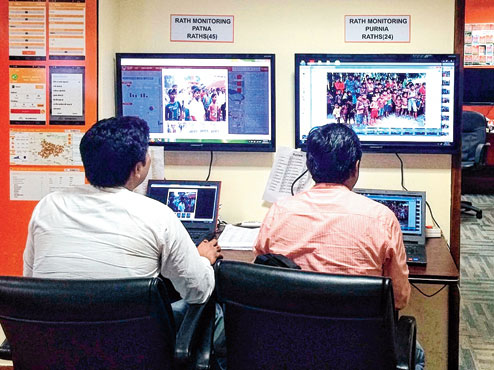
The other BJP war room on Fraser Road was managed by Rituraj Sinha, chief operating officer of security service provider SIS and son of BJP Rajya Sabha member R.K. Sinha. It had around 25 professionals including software and management experts from places like Bangalore and Delhi, and they used to look after the booth-level sabhas with focus on the movement of the BJP's Parivartan Rath (campaign vehicles).
JDU
The JDU war room was the most talked-about electoral backroom this election as it was helmed by Prashant Kishor, the key strategist behind Prime Minister Narendra Modi's path-breaking 2013-14 Lok Sabha election campaign. In the Bihar elections, Prashant's brainchild the Indian Political Action Committee (IPAC) marshalled its forces for Modi's archrival Nitish.
The highly professional IPAC had two war rooms: one at Nitish's residence at 7 Circular Road and another at his close aide RCP Singh's residence at 7 Strand Road. The Circular Road war room was full of workstations equipped with sophisticated equipment, and posters of Nitish on the walls. The backroom players here included graduates from IITs, IIMs, TISS, JNU and several other premier institutions who left their lucrative jobs to campaign for Nitish. Several senior JDU leaders including Rajya Sabha members Pavan Kumar Varma and Harivansh were frequent visitors to the war room.
"We used to start our day at 10am and worked till 12-2 in the night," said a former member of IPAC. "Roles and responsibilities were clearly assigned to the team members. A lot of creative and research work was also involved at the war room. Strategies were formed here and workers of the JDU were also trained on those strategies for electioneering. Teams were formed for all the five phases of the elections and we had camped in the respective districts till the polling day."
The briefing for the workers and other nitty-gritty of executing the battle plans happened in the Strand Road war room, including liaison with the booth-level teams in the districts.
Congress
If the JDU hired Modi's spin doctor Kishor and the BJP had put in place a crack team of MBAs, the Congress had Irfan Alam, a Harvard and IIM-Ahmedabad alumnus social entrepreneur who had earned praise from US President Barack Obama. A gold medallist from Harvard University in the field of campaign management, Irfan was the Congress's media adviser and planner of the election campaign.
Pradeep Choudhary, chief of the research and development wing of the Bihar Pradesh Congress Committee (BPCC), said that his party took a decentralised approach with regard to the functioning of the war room.
"Apart from the central war room at the state party headquarters at Sadaquat Ashram in Patna, there were war-room cells in various districts to ensure proper coordination with grass-root workers. We divided the functioning of the war room into three sections: media section, social media section and the logistics section," Choudhary said. "The war room was from where the strategies were formed, rally schedules finalised and social media platforms managed."

RJD
"Yeh IT-YT kya hota hai (What is this newfangled IT)," RJD chief Lalu Prasad had famously asked a few years ago. But in this crucial election his older son, Tej Pratap, converted his own cowshed in Danapur, 3km off Bailey Road, into a war room filled with computers and computer operators. Admittedly the RJD war room did not look as suave as the war rooms of the BJP or JDU, but the work culture here was just as professionals as the others.
The backroom boys here included about 30 professionals including cartoonists, content writers and slogan writers. They were not only limited to chalking out electoral strategies for Tej Pratap or his younger brother Tejaswi, who contested from Mahua and Raghopur respectively, but also looking after the entire social media campaign for the RJD.
Data was collected from the ground to update the constituency profiles, based on which the party workers on the ground were communicated strategy. While Tej Pratap would come to the war room for around two-three hours in the evening to check how things were progressing, Lalu too would drop in unannounced, sometimes with Rabri, to check the quality of work and to give his suggestions.