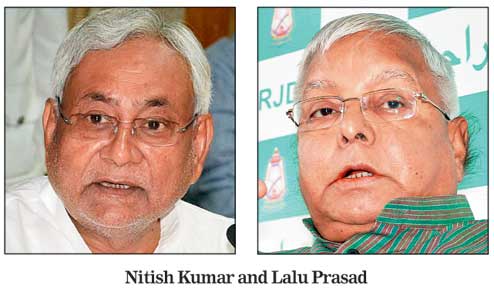

Patna, July 25: As speculation over the fate of the Grand Alliance continues, the jury is out on whether Nitish Kumar can retain his vote base should he decide to part ways.
Independent observers, especially social scientists, The Telegraph spoke to are of the view that Nitish would find it difficult to make his own political space in a state where caste considerations have more often than not played a decisive role in deciding electoral fortunes.
"Lalu Prasad has a much larger controlled vote share than any other political party in Bihar. Other parties may have Yadav leaders but none of them have been able to make a dent in the Yadav votes. Muslims have more faith in Lalu Prasad than in any other political grouping. If Nitish goes with the BJP, the Muslims will further consolidate in favour of Lalu ji. Even among non-Yadav backward castes, the perception that it is Lalu who gave them their voice is still strong," said D.N. Diwakar of the AN Sinha Institute of Social Studies.
Electoral history suggests that Nitish has never fared well when he has contested polls on his own, without being part of an alliance.
Those who favour the return of Nitish to the BJP fold point to the 2010 Assembly elections when the NDA won 206 of the 243 seats. The JDU-BJP together polled 38.87 per cent of the votes then.
In 2015, the Grand Alliance won 178 seats but got a combined vote share of 41.9 per cent, which was around 7.3 percentage points higher than what the NDA got. "It proves that the consolidation of backward castes is higher towards the Grand Alliance than the NDA," said a senior RJD leader.
In the 2014 Lok Sabha elections, which the NDA swept, its combined vote percentage was 39.6. Had the JDU, the RJD and the Congress fought the polls together, they would have got over 45 per cent of the votes.
In Bihar, caste, above everything else, has been a driving force in politics. The Congress cobbled up a social combination of upper caste, Dalits and Muslims to rule the state for a long period against a fragmented Opposition. It was in 1990, during the post-Mandal era, that backward castes and Muslims joined hands to give Lalu Prasad an unassailable advantage over his political rivals. After the arrest of BJP leader L.K. Advani in Samastipur over his Ram Rath Yatra, it was the Muslim-Yadav combine which was responsible for Lalu consolidating his party's hold in Bihar.
Nobody knows about the importance of caste more than Nitish Kumar. In the 1995 Assembly polls in undivided Bihar, Nitish's Samata Party, which contested in a loose alliance with the CPI(M-L), came a cropper, managing to win just six of the 324 seats. All these seats came from one region - Nalanda, a district dominated by Kurmis, the caste to which Nitish belongs.

It was after the 1995 humiliation that Nitish started to tinker with caste politics by first aligning with the BJP, then known as a party of baniyas, upper castes and the urban conservative populace. The Samata Party advocated the Luv-Kush unity - consisting of Kurmis and Kushwahas, the second largest OBC chunk in Bihar after the Yadavs. This group got a boost with the joining of then Dalit mascot Ram Vilas Paswan. It immediately led to a better poll performance by the NDA and by 2000, they were almost neck-to-neck with Lalu's RJD. By 2005 Nitish began to carve out another vote bank - the extremely backward castes (EBCs) - consisting of over 100 castes, numerically small but together making up about 29 per cent of the population. The result was that in the 2005 elections, the NDA had managed to topple Lalu from power. Nitish carried his caste tinkering further by declaring the Mahadalit card - creating a separate segment of 20 sub-castes of Dalits - leaving Paswan high and dry. In 2010, this caste combination won 206 of the 243 seats.
However, the break with the BJP in 2013 made Nitish's caste combination go haywire. In the 2014 Lok Sabha polls, the upper castes and a sizeable chunk of the EBCs went over to the BJP, and the Muslim votes, much to the disappointment of the JDU, remained with Lalu. Despite having a clean image and the reputation of a man who can deliver, the JDU managed to win just two of the 40 Lok Sabha seats.
It was his alliance with Lalu the following year that put the electoral arithmetic right for Nitish again. "During the 2015 Assembly polls it was Lalu Prasad who galvanised the backward caste votes after the RSS chief made a statement favouring review of reservation. As a result, several Dalit and backward caste sections, who may have otherwise voted for the NDA, went over to the Grand Alliance," added a JDU leader known to be close to party MP Sharad Yadav, who has publicly advocated continuation of the Grand Alliance.
Those in the JDU favouring a switch to the BJP maintain that during the Grand Alliance government, governance has gone for a toss and it would adversely affect the performance of the party in the next election. But the political point being made is that Nitish Kumar will have to leave his national ambitions and be subordinate to the Narendra Modi-Amit Shah combine if he joins hands with the BJP. The choice is difficult for Nitish.