|
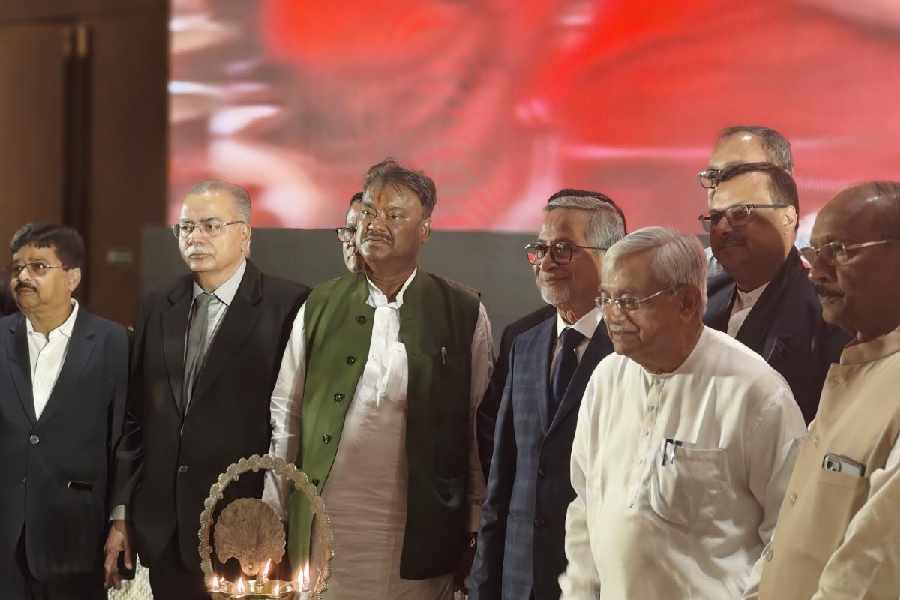
| (From left) Amartya Sen with external affairs minister SM Krishna and Singapore foreign minister George Yeo in New Delhi on Monday. (PTI) |
New Delhi, Feb. 21: The upcoming Nalanda University plans to start its first academic session by 2013 at its new campus in Nalanda in Bihar.
The university’s mentor group headed by Nobel laureate Amartya Sen is also working on a plan to build a similar symbiotic relationship with the 200-odd villages that had surrounded the ancient Nalanda university.
In ancient times these villages supported the Nalanda university — meeting the material needs of students at the university. But the mentor group is busy putting in place a plan with which the new university can help these villages to develop and the university can benefit the villagers, said the university’s vice-chancellor Gopa Sabharwal. The villages have been identified.
The mentor group indicated that the campus could start functioning from 2013, offering programmes which are intellectually challenging and practically useful.
“The possible date to start classes could be 2013,” said Sabharwal, adding that the university’s master plan would be finalised through a global design competition involving the best brains. An international competition to select an architect to design the university campus has already been advertised.
Sabharwal said other infrastructure work has already started at the site — 446 acres that the Bihar government has already handed over for the university campus which is 10km from the site of the ancient Nalanda institution.
The Sen-headed mentor group met here today for its first governing board meeting after the university act came into being. It was also attended by Singapore foreign minister George Yeo among others.
Sabharwal said they were getting “fantastic” support from the Bihar government for the project and cooperation from chief minister Nitish Kumar.
Sen said the university would not only lead to technical knowledge, it would also create employment opportunities.
Sen said he was delighted the ancient university could be revived in his lifetime. “Excellence and fairness in educating people would be the guiding principles of the university,” he said.
Sabharwal said the programmes to be offered in round one include Buddhist studies, philosophy and comparative religion, historical studies and international relations and peace studies.
Courses will be offered in business management in relation to public policy and development studies, languages and literature, ecology and environment studies and information sciences and technology in round one.
The project, being piloted by the ministry of external affairs, will have involvement of East Asian countries, including China. The East Asian Summit, a bloc of 16 countries, is supporting the project.