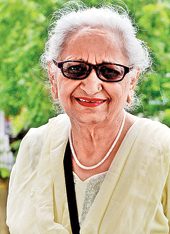

Kamlesh Gill was happy with her life as a doting grandmother at home and a busy social worker outside, with an occasional part in a television commercial. The arc lights and grease paint were a part of an earlier age, when she acted in plays and soaps. And then, after 20 years of retired life, fame suddenly came knocking in the shape of a film role at the septuagenarian's doors.
The role, of a whisky-guzzling, invective-spewing grandmother, is still the talk of the town, three years after Shoojit Sircar's Vicky Donor became a runaway hit. "Biji" is arguably the quirkiest grandmother ever seen in Bollywood.
A decade ago, Gill would have found little space in the Hindi film industry. Those were the days when the industry was still obsessed with cookie-cutter scripts that paid attention only to the lead actors. Supporting actors, more often than not, were poor caricatures with bit roles.
Today, in film after film, the side roles are stealing the show. And they are far removed from the character roles that were once a part of Hindi cinema: the honest servant, the loyal Muslim chacha, the garrulous aunt or the frock-clad Anglo-Indian typist. Now they are as unpredictable as they are memorable.
Take Pappiji - a role played by 39-year-old Deepak Dobriyal of Pauri Garhwal, Uttarakhand. The hero's affable friend in Tanu Weds Manu became so popular that it prompted the filmmakers to give him a more substantial role (still as Pappiji) in the sequel, weaving his own love story into the main plot.

"There are only six or seven superstars and how many films can they do? When 300 films are being made in Bollywood every year, they have to depend on not just the lead actors but others, too," Dobriyal says.
Indeed, Vicky Donor became a mega hit mainly because of the presence of the supporting cast - the Punjabi fertility doctor, the heroine's bhadralok Bengali father, and the hero's doting mother. And, of course, there was Biji.
Gill, 75, sits in her modestly furnished apartment in a busy residential locality in Delhi and recalls the afternoon when she was offered the role. "I was doing a commercial with Shoojit. I was asked to talk endlessly like an aggrieved mother. I did a lot of improvisation, which he liked, and he offered me Vicky Donor without an audition," Gill says. The audience was sold on her superb comic timing and Gill, along with co-star Dolly Ahluwalia, who played her daughter-in-law, became a household name.
"There are so many movies where you actually want to talk about only these characters and not the lead actors," exults trade analyst and film critic Komal Nahata. He cites the case of Nawazuddin Siddiqui, who started out with small roles and is now as much in demand as any leading hero.
The actors essaying these roles do not come from a single block. They are young, middle aged or seniors. Some have theatre backgrounds. But they are mostly all superb actors. And they have faces that make an impression.
"I used to look at my face in the mirror and think that with such an ugly face I stood no chance in films," Calcutta-based actor Rajesh Sharma says. The 45-year-old actor, critically acclaimed for his performances in Bengali films Pratibad and Baishe Srabon, was first noticed in Bollywood as a real estate agent in Khosla Ka Ghosla in 2005.
"He is a delight to watch," says casting director Nandini Shrikent.

The actors are so much a part of the new scripts that screenwriters factor them in while writing their stories. For instance, actor-director Rajat Kapoor kept Sanjai Mishra in mind when he wrote Ankhon Dekhi - a film about an eccentric middle-aged man who believes in only what he sees. Kapoor was adamant that he wouldn't direct the film if Mishra wasn't in it.
Mishra took up the role - and the film and his performance were lauded by critics. "This is the best time for an actor to be in Bollywood," Mishra, 51, says.
The industry, clearly, is upbeat about the trend. "Earlier, scenes were written with friend 1, friend 2, etc. And when you write like that you are automatically leading it to the caricature zone. There is no body to it," says Sharat Kataria, director of Dum Laga Ke Haisha, a film where every character - especially its plump bride - made a mark.
Critics have been highlighting the enormous magic - mostly a combination of talent and experience - that these actors wield. Dobriyal, who first acted in Vishal Bhardwaj's Maqbool in 2003, was noticed - and won an award - as a small-time gangster in Omkara in 2006. But for years before that, he was acting on the stage - first with the Delhi-based theatre troupe Asmita and then with N.K. Sharma's Act One.
Rajesh Sharma, who drove taxis and did odd jobs to earn a living, did theatre for 19 years with Usha Ganguly's group. Aparna Sen offered him his first film role - in Paromitar Ek Din (2000) - after watching him perform on stage.
Mishra joined the National School of Drama in 1988, where Irrfan was his senior and filmmaker Tigmanshu Dhulia a batchmate. Though his family had little to do with acting - his grandfather was a district magistrate and his father worked for the information and broadcasting ministry - they encouraged him to chase his dreams.
"But every step was a struggle as those days cinema just had a hero and villain. They didn't know what roles to offer me," he says.
He got his first break in the television series Chanakya (1991) and his debut film role was in Ketan Mehta's Oh Darling! Yeh Hain India! (1995). During the cricket World Cup series in 1999, Mishra's "Apple Singh" television commercials became so popular that the character was adopted as the face of ESPN Star Sports channel.
"Earlier I was signed on for my comic timing. But with Ankhon Dekhi, I am being offered serious roles, too," says Mishra, who also stars in Masaan. His next big releases are Rohit Shetty's Dilwale along with Shah Rukh Khan and the sequel of Kick with Salman Khan.
The growing importance of the character actors is keeping casting directors on their toes. Earlier, their time and effort were focused on hiring the main characters, but now even a five-minute role is auditioned.

"These days there is a bound script, so there is less ambiguity. As a result, casting has become important, as have the actors who are the supporting cast," Shrikent says.
Some of the actors are now also appearing as heroes or in pivotal roles in small budget films. Saurabh Shukla, who immortalised the character of Kallu Mama in Satya (1999), is one of the main leads in Prakash Jha's new film Fraud Saiyyan and also in the sequel to Jolly LLB, for which he won a National Award.
"For the last two decades, few paid attention to characters in our industry. The credit for change goes to the filmmakers who are experimenting with different storylines," Shukla says.
Sheeba Chaddha, who played the hero's aunt in Dum Laga Ke Haisha, points out that there were important side actors - such as the villain Pran - in earlier films, but agrees that storylines have changed. "I must admit that the scripts I am offered now wouldn't have been written five years ago," she says.
The pay cheques have got better, too. While the leading character artistes can command between Rs 40 lakh and Rs 1 crore, some are paid on the basis of the number of days they shoot. "I get paid Rs 80,000-1,00,000 for a day's shooting," points out Gill, whose latest release is the Salman Khan-starrer Bajrangi Bhaijaan.
Clearly, these are good times. The artistes are happy, as are the directors, producers and scriptwriters - to say nothing of the audience. May a thousand more roles bloom.