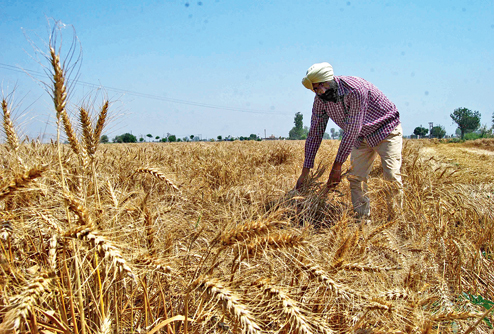

The trail of hay coughed out by the huge harvest machine on his field reminds Manmohan Singh of his own life. "My life has become lifeless like this hay," the 43-year-old farmer says, as the machine with its massive rotating blades swallows rows of dry wheat plants, storing the kernels in its belly and leaving a trail of mangled hay behind.
The farmer of Mohanpur village, around 45km from Ludhiana in Punjab, says his losses this year would be close to Rs 3 lakh. "We were already distressed by the rising input costs. But the rains destroyed even that hope," Singh says. By May, he has to also pay Rs 4 lakh to the owner of the 15-acre land that he tills on contract.
You can tell the seasons in Punjab when you drive down its highways. In winter, you'll see acres and acres of yellow mustard fields; in spring, swaying wheat plants will greet you. And around this time, you'll find walls and walls of sacks of procured wheat in makeshift godowns on the fields.
This summer, the roadsides are bare. "You won't see the sacks because government and private agencies are yet to procure wheat as they did in previous years. They seem to have forgotten us," rues Jagrup Singh, a farmer of Mandiala Kalan. His harvested crop from his 50-acre field has been lying with a middleman for more than 10 days.

As farmers take their lives burdened by debts and crops ruined by the rains and hailstorms, there is concern brewing in Punjab, which accounts for around 20 per cent of India's total wheat production.
The ripe wheat - which was just ready to be harvested - collected moisture because of the rain in February and March, and became so heavy that they drooped, leading to the destruction of the kernel that turns into wheat.
Some 30km from Manmohan's farm, Jitender Singh of Mandiala Kalan village looks at the two acres that he has left untouched in his 14-acre field. Why spend money on harvesting crops that won't even offset the costs of harvesting, he argues.
"I am not sure if I will be able to pay the labourers from what I will get. Perhaps I will set fire to the field," the 45-year-old farmer says. Even the hay is of such poor quality that nobody would like to give it to their cattle, he adds.
Farmers along the Grand Trunk Road from Ludhiana to Khanna and beyond have all similar stories to relate - of bad harvest, an unhelpful government and deep distress. An acre of land used to fetch 23-25 quintals of wheat last year; this year, it will be 15-18 quintals, or even 12 and less in some parts of Ludhiana, Bhatinda and Mansa districts.
Rumours buzz, adding to the distress. The Centre has fixed the minimum support price (MSP) for wheat this year at Rs 1,450, but the farmers have heard that the government will be giving Rs 20 less per quintal because of the poor quality of wheat. MSP is the price set by the central government for government agencies to procure grains from farmers. Around 9 lakh tonnes have been procured in Punjab so far, a far cry from the 115 lakh tonnes government agencies had bought by this time last year. Farmers say that private procurers are offering a procurement rate as low as Rs 950 per quintal.
The mood is bleak in Khanna, often described as Asia's largest grain market. Mounds of grains lie in front of shops of middlemen and agents. Outside the mandi, scores of trucks and tractors are lined all along the national highway, waiting to get into the market and unload their loads of grain. But there is no space inside, for nothing is going out.
Last Thursday, distressed farmers decided to take action - they went to the railway station in a bid to gherao the station and disrupt train services. The police stepped in, but the threat seemingly worked. The Punjab government's procurement agency, Punjab Markfed, sent grain inspectors to check the grain quality at the mandi.
Inspector Baltej Singh is followed by farmers as he moves from mound to mound with a small plate in his hand to check the grains. "The quality is not that good. The lustre is missing, the grains are shrivelled and there is a definite dis-colouration too," he says. "But the government has said that the farmers will get the right price."
Harjinder Singh from Koltapadi in Ludhiana district is not convinced. "I don't know when they will buy my grain," says the 60-year-old farmer, who has been sitting next to his mound of grains for the last eight days.
This is going to get worse, experts warn. "Prices of seeds, fertilizers and labour have gone up in recent years and with the meteorological department predicting a subnormal monsoon, the paddy crop can also suffer," says G.S. Kalkat, chairman, Punjab Farmers' Commission. "Sowing anyway will get delayed because of procurement problems."
Farmer Rajvinder Pal Singh Rana, 42, who had earlier won awards for his crop, worries about the coming days. "I have never heard of so many suicides in the state during the harvest season. I know of two brothers who committed suicide because of the bad harvest and loans. I get to read about a farmer suicide almost every day," the Moga farmer says.

Rana points out that farmers in Rajasthan and Haryana are worse off, having lost 80-90 per cent of their grain. But in parts of Punjab, too, 50-70 per cent of the crop has been damaged.
"A farmer expects to make a profit of Rs 500 per quintal, but if the yield is less and the quality is not that good he cannot expect private agencies to pick up his grain," he says.
With international prices of wheat, paddy and other commodities recording their lowest rates in many years, the government is unlikely to increase the MSP. Agriculture economist P.S. Rangi warns of a looming farm crisis. If Punjab farmers are not encouraged to move away from wheat or paddy and concentrate on pulses and other food crops, the distress is likely to continue, he warns.
"Governments have launched a few schemes in the past, but their footprints have to increase. Otherwise, farmers in distress will become a serious issue, posing problems for everybody," Rangi adds.
Manmohan Singh sits on a cot in his field, and picks up a handful of harvested grains. "Grains should be plump like children. These look like they are a hundred years old," he says. "Who will buy them?"