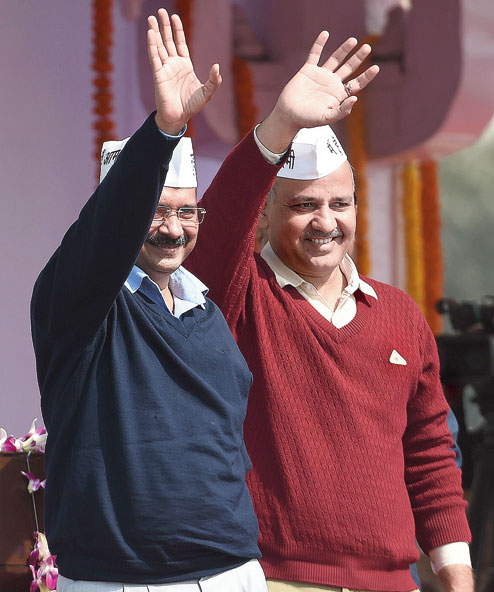

It can't be a homecoming that the chief minister of Delhi, Arvind Kejriwal, will be looking forward to. As he returns tomorrow, rejuvenated by an austere regimen in a Bangalore nature care institute, he will have to deal with a mountain of problems. His Aam Aadmi Party (AAP) is coming apart at the seams, the electorate's expectations are rising, demands for funds are growing - and the Opposition is waiting in the wings to pounce on the fledgling government.
This time last month, there was excitement in the air. The new kid on the political block had formed a government after defeating the two veterans - the Congress and the Bharatiya Janata Party (BJP). Hopes were high, and promises made. To mark its first month, the government on Friday released a report listing its achievements. But not everybody is buying its claim that all is rosy.
One month can be a short - or a very long - time in politics. Some are applauding, no doubt, but already quite a few are sniggering.
First the good news
The man with the greasy palm is bowing out. Corruption is down, in some quarters at least. People visiting Delhi government offices say it is easier now to get hold of birth certificates, ration cards and other documents. The touts who took money to get such work done have disappeared. An online system introduced recently makes it easier for people to track new ration cards issued in the Capital.
"Touts in the transport and property tax offices have vanished because government officials no longer entertain them," says Umashankar Kumar, a broker who deals with departments that handle property tax, licences and other such matters.
There is a sense that the government is like the common man. "Giving people the impression that they are against the laal-batti culture of VIPs and discouraging it with personal example is a good thing," former Delhi chief secretary Shailaja Chandra says.
People have access to members of the legislative Assembly, too. There are helplines to reach each of the 67 MLAs of AAP. "We want to implement true Swaraj in Delhi. Making elected representatives more responsive to people's problems is one way of doing it," AAP leader Ashutosh holds.
The issue of rising fees in private schools is also being looked into. Notices have been sent to 200 schools for charging "exorbitant" fees, a promise AAP made in its manifesto.
Traders are not unhappy either. One of their niggling problems was a provision that made it mandatory for them to claim tax refunds on their input costs before the end of a financial year, leading to a mad rush by March end. The government has now simplified the process - the credit can be carried into the following year.
Vinay Bahl, joint secretary of the New Delhi Traders' Association, points out that the previous government used to show the refund money lying with it as part of the tax collected. "This was done to give the impression that the tax collection was robust. But this was traders' money lying with the government. Many times traders had to pay bribes to get back their own refund money."
But it's not all hunky dory
The government's new advertisements state: " Jo kaha so kiya" - We've fulfilled our promises. Some of the promises - subsidies on power and water, halting of demolition drives and putting a stop to the eviction of hawkers and vendors - are being touted as achievements. But are they?
Right under AAP's nose, one of Kejriwal's promises has been openly flouted. On Monday, days after the government announced that hawkers would not be evicted from the roads, municipal officials and the police confiscated goods from street vendors stationed close to the party headquarters in west Delhi.
"When the hawkers argued, officials mocked them and told them to complain to Kejriwal directly," says Arbind Singh, national co-ordinator, National Association of Street Vendors of India. "During their 49-day rule in 2014, the government displayed a jazba (passion) to deliver. Officials were fearful. That is missing this time. The people sitting in Delhi's secretariat think that passing an order will do the job. They are wrong."
Some teachers are not happy either. On February 16, the government issued a circular saying there would be no termination of contractual government employees until further orders, a longstanding demand of the All Guest Teachers Association (AGTA). But the services of some 250 "guest teachers" have been terminated by the state's education department in the last three weeks. On Wednesday, when the teachers met Manish Sisodia, deputy chief minister and minister for education, he said he was not aware of the termination.
"Our future hangs in the balance and the minister says he doesn't know," AGTA president Parveen Tobaria says.
A 50 per cent cut in power tariff - applicable for those whose power consumption is low - is another bone of contention.
Shakti Sinha, former secretary of finance, power and industries of Delhi, feels that AAP may have bitten off more than it can chew. He estimates that the new subsidies will cost Delhi Rs 2,000 crore every year. And this will go up as people will use more power because of lower tariffs, he argues. "This would mean less money for the social sector - health, education, welfare," Sinha says.
Chandra maintains that Delhiites need no "pampering" because they have a high per capita income and still pay less for electricity than in some other states. "There is no harm in giving free or subsidised electricity to those who fall under a given income threshold but that section has to be identified through systems which has not been done," she says. That means AAP may have to return to the old practice of making up the deficit by cutting investments elsewhere, she adds.
Political opponents are rubbing their hands in glee. "One needs to see how they are going to find resources to sustain (their promises). In one month, they haven't done any governance but doled out subsidies irrationally," maintains BJP Delhi president Satish Upadhyay. "People of Delhi will realise what a big mistake they made two years down the line," stresses Shazia Ilmi, a former AAP member who joined the BJP before the elections.
Wait and watch, the government replies. "We know that we cannot afford to fail in Delhi. Whether it is subsidy on power or water, all these are well thought out. Kejriwal doesn't do anything that he doesn't understand," says Naveen Jaihind, a national executive member of AAP. He adds that the government will find ways to generate resources. But how, he doesn't say.
Those waiting for the government to help people breathe better are fuming, too. Sisodia told the Delhi chapter of the Confederation of Indian Industry earlier this week that his government would not flinch from taking "unpopular decisions" to control pollution in the city.
But the government has already announced that small and medium enterprises will no longer require environmental clearances for setting up new establishments falling under certain categories. These include hotels and restaurants, automobile service providers, flour mills and stone crushers, printing presses and apparel makers.
"With this order the government has abdicated its responsibility," says Promila Sharma, country co-ordinator, Blacksmith Institute, an NGO that focuses on pollution. "These industries generate waste and spread other forms of pollution."
The ugh factor
But by far the ugliest episode that the government - or the party - has faced in this one month has been the upsurge of dissidence. Senior leaders Prashant Bhushan and Yogendra Yadav have been removed from the party's political affairs committee. The dissidents accuse Kejriwal of behaving like a dictator and succumbing to electoral compulsions. The loyalists whisper that the two had tried to sabotage the party's electoral prospects during the Lok Sabha and Delhi polls.
The volunteer is stumped by all this. "Bhushan is the party's conscience keeper and Yadav its political pundit. AAP has to remain AAP and not turn into any other party," warns Abhisek Kumar Preetam, a software professional in Pune. "Arvind is so occupied with his yes men that he has disconnected from the principles of the party."
But Jaihind calls this " samudra manthan" - a churning needed to rid the party of "negative elements" holding it back. "We first need to get rid of rats within our home before we worry about the barking dogs on the road," he says.
Ashutosh admits that the party has been "distracted" by these problems but will be back on its feet once Kejriwal returns. "I won't deny that AAP's image has been affected, but these are short-lived problems."
Now what?
Former bureaucrat Sinha has a suggestion for Kejriwal. "He should focus on good governance, remove extortion and harassment of citizens by government functionaries, and deliver on transparency and efficiency. Political slogans including unrealistic promises should be replaced by effective and inclusive governance," he says.
Kejriwal - now that doctors say his blood sugar level is under control and cough has eased - has to don his chief minister's cap and get to work.
Hits and Misses

- 50 per cent cut in power tariff
- Free 700 litres of water per day for households
- Private schools issued showcause notices for charging high fees
- Relief for city traders on tax refunds
- Easier to get government certificates

- Contractual employees being removed
- Street vendors and hawkers continue to be harassed
- No steps on women’s safety yet
- Party beset by infighting, leaks and stings
Tough times ahead
- Mohalla Sabhas to be empowered to take decisions on health centres, schools, liquor vends. Needs legislation from the central government
- Government to lose Rs 2,000 crore a year because of power and water subsidies; development projects may suffer
- AAP has promised full statehood to Delhi, but Centre unlikely to play ball
- Regularisation of resettlement colonies and handing over of ownership rights promised within three months — experts say this may take years
- Setting up 500 schools and 20 new colleges in five years calls for huge resources.