 |
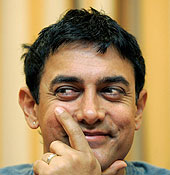
| Aamir Khan |
Role playing has just taken a new turn. Actors and directors in the Hindi film industry are these days doubling up as journalists. And not just on cinema. Film publicity no longer banks on interviews with the media before a release. The interviews are taking place — but conducting them are not the usual anchors and film reporters. Occupying the questioners’ chairs are leading members of the industry.
That’s just what actors Saif Ali Khan and Rani Mukherjee did before the launch of their new film Ta Ra Rum Pum. The trend started last year. Aamir Khan and Kajol interviewed each other on a national channel before the release of their film Fanaa. Both actors are known to be extremely reclusive. So they preferred to do the interviewing — and answering — themselves, no doubt making life easier for everybody, from the actors to Yashraj Films and director Kunal Kohli, who was, incidentally, once a journalist.
Vidhu Vinod Chopra did all the Ekalavya interviews himself and then released them to the media. Chopra interviewed Amitabh Bachchan, Saif and Sanjay Dutt as part of the pre-release interviews for the film. The cast was happy with that — for Chopra certainly didn’t ask them any questions that they didn’t want to answer. “I think it is just a normal way of publicising a film. If directors or stars pose the questions, they know what to ask. The questions are more personal and also give the stars the chance to narrate what they want to, and keep under wraps what they don’t want to. They don’t have to necessarily answer what journos come up with,” says actor Ashmit Patel.
And filmmaker Vipul Shah believes that it’s better if his stars stay away from journalists. “Anyway, they have to say the same things about the film in an interview. So why not hand the media a pre-recorded interview with the stars where they don’t have to answer any uncomfortable queries,” argues Shah. Safe interviewer brings us to Karan Johar who gets almost everyone from the film industry on to his show — Koffee with Karan — and all that he needs to do is spend on a gift hamper on them.
not surprisingly, actor Rohit Roy looks at Karan Johar’s show with awe. “All these celebrities are obviously vastly talented even outside their core professions. I think active minds want to keep dabbling in various related fields to keep the creative juices flowing,” he says. “Karan Johar has more grace and warmth than a lot of professional hosts who tend to get mechanical after a while.”
While a lead actor playing roles of comedians and villains or even becoming a director can be considered an additional weapon in his creative armoury, there is still some concern over whether they can successfully essay the role of a prying journalist. “I think it’s all right for actors to turn journalists occasionally,” says actor Rahul Bose, who has himself donned a citizen journalist’s hat for a television channel. “Covering the Mumbai floods as a citizen journalist gave me a good idea of what journalism is all about. It was a whole new experience for me. From the viewers’ point of view, it was a refreshing change.” At the end of the day, however, Bose holds that “actors will be actors” and can’t replace journalists. “Journalists are best at what they do. These are marketing gimmicks, but I think it’s fine once in a while.”
Jackie Shroff interprets the scenario differently. He says that actors fear getting into a rut. “They may be scared of stagnation or bored stiff with the same old story,” he laughs. Item girl Meghna Naidu agrees, insisting that the interviews make life exciting. “Such trends make projects more interesting. It is important for filmmakers and actors to keep their audiences excited all the time. Actors have to play different roles and retain their audiences,” she says.
But not everybody is convinced that the trend is going to be an enduring one. Actress Amrita Rao, for one, perceives it as a short-lived phenomenon — she holds that it has been engineered by the media itself. “The media are extensive and aggressive and have to keep coming up with newer angles to attract viewers. Actors and directors, being greatly popular, are roped in by channels. But neither will Karan Johar stop directing, nor Ajay Devgan stop acting after directing.”
Trade analyst Amod Mehra interprets the star-interviewing-star exercise for Ta Ra Rum Pum similarly. “It’s mundane for viewers to watch the same thing again and again with the same interviewers. This gives them more reasons to watch a programme. For example, Ta Ra Rum Pum has done very badly at the box office but continues to be promoted by a TV channel. Nishabd tied up with a radio station live for the first time. This in fact shows how much mileage the media can give actors and movies. But I will add that this is not a trend,” says Mehra.
But journalists on the beat fear that the EPK — Electronic Press Kit — culture of Hollywood will soon set in. “In Hollywood the producers hand over the EPK to the TV media and a similar one is given out to the print people who are free to reproduce the interviews done for the promotion of the film with a few personal questions thrown in,” says Alka Shukla, a journalist at a TV news channel. “If Bollywood producers start doing this regularly, like it was done for Dhoom 2, it might be difficult for journalists to even meet stars for interviews. “But that doesn’t worry the film industry. After all, what could be better than a home-made promo — something that is for the people, but of the industry and by the industry?