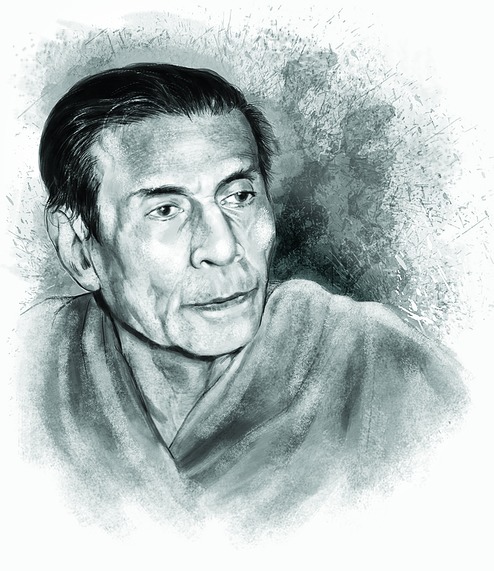

Illustration: Omkarnath
Ya Chandi, madhukaitabhaadi daitya dalani/ Ya Mahishomoolini... O Chandi, slayer of demons such as Madhu and Kaitabha/ Annihilator of Mahisasura... A mixed chorus follows the billowing conch. The verses in Sanskrit, joyous, exhilarating, first surge, then break gently against the dark sky. Happy, excited - a hundred other nameless emotions quiver with anticipation. We are almost upon that long-awaited moment of autumnal grandeur. Almost, but not quite.
And then, an ancient voice rises from the dark like a gong. Singular. Solid. Its timbre, brassy. Its enunciation, strident. Aswiner saradapraate beje utheche alokomonjir... O autumn morn, ringing with wondrous light... Birendra Krishna Bhadra's soulful chant dissolves into an ordinary dawn and elevates it into a Mahalaya morning. Mahalaya, that marks the descent of the Hindu deity Durga to earth. Mahalaya that marks the countdown to Durga Puja.
It has been 26 years since Birendra Krishna's death, 85 since he lent his artistry to the first Mahisasuramardini, the programme aired by the colonial predecessor of the All India Radio (AIR) - the privately owned Indian Broadcasting Company - at the crack of dawn on Mahalaya day.
Radio is not what it used to be in the 1930s India. The world is not what it used to be then. No one need wait 365 days to listen to a piece of music. However, to all those whom Mahalaya means something even today, Mahalaya and Birendra Krishna Bhadra remain inseparably soldered.
Like its muse, the programme Mahisasuramardini had more than one creator. There was the playwright Bani Kumar, who had scripted it all, the legendary Pankaj Mullick, who set it to tune, and Birendra Krishna Bhadra, who did the Chandipath, or invocation of the goddess, and was also the compere.
"The first 30 years [since its inception in 1932] Mahisasuramardini was a live programme. All artistes used to perform real time at the AIR studio in Calcutta. A car would pick up my father sometime after midnight on Mahalaya day and ferry him to the AIR office at Eden Gardens," recalls Sujata Devi, Birendra Krishna's eldest daughter, who is almost as old as the programme.
We are at the Bhadras' ancestral house in Shyampukur in north Calcutta. The large bedroom on the second floor, where we are seated, has one large four-poster bed and plenty of windows. Sujata Devi points to the bed and says, "That's where he breathed his last."
It has not been easy to get her to talk about her late father. Only half an hour ago, she had refused outright. "Not this year, I won't talk. Not a word on him," she had been emphatic, bordering on the petulant.
The gist of her complaint: people from the media remembered her late father only around the time of the Pujas. They would come with their cameras and questions. They would badger her for interviews. And then, the ripples would subside, the layers of oblivion would close in again on Birendra Krishna.
What made Sujata Devi change her mind, it is difficult to say. Perhaps it was her need to talk about her late father. Perhaps she found comfort in new empathy. Perhaps like the ancient mariner these retellings momentarily alleviate some of the unhappiness that emanates from a sense that her father was not given the place that was his due.
Once she starts talking, it is liked a tidal wave of memories, information and emotion. "In personal life, he was not overly religious," says Sujata Devi of her father. Then adds sombrely, "We never saw him offering puja or even light an incense stick."
Mihir Bandyopadhyay, a former compere and lyricist at AIR, was a junior colleague of Birendra Krishna. He recollects how in the initial days, the conservative Brahmin fraternity of Bengal objected to Birendra Krishna, a Kayastha, doing the ritual Chandipath.
Bani Kumar, who scripted the programme, ignored the critics. His gut sense proved correct. The programme was a hit and Birendra Krishna became a household name. He did not rest on his laurels though. The careful artiste, according to Bandyopadhyay, spent hours refining his Sanskrit accent, keeping in mind a pan-India audience.
What is so great about Birendra Krishna's Chandipath? Sanskrit scholar Nrisingha Prasad Bhaduri cites an anecdote. One time, a man was reading from the Gita. Among his audience, was the 15th century spiritual leader Chaitanya Dev. Reading done, when the man apologised to Chaitanya Dev for his imperfect pronunciation, the reformer said, "Tumi chinta koro na. Prabhu bhab tuku grohon korben... Do not worry. The Supreme Power will not look beyond the sincere telling." Says Bhaduri, "Birendra Krishna's Chandipath stands out because of the feeling he poured into it. One may not understand the meaning of the words, but one gets a sense of the prayer."
Birendra Krishna began his professional life as a clerk in the Railways. His office was at Fairly Place in central Calcutta. A stone's throw away from it, at No. 1 Garstin Place, was the building that housed the Indian Broadcasting Company. During lunch hours, Birendra Krishna started indulging his pet passion - radio plays.
In the initial days, his voice had a hoarse, grating quality. Not unexpectedly, he failed AIR's audition, when it was hiring comperes and staff artistes. For a good while, he was content to script and produce radio plays. Then, one day, there was a requirement for an artiste with a distinct voice type for a play. Birendra Krishna got the role, and there was no looking back after that.
However, Mahisasuramardini was only a part of Birendra Krishna's vast repertoire. "He was also a theatre actor and director, and even dabbled in films," says the 93-year-old Sushil Kumar Chatterjee, better known as Naku Babu, leaning in conspiratorially.
Naku Babu, an amateur sound engineer, had got to know Birendra Krishna during his final years; they were neighbours. According to him, our Mahalaya Man was a radio pioneer. "He introduced running commentary of football matches on radio, even though he knew nothing of the game," he says. Naku Babu also talks about Birendra Krishna's commentaries of the final journeys of eminent people for AIR audiences, vivid and moving and very popular with the masses.
Ajit Mukhopadhyay, a veteran drama producer with AIR, was trained by Birendra Krishna. Says the 80-year-old, "He taught us all the nuances of voice acting; how to hold the breath and let it go; how to express exhaustion, frustration..."
Bandyopadhyay, who has worked with the legend, helps us piece together a picture of the man. How he wore a khadi kurta, a dhoti and a wrap all year round. How he would carry an umbrella in his right hand and a jhola in the left, stuffed with scripts of audio plays. How he had a habit of taking snuff intermittently. How he took the last tram back home around 10pm every day.
He tells us that Birendra Krishna's persona was a combination of utter simplicity, gravitas and incisive wit. The 78-year-old recalls one time when Birendra Krishna was on his way to work, when a stranger intercepted him and began pestering him with all sorts of questions. Where did you learn such chaste Sanskrit? Do you bathe in the Ganges before the Chandipath? Says Bandyopadhyay, "Suddenly, Birenda turned on his interrogator and said, 'By the way, how is your gonorrhea? Cured, I hope.' The man got off at the next stop."
After 1966, AIR played only pre-recorded programmes of the Mahalaya. Even then Birendra Krishna would drop in at the studio early in the morning to ensure that the right spool was being loaded. "It remained his routine until he retired in 1970," says Bandyopadhyay.
Then in 1976, when the Emergency was on, AIR authorities decided to scrap the "ancient programme" altogether and produce a brand new version with matinee idol Uttam Kumar as the compere. To invoke the goddess, AIR sought the assistance of an earthly constellation - singers Hemanta Mukherjee, Lata Mangeshkar, Asha Bhonsle. The purists insisted on a Sanskritised script this time. When the new programme was aired there was an outrage. In 1977, the information and broadcasting minister of the newly formed Janata government, Lal Krishna Advani, had to make a public announcement - no less - that the older version of the programme was being reinstated.
Bandyopadhyay says he asked Uttam Kumar why the programme flopped. "The film star accepted that Birendra Krishna was a far superior compere. He also added that in hindsight, the effort to refurbish a thakur ghar or prayer room into a modern drawing room seemed mindless, even unnecessary."
But by then, Birendra Krishna had already retired from AIR. We learn from Sujata Devi that since he was an artiste-on-contract, he was not even eligible for a pension. Thereafter, once in a while, AIR authorities engaged him occasionally to do a reading of the Mahabharata for a 15-minute slot at an honorarium of Rs 75. Sometimes, organisers of para pujas approached him for the Chandipath. "They paid him peanuts," says Naku Babu.
In 1991, Birendra Krishna died. He had once relayed the final journeys of Bengal's who's who, from Rabindranath Tagore to Bidhan Chandra Roy, but his own last days went almost unnoted. Sujata Devi's anger now assumes context.
Naku Babu is in possession of a huge collection of shellac and vinyl records of Birendra Krishna's recitations, skits, satires. But who is interested in sparing a thought for the preservation of the priceless? Nostalgia is cheaper, requires little effort; it suffices.
In recent times, the Sutanuti Parishad, a cultural body, made an effort. It has put up a memorial marble plaque outside Birendra Krishna's Shyampukur residence. It reads: Betarey Mahisasuramardini sarbakal joyee onyotamo rupakar ei susantan ei baritey amrityu baas korechhen... He who came to be known for his timeless rendition of Mahisasuramardini lived here all his life.
As we were saying - nostalgia is cheap.