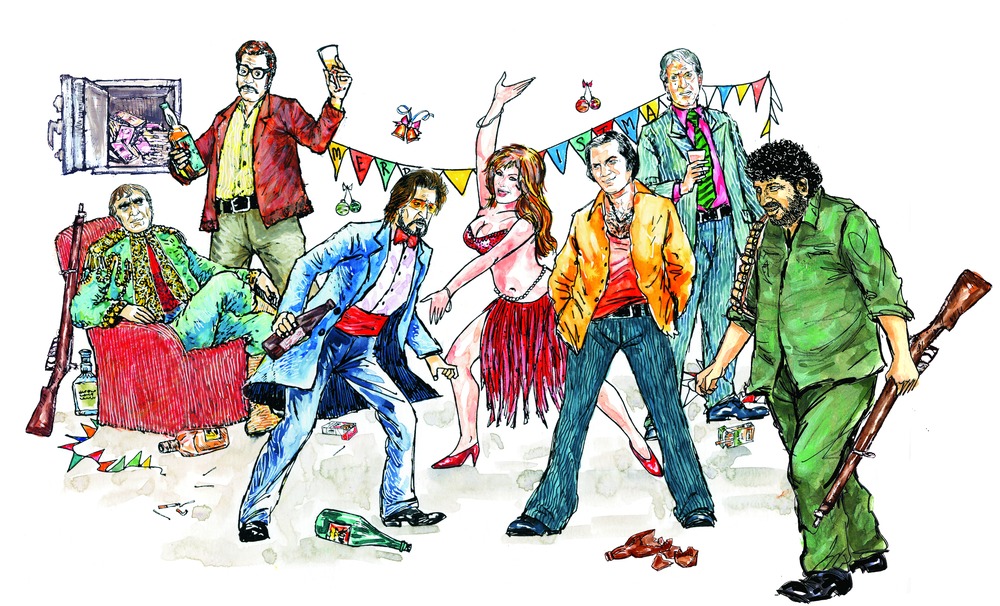

The man with the saxophone plays a lilting tune, and the spotlight caresses the woman in a pair of fishnet stockings, shaking a shapely leg. The man with the puff looks at the woman with the bigger puff sitting all alone in the nightclub, toying with her bottle of Coke. In the shadows, a man in a dapper suit smirks and lights a cigarette.
Identifying characters in a Hindi film was easy once. The puffs were the hero and the heroine; the long legs, the vamp. And, of course, the smirk was the villain.
The hairdos may be gone, but the hero is there, as is the heroine. The villain and the vamp, however, have all but disappeared.
"With the passing of time, everything changes. Cinema, too, has changed. In the past, there were three main characters - hero, heroine and the villain. And people would identify them as such. That's no longer the case," says the veteran villain, Prem Chopra.
Take this week's much-awaited film, Dangal. Aamir Khan plays the role of a real-life former wrestler called Mahavir Singh Phogat. Phogat can't win a gold medal for India in wrestling but hopes that he'll have a son, whom he'll train for the gold. His wife gives birth to four daughters. Phogat is disappointed. And then, one day, he starts training the girls.
In the good old days, there would have been an enemy nation - or perhaps a jealous aunt - who would have tried to crush the would-be champs. But if there is a villain in the film, it's mindsets - as several other films of 2016 have demonstrated.
"The villain today is the belief system," agrees director-producer Shoojit Sircar, whose 2016 production Pink created a stir by stressing the tenet that a no means a no.
This is not to say that the there are no villains any more. Action films in particular still need a bad guy who has to be worsted by the hero. Among the films of 2016, Kahaani 2 and Fan had villainous characters. And in a film called A Flying Jatt, the hero was gifted magical powers by a tree, and fought a villain whose strength was pollution.
But a great many other films - including Befikre, Sultan, Dear Zindagi and Ae Dil Hai Mushkil - had no place for the typical villain. If there was a demon that had to be fought, it was a state of mind - gender inequality ( Ki aur Ka, Pink and Dangal), homosexuality (Aligarh), patriarchy ( Sultan), and so on.
That's not surprising, for villains reflect societal concerns. When feudalism ruled, the villain was the landlord or the zamindar. When money was seen as filthy lucre, the village money lender was the bad man.
"Before economic liberalisation or 1991, the bad guys all had to do with money. They stood on spiralled staircases and shouted at people who had no money. They narrowed their eyes, smoked cigars and talked of sonay ke biscuits," says film writer Shubhra Gupta, the author of an upcoming book on cinema.
Every era had its own enemy. Dacoits spelt terror when the milieu was rural. When nation-building was a slogan, black marketers, food adulterators, medicine contaminators and smugglers were the most despised lot.
A pantheon of actors played these negative roles: When K.N. Singh looked at the heroine with his hooded eyes, Madan Puri frowned and Jeevan or Kanhaiya Lal laughed, the audience knew that something evil was about to happen. Prem Nath had to merely smile and Pran only had to flare his nostrils to indicate that trouble was afoot.
"When I appeared, people knew something bad was going to happen. They sat on the edge of their chairs," Chopra recalls.
Chopra and a host of others, including Ranjeet, Shetty, Shakti Kapoor, Danny, Kader Khan and Gulshan Grover, were the cinema world's designated villains. Noted actors such as Nana Patekar, Anupam Kher, Amrish Puri, Kulbhushan Kharbanda and Sadashiv Amrapurkar played memorable villain roles. Amrapurkar is still remembered as the cruel transgender, Maharani, in the 1991 film Sadak, and Kharbanda as Shakaal in the 1980 film Shaan.
The Eighties and Nineties saw the rise of the terror plotter. The villain was someone inimical to the nation. Dr Dang - Kher in Karma - sought to wreak havoc in India; Mogambo - Puri in Mr India - planted bombs that looked like toys.
"The villains were mostly based on Bond villains," explains screenplay co-writer Ritesh Shah, the writer of Pink. "There was a certain mystique attached to their names, too. Mogambo, Dr Dang, Shakaal, and so on."
And, of course, there was Gabbar Singh of Sholay, who, along with the Loin of Kalicharan, the actor Ajit, was the most memorable screen villain of all time.
There was even a time when a villain's lines in a film found place in popular vocabulary. Lines such as "Prem naam hai mera, Prem Chopra" (Bobby), "Mogambo khush hua" (Mr India), and " Ab tera kya hoga, Kalia" (Sholay) are still etched in public memory.
"Amjad Khan's Gabbar was the turning point. No one could do a dacoit's role after that," Delhi-based theatre director N.K. Sharma believes. And Ajit, still famous for the words " Saara sheher mujhe Loin ke naam se jaanta hai", generated an entire joke industry, Sharma points out.
The villains donned different caps over the years - the pagris of the dacoits soon gave way to the politician's topi, and then the terrorist or the fundamentalist's skullcap. Dark glasses became the symbol of the underworld don.
"But these were also caricatures," argues Sharma, whose theatre group Act One has produced actors such as Manoj Bajpayee and Ashish Vidyarthi. "The way we show a terrorist as a villain is not the way he is," he holds.
And that, Shah believes, is the reason villains have bowed out.
"The story line or content of today's films is, if not close to reality, at least quasi real. Good versus evil is not a black and white issue any more," he stresses.
Another factor that helped sound the death knell for villains was the changing face of the Indian hero. Amitabh Bachchan's angry young man - angst-filled roles that he played in a spate of films in the Seventies and Eighties - ushered in the hero who revelled in shades of grey.
But perhaps the final push came from the success of the so-called wholesome cinema, focusing on family values. The beginning of the new century saw a plethora of such films, many of them from director-producer Karan Johar's stable. A film such as Kabhi Khushi Kabhie Gham, with a strapline that said "It's all about loving your parents", didn't have a place for a sneering villain. At best, it could have a stern dad.
The film was a mega success. "The family drama appealed to the aspirational Indian. And it became such a huge hit that there was no turning back," Gupta says.
That villains were on their way out became apparent in 2007, when comic actor Boman Irani was nominated for an award for the "best negative role" for his part in the comedy film Lage Raho Munna Bhai. That was also the year that the prize-giving organisation did away with awards for villains and vamps.
Sircar, who is not yet sure who his next villain will be, believes that in the future, the focus in Mumbai will be on scientific or sci-fi fears such as viruses and outer space attacks. But Shah holds that films will take on prejudices.
"The new villains will be sexism, exploitation, terror, corruption. The figures will not be larger than life. Perhaps, they will be an apathetic bureaucrat, a neighbour, an uncle, a coach - someone identified as opposing 'progress'," he says. "For the villains are not ogres or monsters. They are all around us."
AND WHERE’S MONA DARRRLING?

If films have changed, so have audiences. Time was when, along with laughter and claps, appreciation came in the form of a sharp wolf whistle. The whistle, mostly from the front rows, usually announced the arrival of a female form poured into a bodysuit. The whistles became louder as the drums rolled, and Helen shook her eminently shakeable body.

Hindi cinemas vamps — cabaret dancers, gangsters’ molls, envious friends and cruel relatives — have taken their last curtain call. There was a time when Nadira smouldered, Helen sizzled, Shashikala spewed venom, Manorama plotted, Bindu bared and Padma Khanna oozed sex. Doing all that now are the heroines.

Roles are not written for vamps any more. After all, the heroines can jiggle as well as the vamp, and the so-called item dance is all that a film needs. To top it, characters are not black and white any more, and traits that were once reserved for the vamps — fondness for cigarettes and alcohol, for instance — could well be part of a heroine’s role.
Cinema watchers believe that vamps were edged out by actors such as Zeenat Aman and Praveen Babi — tall, statuesque women who looked good sheathed in figure hugging gowns.
And when Zeenat began swaying to Aap jaisa koi and Babi to Jawaan jaaney man, there was no space for Helen anymore.