Bombay to Calcutta in 80 minutes


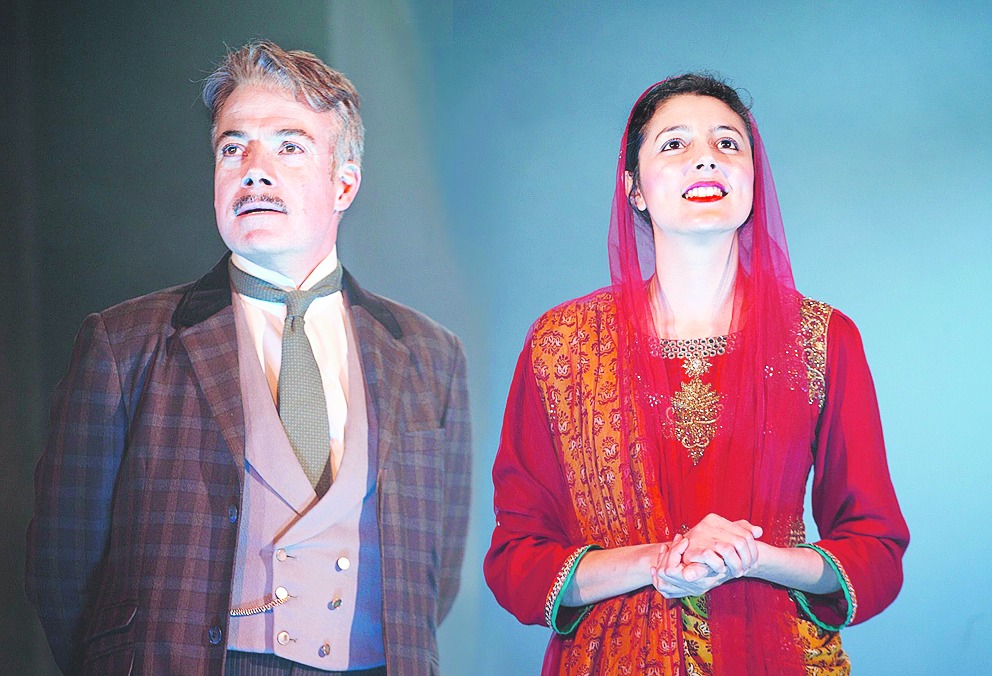
Why did the British go around their empire once upon a time trying to remake other cultures, notably Indian, in their own image? This is the question that Mrs Aouda asks of Phileas Fogg in a new and delightful theatrical adaptation of Around the World in 80 Days that has opened as a Christmas offering at the St. James Theatre in Victoria, London.
In the 1873 novel by Jules Verne, Mrs Aouda is the young widow rescued from sati by Fogg, who is trying to win a bet by circumnavigating the globe in record time.
The novel has been adapted by an American playwright, Laura Eason, who has brought the production from the Lookingglass Theatre Company in Chicago to London. In Eason's version, Mrs Aouda is given a voice and strong views about the British empire. She is saved by Fogg from the burning embers, but she, too, manages to rescue the Englishman from a life of loneliness. She is the one who proposes to him.
Eason makes her political points with a light touch. This is a quick moving and entertaining play that is perfect for audiences aged nine to 90. Though Fogg (played by Robert Portal) and his French valet, Passepartout (Simon Gregor), also traverse the Far East and America, the heart of the story is set in India. And there is real chemistry between Fogg and Mrs Aouda (Shanaya Rafaat).
It is Mrs Aouda who questions Fogg on why the British want to remake the world in their own image. "As a character she has very few lines of dialogue in the novel. She is not very present, she is not very fleshed out.
"What I did in the adaptation was try and expand and deepen her character and the lines she has about the regret of leaving her country and her family - that's what I brought to the adaptation to reimaging her as a fuller character in the theatrical version," Eason told me when I caught up with her after seeing the play.
Maybe Incredible India should tour the show to India and other countries. After all, much happens on the journey from Bombay to Calcutta via Allahabad on the newly opened Great Indian Peninsula Railway.
Syria debate

Looking at the House of Commons last Thursday reminded me of one of those epic paintings which capture a historic moment in the life of a nation. For David Cameron, addressing 600 fellow MPs was easy peasy after net practice with 60,000 at Wembley.
Someone really should make an educational video of the 10-hour debate, with its cut and thrust, and send a copy to what American journalists insist on calling India's "lawmakers". Though the Commons was rowdy at times, all sides were heard.
Cameron was followed by Jeremy Corbyn, leader of the Labour Opposition, who is well meaning, sincere, prefers diplomacy to bombs but makes Manmohan Singh seem an exciting speaker by comparison.
The British do love a good war. There was a parallel debate, but without a vote, in the House of Lords where the Archbishop of Canterbury, Justin Welby, supported the motion to bomb Syria. Clearly, there is little to worry about when God is on your side.
Dickens treat

As a seasonal treat last week, the Foreign Office organised a tour for journalists of 48, Doughty Street, Camden, London, which is the foremost Charles Dickens museum in Britain.
This Georgian terraced house is where Dickens lived from 1837 to 1839 and "wrote The Pickwick Papers, Oliver Twist, Nicholas Nickleby and began Barnaby Rudge", according to the museum's director, Cindy Sughrue, and curator, Louisa Price.
Dickens began life as a parliamentary reporter who thought very little of MPs - although perhaps he would have been impressed with the Syria debate.
Dickens's favourite books included The Pictorial Edition of the Works of Shakespeare's Tragedies Volume I, The Life and Adventures of Robinson Crusoe, Specimens of English Sonnets and a lot of material on crime.
The house has a desk which actually comes from Gad's Hill Place, in Kent, the country residence where Dickens lived the last years of his life from 1858 to 1870 and wrote A Tale of Two Cities, Great Expectations, Our Mutual Friend and began The Mystery of Edwin Drood.
The bestseller in the museum shop is Great Expectations.
Book choice
Ritula Shah was presenting The World Tonight on BBC Radio 4 last Thursday when her programme went live to the Commons for the vote on whether to bomb Syria - David Cameron won the argument for military action by 397 votes to 223.
Ritula probably has to read a lot in the line of duty but, asked for her favourite five books, this is her reply: Pride and Prejudice (Jane Austen); The Trial (Franz Kafka); A Bend in the River (V.S. Naipaul); Middlemarch (George Eliot); and Midnight's Children (Salman Rushdie).
I also asked the scientist and novelist Sunetra Gupta, professor of theoretical epidemiology in the department of zoology at Oxford University, for her list.
This comprises books "I really love": Duino Elegies (Rainer Maria Rilke); Mrs Dalloway (Virginia Woolf); The Arcades Project (Walter Benjamin); Jogajog (Rabindranath Tagore); and Aparajito (Bibhutibhusan Bandyopadhyay).
Modi-fication
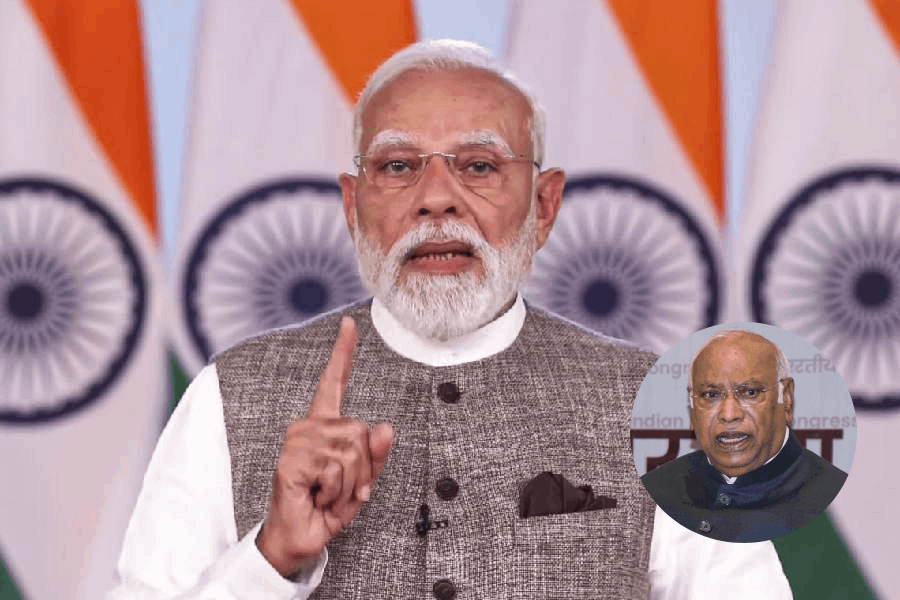
Will Narendra Modi win a second term as Prime Minister?
John Elliott, who first published his book, Implosion: India's Tryst with Reality, in hardback in February 2014, has now added a last chapter, "Modifying India: An Update", for the paperback edition.
Elliott was in India for the Financial Times from 1983 to 1988 and returned in 1995 to write for The Economist.
He was in Wembley last month so he has seen Narendra Modi both in India and in England.
Elliott points out that back in July 2002, he was perspicuous enough to put it into writing that Modi looked to him like "India's next big leader" when the idea seemed inconceivable to many of his Indian friends.
"If he fails to tackle poverty, boost employment, improve governance and curb corruption, or if he allows his nationalist compatriots to spread communal disharmony, the country will quickly tire of his charms and vote against the BJP - which could even banish him back to Gujarat," predicts Elliott. "He has five years till the next general election to do enough to win the second term that he needs to make India a stronger, successful and proud nation. It is for Modi to win, or lose, his place in history."
It's now less than five.
Tittle tattle
Lady Kishwar Desai celebrated her birthday on Tuesday by calling a meeting at the House of Lords where she and her husband, economist Lord Meghnad Desai, discussed their evolving plans to put up a "museum of Partition" in Amritsar. A suitable property has been identified.
The idea is to record personal tales and collect memorabilia before the 10-12 million who crossed borders, both in Punjab and in Bengal, pass away.
Instant judgements had to be made in 1947 on the division of assets, including even books in public libraries.
Part I of a novel to India and Part II to Pakistan?
"No, I don't think it was as bad as that," Kishwar admonishes me.
But that might have brought, at least, two people together.