
Yogesh Master used to shrug off phone calls and letters relaying death threats. But when two men on a motorbike started hounding him, he got worried.
"They would ask to meet me on the pretext of giving an invitation or a gift. Then they'd glare at me and walk away," the Bangalore-based author and playwright says. After four such visits, he notified the cops and has been given police protection.
Threats have been coming his way routinely for the last two years, ever since he published his book, Dhundi, in which he described the Hindu God Ganesha as a tribal born to a low caste mother. But the bikers' appearance two months ago was a different matter.
Men on motorbikes had struck earlier. And last Sunday, a retired vice-chancellor of Hampi University was gunned down at his residence in Dharwad, a laidback north Karnataka town. The assailants were two men on bikes.
In June last year, Malleshappa M. Kalburgi, 77, had dismissed idol worship as humbug, which had brought protestors from the Bajrang Dal and the Vishwa Hindu Parishad (VHP) to his doorstep. The professor was placed under police protection - which was removed two weeks before his murder.
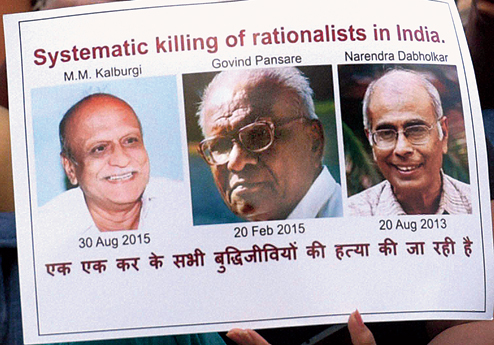
Kalburgi was the third rationalist thinker to be killed in the last two years. In August 2013, Narendra Dabholkar, an outspoken campaigner against superstition, was shot dead by two assailants on a motorbike while out on a morning walk in Pune.
In February, Govind Pansare, a veteran Communist leader and author who angered conservative sections in Maharashtra with his secular interpretation of Shivaji, was shot dead in Kolhapur - again by two men on a bike.
"The three murders are eerily similar - there were two men, who struck in the morning and used a bike to get away," says U. Kalanathan, a Thiruvananthapuram-based rationalist thinker and former secretary of the Federation of Indian Rationalist Associations (Fira). "It seems like a conspiracy to hit the movement."
The police are also probing this angle. "Police teams have been sent to Pune and Kolhapur to get details of Dabholkar and Pansare's murders," a police official investigating Kalburgi's case says.
These, clearly, are inauspicious times for rationalist thinkers. "Intolerance has grown to the extent that anyone who dares to speak against organised religion ends up with a bullet in his head," says retired Mysore University professor K.S. Bhagwan.
A posse of policemen stands guard outside his house in Mysore's Kumvempu Nagar. After Kalburgi's killing, a Karnataka Bajrang Dal leader tweeted a threat to Bhagwan, "You are next."
Bhagwan came on the right-wing radar earlier this year, when he said the Bhagvad Gita had "a casteist and obscurantist view of the world".
The liberals fear that intolerance against rational thought is growing in a society that celebrates Radhe Maa, Ram Rahim Singh and Asaram Bapu. "There's been a spike in TV evangelism, with channels like Aastha and Sanskar bringing the guru's ashram into urban homes. And the show is only getting bigger," Bhagwan rues.
It wasn't always like this. "Rationalism has been around in India since pre-modern times. There was a time when rationalists such as Abraham Kovoor and Bangalore's H. Narasimhaiah enjoyed a huge following," says V.S. Sreedhara, former professor at Bangalore's Vijaya College and member, People's Democratic Forum.
Sreedhara - who was part of a National Law School team that drafted an anti-superstition bill for Karnataka - has been at the receiving end of religious ire. In 2007, he was taking a class when three men walked into the room, pulled him by the collar and asked him to keep his views to himself. "When some students spoke up for me, they were beaten," he recalls.
But the rationalists hold that such attacks end up spreading fear and stifling dissent. "People are getting scared and backing off from openly embracing rationalism," says Ramdas Rao, a Mangalore-based university professor and state committee member of the People's Union for Civil Liberties.

Rao sees the growth of violent intolerance all around him. The south Karnataka coastal city has emerged as the favoured hunting ground for the moral policing brigade. According to data collated by the Mangalore unit of the Karnataka Communal Harmony Forum, there were 45 moral policing incidents in the city in 2013.
Last month, a young Muslim man was stripped and beaten up for speaking to a Hindu woman. Women and college students have been attacked in pubs and private parties. In 2009, a local Hindutva group, the Sri Ram Sene, declared war on Valentine's Day, driving out couples from pubs and accosting them on the streets.
Rao finds that increasing vigilantism is pushing the city's educated class and youth away from the rationalist movement. "Some academic institutions have asked teachers not to discuss rationalism in class," he says. "College students are also increasingly cagey about voicing liberal views on public platforms. No one wants to get into trouble."
Being an education and IT hub, Mangalore would seem an unlikely breeding ground for rabid groups. But Rao believes economic prosperity and communal politics always come hand in hand. "Capitalism widens the gap between the rich and the poor. This increases resentment among the have-nots, pushing them towards religious politics," he explains.
At the same time, some liberal thinkers point out that the rationalist movement is also on the growth track. "In the last census, 2.7 million people listed themselves as atheists. That's not a small number," says Fira president Narendra Nayak.
The federation has 82 organisations affiliated to it - up from under 65 in 2001. The group that Dabholkar founded, the Maharashtra Andhashraddha Nirmoolan Samiti (Committee for the Eradication of Blind Faith), has been thriving, too, says its executive president Avinash Patil.
"We have 10,000 members - the numbers have doubled in the last two years," he says, adding that the anti-superstition organisation has 310 branches across Maharashtra's 35 districts.
Non-believers, after all, also have strict belief systems. As professor Bhagwan says, "Only compelling scientific evidence - and not Twitter threats - will make me change my belief."