 |
It’s not easy to spot Askandra on the map of Rajasthan. But the sparsely populated village, nearly 60 kilometres from the Pakistan border and in the heart of the Thar Desert, can make — or mar — India’s solar energy dreams.
Askandra is the only Indian village that can boast of hosting two of the biggest-ever solar power projects the country has ever attempted. But the chances of either of these 100 megawatt (MW) projects feeding clean electricity in time to the power grid are rather remote.
India’s ambitious national solar mission is in trouble. And Askandra is one of the problems. Inordinate delays in the execution of half a dozen big-ticket solar projects, including those in Askandra, have cast a long shadow on India’s plans to put up a robust solar power infrastructure. Also crippling the fledgling sector are some dubious technology choices and foolhardy policy decisions, independent experts maintain.
Finances are another serious problem. Most developers rue that finances available in the country come at exorbitantly high interest rates, often forcing them to scout for funds abroad. But loans from foreign banks have their downside — developers are often forced to buy material recommended by the bank’s host country, and this has hit domestic solar cell manufacturers badly.
The glitches are the sorry side of a plan that was announced with much aplomb in 2010. The roadmap for the Jawaharlal Nehru National Solar Mission (NSM), which intends to supply 20,000 MW to the grid in three phases over 12 years, was creatively crafted — and won hosannas from independent observers.
And they had good reason to cheer. In the first phase, which ends this financial year, the plan was to create capacities to generate 1,000 MW of electricity. Another 9,000 MW and 10,000 MW in subsequent phases are expected to help India emerge as one of the top solar energy producers. It also seeks to produce 2,000 MW as off-grid power to cater to isolated places where grid power is unlikely to reach.
“In an underdeveloped market like India, such a mission-mode approach was certainly needed to catalyse action,” says Arunabha Ghosh of the New Delhi-based non-profit think-tank Council on Energy, Environment and Water. “When the mission started, we were at 17.8 MW; now we are over 1,000 MW from solar power,” he says.
One of the reasons why these numbers look impressive is a massive solar programme launched by Gujarat, which is independent of the national mission. Solar plants in Gujarat account for over 800 MW — nearly two-thirds of the total capacity in the country.
But the mission has been applauded on many counts. Experts have commended the way the ministry of new and renewable energy (MNRE) — which piloted the mission — has gone in for a transparent bidding process called reverse auctioning and the innovative manner in which it has bundled expensive solar power with cheaper power from coal-fired stations to make it cost-effective.
During the first phase, as many as 500 bidders competed for 63 projects, taking the new investments in solar energy to more than Rs 12,000 crore. “We consulted a range of stakeholders, including companies that participated in the bid but did not win a contract. Everybody appreciated the tender process,” says Ghosh.
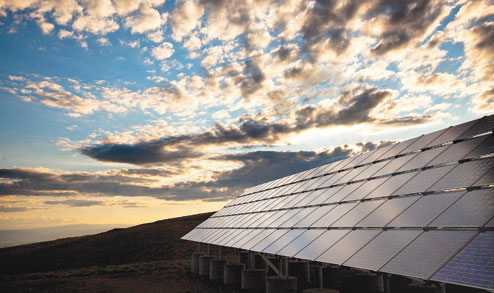
On the technology front, there was an array of technologies to choose from. Firms could either go for solar photovoltaic (PV) technology, which converts sunlight directly into electricity, or solar thermal technology, where heat from sunrays is trapped to run steam turbines.
There was a conscious decision to go for an equal split between solar PV and solar thermal. Being a proven technology, implementing solar PV projects has been rather easy. But that has not been the case with solar thermal. “But I would still bet on solar thermal as it is more suitable for a country like India,” says Chandra Bhushan, deputy director-general of the Centre for Science and Environment (CSE), New Delhi.
One of the major limitations of solar PV is that it can produce electricity only when the sun is out. Solar thermal, on the other hand, can generate electricity round the clock. Besides, over the years solar thermal may become more cost-effective, says Bhushan.
Not surprisingly, the government has fallen behind in targets. It had promised to create capacities to generate 1,000 MW of electricity by March-end, but as of now it’s just pushing 390 MW. MNRE officials and solar thermal insiders refused to comment about the mission’s problems, despite repeated attempts.
Clearly, three years since the plan unfurled, serious problems are cropping up. The biggest snag, experts say, are solar thermal projects — almost all of them in Rajasthan. Though most of them have three more months to be operational, in all likelihood none will meet the deadline. A spokesperson for the Gurgoan-based Lanco Infratech, which has undertaken engineering, procurement and construction work for the two Askandra projects, says they may need 6-12 months to complete the projects.
There are several reasons for the delay. Among the problems are insufficient and inaccurate solar radiation data, expensive financing, unclear future of government subsidies, difficulty in securing land and water, the need for finding local manufacturers as stipulated by the policy and tight deadlines. “The truth is that many developers in India underestimated the difficulty in developing solar thermal projects,” says Belen Gallego, founder and director of CSP Today, a business intelligence firm specialising in solar thermal projects.
The solar thermal project developers have already approached the ministry for an extension. The major reasons cited by the developers are faulty data and non-availability of heat transfer fluid, required for absorbing the heat from solar collectors for heating water. The ministry is yet to accede to their demand.
Experts admit that their demand is legitimate as the technology is still evolving. “They could be given an extension of six months,” says Chandra Bhushan of CSE.
Bhushan, however, suspects that most projects would be delayed by years and not months, considering the quantum of work that’s still left to be done. But a spokesperson for the Raipur-based Godavari Green Energy, which is setting up a 50 MW plant near Jodhpur, claims the project will be up on time.
What’s of concern are the fears voiced by experts that several solar thermal project developers will eventually abandon their projects. “This is because the prices of solar PV technology have come down due to a glut in the market caused by the recession in Europe and the US. So they may even try to migrate to solar PV,” he feels.
He also observes that dusty Rajasthan is not an ideal place for setting up solar thermal projects. When dust deposits on solar collectors, it obscures reflection and reduces energy yield. Studies have shown that if the dust is allowed to accumulate for a month in deserts, it brings down the output of solar panels by about 35 per cent. “Regions such as Jharkhand and Ladakh would be better suited for solar thermal plants,” Bhushan says.
If thermal plants are a problem, solar PV projects have their share of complaints. The PV projects that are a part of NSM phase I have already started supplying electricity to the grid, but for them, too, financing has been a thorny issue. Many developers have skirted the problem by opting for loans mainly from the US’s Exim Bank, which charged them 4 per cent interest, far less than the 12-15 per cent that Indian banks charged.
“Indian financial institutions perceive solar energy in India as a risky investment because it is a fledgling industry without a proven record in meeting deadlines and benchmarks,” Ghosh reasons.
But the over-dependence on US loans has thrown up another problem. The US insists that those borrowing from the Exim Bank need to procure materials from US firms. With most US firms specialising in thin film technology, there has been a tilt towards thin film technology in phase I, going against global trends for silicon modules, which account for 86 per cent installations across the world. In NSM, it is less than 50 per cent.
 |
| Map showing distribution of NSM projects in India |
Thin film technology has its downside. Some experts point out that, unlike crystalline silicon, it is not time-tested. Silicon solar cells have higher efficiency and lead to better power output. Thin film is much cheaper. “But there is genuine concern over how long these thin film-based projects will be able to produce electricity at acceptable levels, considering they have to supply it for the next 25 years,” says Ankit Singhvi of NN4Energy, a Gurgoan-based solar energy firm that develops solar power projects for private clients.
Of course, it’s not that the installations of solar PV projects were without glitches. A sizeable number of these projects too were delayed. However, the government was very strict with defaulters, encashing their bank guarantees in part or full depending on the delay. But sadly for the government, strict measures don’t always help — it may find itself in court if it now offers concessions to solar thermal projects, which they certainly need.
All in all, India’s solar mission could be tripping up. The sun hasn’t set yet — but darkness looms.
GOOD NEWS
Government promises 1,000 MW of solar electricity by March-end
Solar plants in Gujarat account for over 800 MW of electricity
Solar thermal suitable for India
BAD NEWS
Only 390 MW generated so far
Gujarat is not part of the central mission
Implementation not easy