

When French filmmaker Jean Renoir was shooting The River in 1949, Rambrahma Seth was a strapping youth of 19. Today, the 88-year-old patriarch of the Seth family of Sukchar, on the northern fringes of Calcutta, dimly remembers how a boisterous shooting crew had congregated near the family-owned Shiv temples at Sapuritala, in Sukchar.
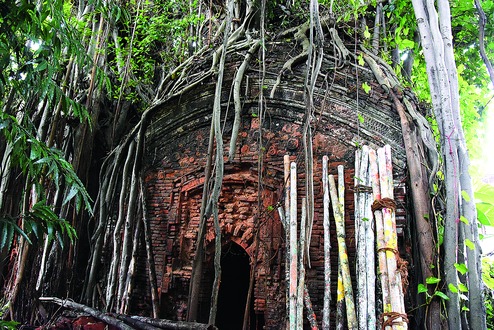
Says Rambrahma, "Much later, after I had seen the movie, I wanted to spot the temples. And there they were - the terracotta triumvirate, clasped by the jhuris or prop roots of a banyan tree, standing amidst weeds and shrubs by the banks of the Hooghly. That is where the girl in the movie spotted her would-be husband."

It is late afternoon. We take the Raja Radhakanta Debbahadur Road past the ancestral houses of the Seths before plunging into the winding lanes of Sukchar to reach the spot where the temples once stood. There are not too many people in sight except for a group of teenaged boys chatting animatedly.

Would they know if there are any terracotta temples around? A hush falls upon the group. The next few seconds, we can feel darting glances measuring us up. Finally, they point to what looks like a silhouette of three stacks of bricks.
Hidden behind a huge garbage dump and screened by a flex signage advertising the services of some travel agency, we finally discover the temples, or what remains of them.
The shivlings have long gone. The elegant arches at the entrance seem to have fought a bitter but resilient battle against the ravages of time. Its patterns are intact and discernible: flowers, peacocks hunting snakes, lions wrestling each other, and dragons - yes, dragons.

The banyan tree from the movie exists too. Its embrace, grown more possessive with the years, cradles the frail temples. "We are grateful to the tree for saving the temple from complete extinction," says Sekhar, Rambrahma's nephew.
Sekhar is happy to pour his heart out - his worries about the wasting heritage. Thoughtless locals, political parties who don't hesitate to use the walls for poll campaigns, encroachers...

Tapas Mukherjee lives in Khardah near Sukchar. He used to be a municipality official with an interest in local history, but after the death of his young daughter some years ago, he turned to research full-time. He seems to know more about the temples than the Seths.
He tells us they were built by Ramakrishna Seth, an ancestor of Rambrahma, in 1731 AD. "Look closely," he urges us to check the microscopic Bengali inscription on a blackened tile from the temple - Sri Ramakrishna. 1138 Sana (Bengali for year). Nirmankarta or founder.

Ramakrishna Seth was a sugar merchant who had arrived from Varanasi in the early 18th century. The red sugar he manufactured at Sukchar had buyers from far and wide - Burma, Batavia and so on. He lived for nearly a century and amassed considerable wealth. A devotee of Shiv, he constructed these temples.
Says Mukherjee, "The temples represent a confluence of Islamic and Bangla styles of architecture. The aath-chala or eight eaves style has a touch of the Islamic dome, which is rather unique."
Mukherjee informs us that the ancient name of this place is Deulpota and it was a seat of Buddhism in Bengal during the reign of the Palas (8th to 11th centuries). In the 1960s, a Buddhist stele (stone slab) from this period was unearthed near the temple. It now lies in a storage room of the Khardah municipality building. He strings the disparate histories into an intelligible sequence. "The Hindu kings of the Sena dynasty (11th and 12th centuries) helped settle down Kulin [high-caste] Brahmins in the area. The Buddhists were either driven out or converted." In the nearby Panchanantala Road, an Ardhanarishwar [the androgynous Hindu deity] sculpture was found in 2012. "The sculpture clearly belongs to the Sena period," says Mukherjee. It has been preserved in a nearby temple.
All this has nothing to do with our Shiv temples, but context nevertheless and, of course, evidence to show that the place has a rich cultural heritage.
Sekhar believes the temples lapsed into neglect after the untimely death of his grandfather, Kalipada Seth, in 1933. Mukherjee, however, feels that the enthusiasm about the temples ebbed even further, when in the post Ramakrishna Seth days his descendants shifted their allegiance from Shiv to Raghunath Jiu.
The how and when is immaterial; fact remains that the temples of Sukchar need help. Sekhar has made a last ditch effort to reach out to the State Heritage Commission and the tourism department, but results are awaited. Mukherjee's appeal to the Archaeological Survey of India has fallen on deaf ears. He says, "Set religion aside. Forget all talks of Shaivism, Buddhism. These temples are extensions of our culture. Don't they deserve better?"