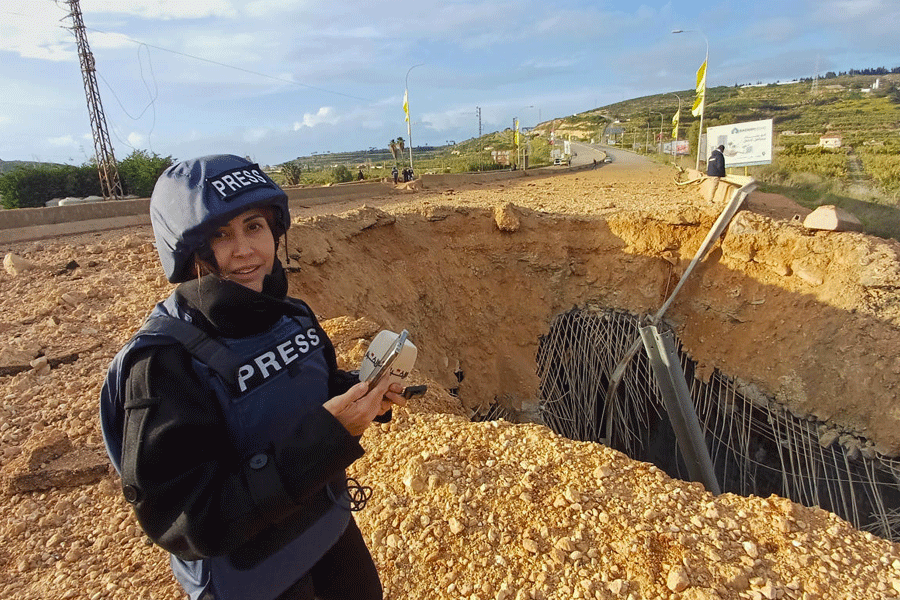
A Lebanese journalist who was wounded in an Israeli airstrike that killed her colleague this week described hours of agony as they waited for help to arrive, in an interview with The Associated Press on Friday.
Zeinab Faraj, a young freelance photographer and video journalist, frequently moved on assignment with Amal Khalil, a longtime correspondent in southern Lebanon with the Lebanese newspaper Al-Akhbar.
The two were driving behind a relative of Faraj in the village of al-Tiri, about 8 kilometres from the border with Israel on Wednesday.
That was five days after a fragile truce was implemented between Israel and the Lebanese militant group Hezbollah, planning to cover the post-ceasefire situation in the area.
As they passed through the village, Khalil holding her phone out the window to film, an Israeli strike hit the car in front of them, Faraj said, speaking from the Beirut hospital where she is recovering.
The women pulled over and got out of the car, hunkering down on the side of the road as a drone remained in the sky overhead. About an hour later, a second strike hit Khalil's car, next to them.
'Don't leave me alone'
Faraj managed to pull open the metal shutter of a shop behind them and the women took refuge inside.
"Amal was crawling, she was wounded - her nose and head and shoulder and leg," Faraj recalled, speaking with difficulty with her face swollen and bruised. Faraj said Khalil had also suffered burn wounds after the targeted car next to them caught fire.
The journalists were able to speak with their families and colleagues. Faraj said Khalil had put on a brave face and tried to assure her family that they were fine.
In the meantime, a flurry of contacts had begun between the Lebanese Red Cross, the Lebanese army, the UN peacekeeping force known as UNIFIL, and the Israeli military to try to secure safe passage to evacuate the journalists.
After a while, Faraj began to drift off.
"When I said I wanted to go to sleep, Amal came closer and hugged me and told me, 'Zeinab, don't leave me alone,'" she said. "I realised that Amal was not in good condition. The colour of her face had changed and I realised that she had some internal bleeding, too."
She was half asleep when she heard the sound of a missile falling. A third strike hit the building where the two journalists were sheltering.
Faraj was thrown out of the shop by the impact while Khalil was trapped inside.
"I was in and out of consciousness, and then I thought my dad had come to get me and I began calling to him, 'Baba, I'm here, come and help me,'" Faraj said.
A long-delayed rescue
A rescue team arrived and was able to pull Faraj out of the rubble and evacuate her as well as the bodies of the two people killed in the strike on the first car.
Lebanon's health ministry said in a statement that the Israeli military opened fire on the Red Cross ambulance that arrived to rescue Khalil, forcing it to turn back.
Israel's military said individuals in the village had violated the ceasefire, endangering its troops, and denied that it targets journalists or that it prevented rescue teams from reaching the area. It said the incident was under review.
Faraj had lost consciousness and said she was unaware that Khalil had not been rescued along with her until hours later.
Shortly before midnight, after the Lebanese army, civil defence and the Lebanese Red Cross received clearance and got to the scene, Khalil's body was pulled from the rubble.
Faraj believes that "if they had gotten to her a bit sooner, Amal would be here today."
The latest Israel-Hezbollah war began on March 2, when the militant group fired a barrage of missiles over the border, two days after the US and Israel launched their war on Iran.
Israel responded with widespread bombardment in Lebanon and a ground invasion.
Since the ceasefire, Israeli forces have continued to occupy a border strip that extends around 10 km into Lebanese territory, describing the area as a necessary buffer zone to protect its northern towns from Hezbollah rockets. Both Israel and Hezbollah have continued to launch strikes despite the truce.
Khalil was allegedly threatened
Faraj believes that the journalists were deliberately targeted. Khalil had said publicly that during her coverage in southern Lebanon in the previous Israel-Hezbollah war in 2024, she had received threatening messages from an Israeli number.
It was not clear whether the messages came from the Israeli military or from a private individual. The Israeli army did not immediately respond to a request for comment.
Days before Khalil's death, Avichay Adraee, an Israeli army spokesperson, in a post on X reposted a video from Al-Akhbar showing Khalil rescuing a cat from the rubble of a destroyed building. He called the newspaper "terrorist media speaking on behalf of Hezbollah, the devil" because it has a pro-Hezbollah editorial line.
The Committee to Protect Journalists, an international watchdog, in a statement called the post "incitement."
"Under international humanitarian law, journalists, as civilians, are protected from direct and indiscriminate attack, regardless of the positions or affiliation of their media outlets, provided they do not directly participate in hostilities," the group said.
"There is no evidence that Khalil or Faraj were directly participating in hostilities."
It called for an international investigation into Khalil's killing.
According to Lebanon's information ministry, nine journalists have been killed by Israeli strikes since March 2. In total, nearly 2,500 people have been killed in Lebanon in the latest Israel-Hezbollah war, including 277 women, 177 children and 100 health workers. Fifteen Israeli soldiers and three civilians have been killed.