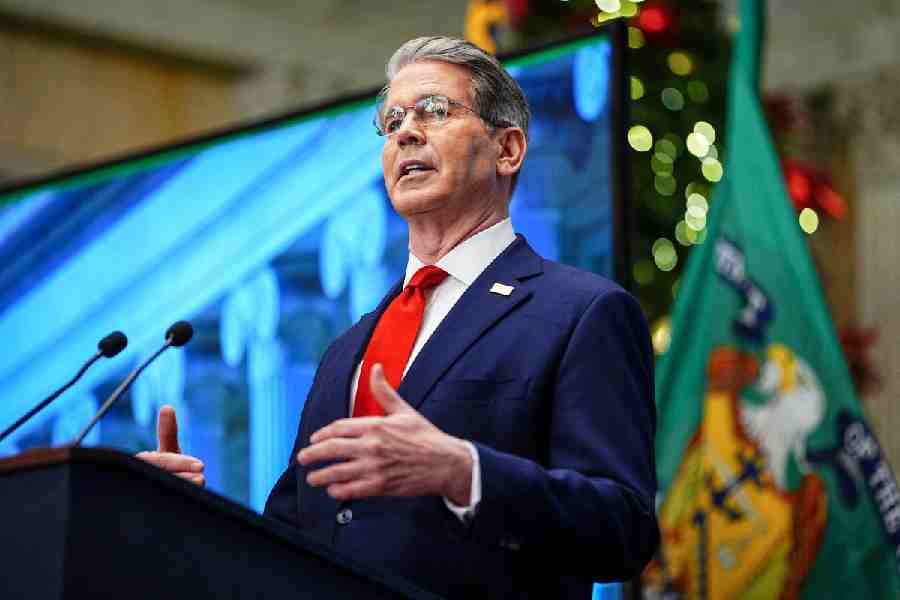
US Treasury Secretary Scott Bessent has told Reuters that additional US sanctions on Venezuela could be lifted as soon as next week to facilitate oil sales, and that he will also meet next week with the heads of the International Monetary Fund and World Bank on their re-engagement with Venezuela.
Bessent said in an interview late on Friday that almost $5 billion worth of Venezuela's currently frozen IMF Special Drawing Rights monetary assets could be deployed to help rebuild the country's economy.
"We're de-sanctioning the oil that's going to be sold," Bessent said during a visit to a Winnebago Industries engineering facility. The Treasury was examining changes that would facilitate the repatriation of sale proceeds of the oil stored largely on ships back to Venezuela.
"How can we help that get back into Venezuela, to run the government, run the security services and get it to the Venezuelan people?" he said of the Treasury's sanctions analysis.
Asked when more sanctions could be removed from Venezuela, Bessent said, "It could be as soon as next week," but did not identify which ones.
The moves are part of the Trump administration's effort to stabilize Venezuela and encourage the return of U.S. oil producers to the country a week after U.S. forces captured Venezuelan leader Nicolas Maduro in Caracas and brought him to New York to face drug trafficking charges.
US sanctions have banned international banks and other creditors from engaging with the Venezuelan government without a license. The institutions have cited this as an impediment to a complex $150 billion debt restructuring widely viewed as a key to the return of private capital to Venezuela.
On Friday evening, President Donald Trump signed an executive order blocking courts or creditors from impounding Venezuelan oil revenue held in U.S. Treasury accounts, declaring that these funds should be safeguarded to help Venezuela create "peace, prosperity and stability."
IMF, WORLD BANK RE-ENGAGEMENT
Bessent, who controls the dominant US shareholding in the IMF and World Bank, said that the two institutions had already reached out to him about Venezuela.
The Treasury chief said that the US Treasury would be willing to convert Venezuela's IMF Special Drawing Rights held at the Fund to dollars for use in rebuilding Venezuela.
Venezuela currently has about 3.59 billion SDRs, which are worth about $4.9 billion at Friday's exchange rate, but it cannot currently access them. SDRs are made up of dollars, euros, yen, sterling and Chinese yuan.
The Treasury last year agreed to back a $20 billion swap line for Argentina partly with that South American country's SDRs in an effort to stabilize the peso and help Argentine President Javier Milei's party win in parliamentary elections.
An IMF spokesperson said that the Fund was closely monitoring developments in Venezuela and declined comment on Bessent's mention of a meeting next week.
The IMF has not engaged with Venezuela for more than two decades, with the last formal IMF assessment of Venezuela's economy completed in 2004. Venezuela paid off its last World Bank loan in 2007, when Maduro's predecessor, the late Hugo Chavez declared that Venezuela "will no longer have to go to Washington" for funding.
A source familiar with the World Bank's internal discussions on Venezuela said that the development lender was in the early stages of exploring how it could be helpful to Venezuela, noting that the bank moved in quickly with assistance to Afghanistan and Syria after regime changes and provided early support to Gaza and Ukraine.
FAST MOVERS
Bessent said that he believed that smaller, privately held companies would move swiftly back into Venezuela's oil sector, despite reluctance voiced by some oil majors including Exxon Mobil, whose past Venezuelan assets were nationalized twice.
"I think it's going to be the typical progression where the private companies can move quickly and will come in very quickly. They haven't talked about financing at all," Bessent said.
"Chevron has been there a long time and will continue to be there, so I believe that their commitment will greatly increase."
Bessent added that he believed there was a role for the US Export-Import Bank in guaranteeing financing for Venezuela's oil sector, echoing previous comments from US Energy Secretary Chris Wright.