Starting with the 2024 decision that gave President Donald Trump substantial immunity from prosecution and continuing through a score of emergency orders provisionally greenlighting an array of his second-term initiatives, Trump has had an extraordinarily successful run before the Supreme Court.
That came to a sudden, jolting halt on Friday, when Chief Justice John G. Roberts Jr, writing for six members of the court, roundly rejected Trump’s signature tariffs programme. It was the Supreme Court’s first merits ruling — a final judgment on the lawfulness of an executive action — on an element of the administration’s second-term agenda. It amounted to a declaration of independence.
It also served as another in a series of clashes between the leaders of two branches of the federal government cut from very different cloth: the controlled, cerebral chief justice and the biting, brazen President.
It could make for an awkward evening on Tuesday, when, if history is any guide, Chief Justice Roberts and several of his colleagues will attend Trump’s State of the Union address, sitting in their robes within eyesight of the President.
On Friday, Trump may have provided a preview of his remarks, saying at a news conference that he was ashamed of some of the justices — presumably the ones who voted against him. “They’re very unpatriotic and disloyal to our Constitution,” he said of those justices.
There is precedent for a presidential critique of a recent Supreme Court decision during the annual presidential speech. In 2010, President Barack Obama castigated the court for its decision in the Citizens United campaign finance case, which amplified
the role of money in politics. Chief Justice Roberts’s expression suggested he did not enjoy the rebuke.
There was also an awkward moment last year after Trump addressed Congress. As he was leaving, the President greeted the chief justice by saying, not long after the immunity decision: “Thank you again. I won’t forget it.”
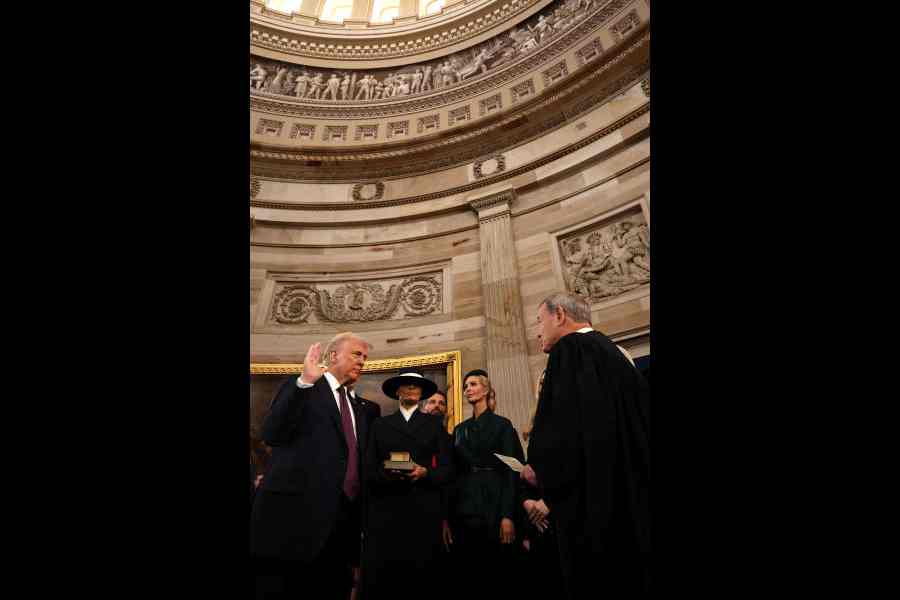
Amid speculation that Trump was referring to the immunity decision, which largely shielded him from charges that he had plotted to subvert the 2020 election, Trump later explained that he was thanking Chief Justice Roberts for swearing him at his inauguration.
Last month, in an attempt at humour at the annual Alfalfa Club dinner, Trump said he would not tell a “vicious joke” about the chief justice, who was present. “I’m going to kiss his ass for a long time,” the President said.
That strategy did not seem to work. In the tariffs decision and elsewhere, the chief justice has pushed back.
Last March, just hours after Trump called for the impeachment of a judge who sought to pause the removal of more than 200 migrants to El Salvador, Chief Justice Roberts issued a rare public statement.
“For more than two centuries,” the chief justice said, “it has been established that impeachment is not an appropriate response to disagreement concerning a judicial decision.”
In 2018, the chief also defended the independence and integrity of the federal
judiciary after Trump called a judge who had ruled against his administration’s asylum policy “an Obama judge”.
Chief Justice Roberts said that was a profound misunderstanding of the judicial role.
“We do not have Obama judges or Trump judges, Bush judges or Clinton judges,” he said in a statement. “What we have is an extraordinary group of dedicated judges doing their level best to do equal right to those appearing before them. That independent judiciary is something we should all be thankful for.”
Trump, for his part, has been a longtime critic of the chief justice. After the 2012 ruling upholding a key provision of the Affordable Care Act, Trump wrote on Twitter that “I guess @JusticeRoberts wanted to be a part of Georgetown society more than anyone knew,” citing a fake handle. During his first presidential campaign, Trump called the chief justice “an absolute disaster”.
New York Times News Service