In India, the timing of the US Supreme Court’s ruling against President Donald Trump’s use of an emergency law to impose tariffs caused acute whiplash. The country had just escaped a 50 per cent tariff with a trade deal announced not even three weeks ago.
One term of that deal has been making India’s Prime Minister, Narendra Modi, particularly uncomfortable.
India agreed to cease buying crude oil from Russia, as Trump had been demanding since August, when he doubled tariffs on most Indian goods to punish the country, he said, for obstructing his efforts to end the war in Ukraine. Since the deal was announced, Modi has been accused by his political opponents of bending India’s trade policies with third parties, in this case Russia, to appease the US.
The ruling on Friday makes things even trickier for Modi.
On one hand, the stick Trump had used to get India to acquiesce was the International Emergency Economic Powers Act, the same law the Supreme Court declared he was using improperly.
The Trump administration characterised the Russian oil part of the deal as a quid pro quo. A White House document published on February 9 said the punitive tariff was dropped “in recognition of India’s commitment to stop purchasing Russian Federation oil”.
Yet Indian buyers had been reducing their intake of seaborne crude from Russia for months, and increasing their relatively small import of American energy products. A move by the US Treasury in October to penalise companies that did business with the two biggest Russian oil firms, Rosneft and Lukoil, also discouraged the trade.
India’s government has stayed cagey about the reason for that shift, to the point of barely acknowledging the role of the Trump-Modi agreement. It would be politically difficult, if not disastrous, to admit that the US was forcibly changing India’s commercial relationship with Russia, an old economic and defence partner. All India has said is that its decisions were guided by “national interests”.
On February 12, Randhir Jaiswal, the spokesman for India’s foreign ministry, said carefully that the document was “consistent” with what the two countries had agreed. Asked the same thing on Friday, Jaiswal said at a news briefing “to look at what we said in the last few weeks”.
Russia has not done anything to ease India’s predicament. “We have no reason to believe that India has changed its position on buying Russian hydrocarbons, from what it was before the tariffs,” a spokesperson for Russia’s foreign ministry said on February 18.
Other provisions of the trade deal have caused trouble for Modi.
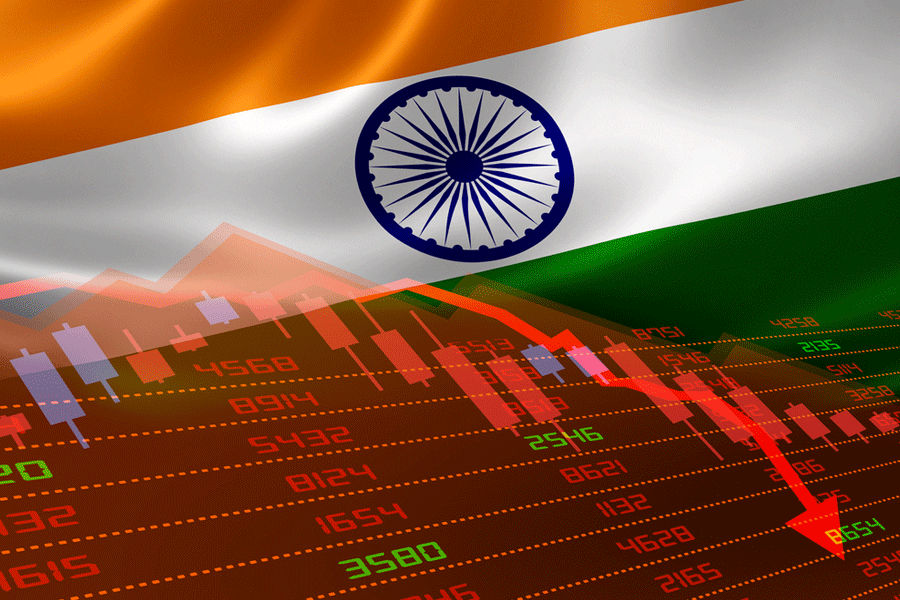
While India won immediate relief from the 50 per cent tariff, Modi promised to open some of its most coveted agricultural markets — drawing immediate condemnation from India’s farmers. He also pledged to spend $500 billion on American goods over five years, in effect doubling India’s imports from the US, and “to strengthen economic security alignment” between the two countries, in ways that have yet to be spelled out. Modi’s critics called it capitulation.
With the Trump administration’s ability to impose such sweeping tariffs now in doubt, India’s main Opposition party on Saturday called for the entire deal to be put on hold.
At the same time, both countries have interests in working together.
On Friday, hours before the Supreme Court’s ruling, the new American ambassador to India, Sergio Gor, welcomed India’s entry into a Trump administration programme called Pax Silica.
Joint maneuvers against China can be made politically palatable in India, which fought a bloody skirmish along their border less than five years ago. Taking direction from Washington on Russian oil, however, is touchier. Muyu Xu of Kpler, a shipping-data firm headquartered in Brussels, estimated that India was still importing a million barrels a day in February.
Xu, in an email, wrote that Kpler’s analysis shows that Indian refiners will continue buying more oil from sources other than Russia this month, adding that it would take another month to see whether India was cutting off the flow of Russian crude.
New York Times News Service