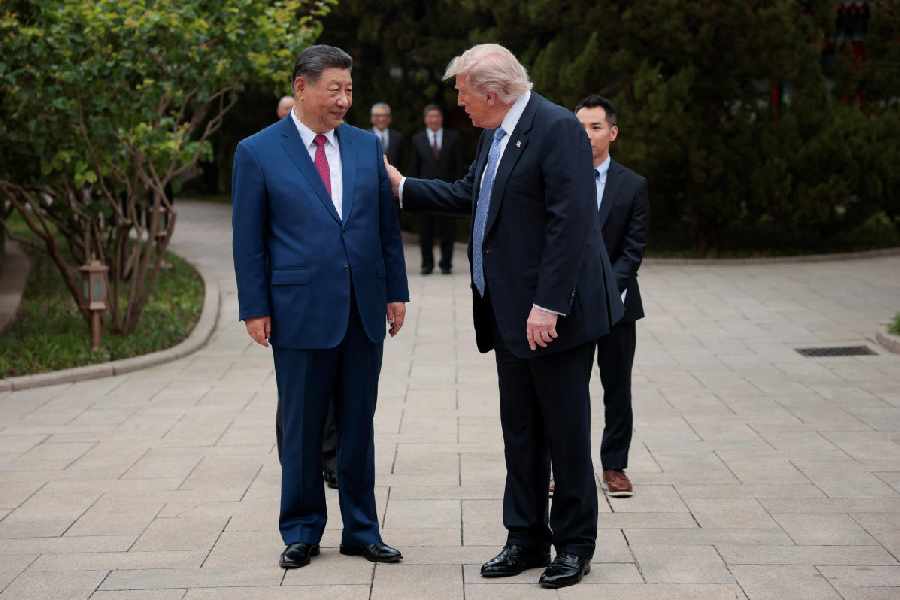
US President Donald Trump said on Friday that he discussed lifting sanctions on Chinese companies buying Iranian oil during his visit to Beijing and would make a decision soon.
The US recently imposed sanctions on several Chinese oil refiners over purchases of Iranian oil, including Hengli Petrochemical, one of the country's largest private refiners and a key player in Beijing's push to modernise and upgrade the industry.
"We talked about that, and I'm going to make a decision over the next few days," Trump told reporters aboard Air Force One shortly after leaving Beijing following his two-day summit with President Xi Jinping.
Trump also said his patience with Iran was running out and that he and Xi agreed Tehran could not be allowed to develop a nuclear weapon and must reopen the Strait of Hormuz. However, there is little indication whether Beijing will use its influence with Tehran to help end a conflict China said should never have started.
"We've settled a lot of different problems that other people wouldn't have been able to settle," Trump said after meeting Xi on the second day of talks covering the Iran war, Taiwan, trade and other issues.
Xi did not comment publicly on his discussions with Trump about Iran, though China's foreign ministry issued a blunt statement expressing frustration over the conflict.
"This conflict, which should never have happened, has no reason to continue," the ministry said.
US officials, including Trump, also raised the possibility of China buying more American energy during the summit, although Chinese readouts of the meeting made no mention of any agreements.
The US president also said he was open to a 20-year suspension of Iran’s nuclear program, but stressed there had to be a "real" commitment from Tehran.
"Twenty years is enough, but the level of guarantee from them, it's got to be a real 20 years," Trump said.
Iranian foreign minister Abbas Araghchi welcomed Chinese mediation in the two-month-old conflict, describing Beijing as a "strategic partner".
"We know that the Chinese have good intentions. So, anything they can do to help diplomacy would be welcomed," he said.
Speaking to reporters during his visit to attend a BRICS foreign ministers' meeting in New Delhi, Araghchi said Tehran had "no trust" in the US and would proceed with negotiations only if Washington was serious.
Referring to the "very complicated" situation in Hormuz, the foreign minister said all vessels could pass through the waterway except those "at war" with Tehran, and only if they coordinated with Iran's navy.
Trump touts agriculture deal with China
Trump claimed that American farmers will be happy with his trade deals and that China would be buying "billions of dollars" of soybeans, but gave no details on any new purchases.
US Trade Representative Jamieson Greer said on Friday that the government expects China to buy "double-digit billions" worth of US farm goods over the next three years following the state visit, but noted the figure was not just for soybeans but all agricultural products.
China has dramatically curbed its purchases of U.S. soybeans since Trump's first term, sourcing about 15% of its soybeans from the U.S. in 2025, down from 41% in 2016. Instead, the country is turning to cheaper alternatives from Brazil.
US farmers are expected to yield the second-largest soybean harvest on record this season, according to the U.S. Department of Agriculture.
Boeing gains
Trump declared that American aircraft manufacturer Boeing will make its first major sale to China in nearly a decade with an order for 200 planes, which could grow to as many as 750 planes.
The White House has not released details of the deal, and the company itself has not commented. Boeing CEO Kelly Ortberg had joined Trump for the trip to Beijing, one of a large group of CEOs seeking to sell products and services to China. For Boeing, the deal would mark a significant breakthrough in a market that was once central to its long-term growth.
Trump also said the deal would benefit General Electric, which he said would supply 400 to 450 engines. General Electric did not immediately comment on the agreement.