 |
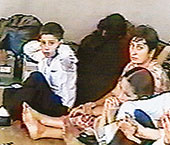
| Hostages sit on the floor in the gym of a school during the siege in Beslan, Russia, on September 1, 2004. (AP) |
April 19 (Reuters): During the lifetime of the two Boston bombing suspects, their homeland Chechnya has seen two Russian invasions unleash some of Europe’s worst bloodshed in generations, and produced fighters who have carried out horrific attacks on civilians.
So far there has been no claim of responsibility for the attacks on the Boston Marathon or evidence made public of the motivations of the suspects, brothers Tamerlan and Dzhokhar Tsarnaev.
Although it is not clear whether they ever lived in Chechnya, they were both enrolled in a school in Dagestan, a neighbouring region that was drawn into Chechnya’s violence during the 1990s.
Both provinces are part of the North Caucasus, a mountainous strip of southern Russia populated mainly by Muslim ethnic minorities, with a history of rebellion against Moscow dating back centuries.
In Tsarist times, Russian forces fought constant wars against fighters from the Chechen, Dagestani, Ingush and other ethnic groups. Under Stalin, the entire Chechen people were deported to distant central Asia as a potentially hostile nation.
Although some returned, some stayed, and there have been reports that the Tsarnaevs were raised in remote Kyrgyzstan. When the Soviet Union broke up in 1991, Chechens sought independence like the people of the 14 other ex-Soviet republics that left Moscow’s orbit. But Moscow decided to fight rather than let them leave.
Bombing suspect Dzhokhar was born in 1993 at a time when Chechnya was pursuing its independence, and his given name Dzhokhar is that of Dzhokhar Dudayev, the Chechen secessionist leader of the time. Dudayev was killed by a Russian missile in 1996 as his rebel forces were inflicting a humiliating defeat on Russian troops.
Moscow withdrew its forces after a two-year fight but Vladimir Putin, then Prime Minister, sent them back in 1999, this time crushing the independence movement and putting in place a hand-picked loyalist leader whose son now runs the region with an iron fist. During and after the conflicts, Chechen fighters increasingly adopted the tactics of ever-deadlier and more brazen attacks in Russia.
In 2002 Chechen fighters seized a Moscow theatre. When Russian troops stormed it, 129 hostages and 41 Chechen guerrillas were killed. The attacks culminated in the siege of a primary school in the town of Beslan. They rigged the school with explosives and held children hostage. When Russian troops stormed the building, 331 hostages were killed.