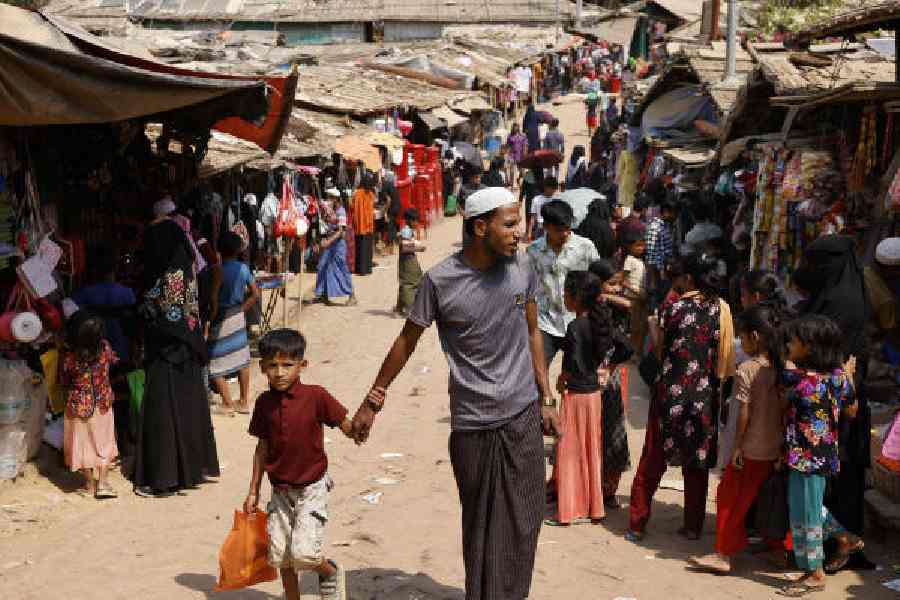
When he woke up in his bamboo shelter on New Year’s Day, hundreds of Facebook notifications were awaiting Mohammed Faruque on his phone. It was his birthday. It was his wife’s birthday, too. And that of his five brothers and sisters, his parents, and his best friend, Mohammad Ullah. And most fellow residents of Camp 7.
He had already posted his best wishes the night before, apologising tongue-in-cheek that he would not be able to congratulate them all.
According to their United Nations refugee cards, hundreds of thousands of Rohingya in this and more than 30 other camps in Bangladesh were all born on the same day, January 1.
Not really, though. When members of the ethnic minority were violently driven from their homes in neighbouring Myanmar in 2017, the overwhelmed UN aid workers put that date on the paperwork used to register them.
The shared, arbitrary birthday leads to annual rounds of humour on social media. “We need a cake that can cover an area of around one kilometer,” one refugee posted this year.
But the jokes are bittersweet. The refugee card is the only identity document that Mohammed Faruque says he owns. He was actually born on September 13. Along with the loss of a homeland that has left him stateless, the incorrect birthday makes him feel like a part of his real identity has been taken.
“When I see the date, I feel like I am no one,” he said.
It is an erasure that began decades before, when successive military governments began chipping away at their citizenship rights. The Rohingya were finally driven from Myanmar during an ethnic-cleansing campaign of arson, murder and rape.
When they fled to Bangladesh, many were given the arbitrary birth date to fit them into the UN’s refugee system. The same thing has also happened to refugees in other parts of the world.
The Office of the UN High Commissioner for Refugees said 67 per cent of Rohingya living in the camps are registered as born on January 1.
In the chaotic early days of the refugee crisis, staff were not always careful with data, said Md Tajwar Rashid Ayan, who worked at a UN registration centre. He said many arrivals also could not provide a birth date.
“We didn’t have much time, and the refugees needed a document,” he said. “We had to put something.”
The UN refugee agency said that it could not rule out that mistakes were made, but that refugees also have a responsibility to update information. “We continue inviting them to specify their dates,” said Astrid Castelein, head of protection for the agency in Bangladesh.
Refugees say this is hard to do. One woman in the camps, Rafsan Jaan, said she tried to change data on her card last year, but was told it was impossible after five months.
Mohammed Anis, a resident of Camp 12, has just turned 26 according to his UN identity, but was actually born on January 15.
When he reached Bangladesh, the UN staff did not want to know which day or month he was born, he said. “They just asked me: How old are you? I said 17.”
They gave him an identity card with January 1 as his date of birth, and as a fresh arrival, he did not feel he could complain.
Ever since, the mistaken birthday has trailed him. When he recently applied for a job, he felt obliged to use it on his résumé. “The date is wrong and I feel upset about it,” he said. “One day we might be forgetting our actual date of birth.”
As members of the world’s largest stateless community, many Rohingya cling to whatever documents they still have as proof they have not totally lost their identity.
New York Times News Service