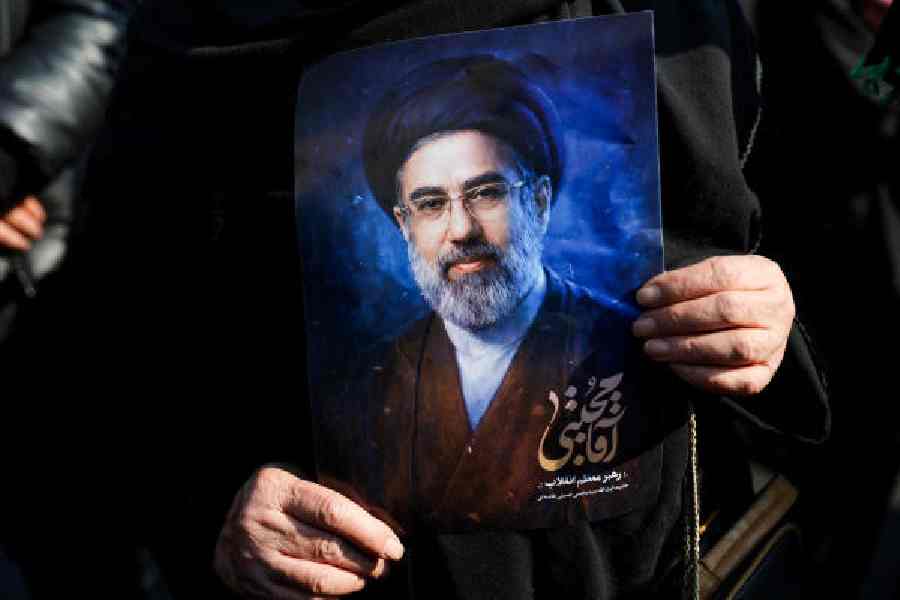
There have been only two supreme leaders since the job was created after the Iranian Revolution in 1979 for Ayatollah Ruhollah Khomeini. Now Iran has a third.
Mojtaba Khamenei, a 56-year-old politician, cleric and son of the previous supreme leader, was appointed to the role by a council of 88 clerics, known as the Assembly of Experts, according to a statement released early on Monday morning local time.
As supreme leader, Mojtaba Khamenei becomes the head of state of the Islamic Republic of Iran, both a spiritual leader and the highest authority in the land. Under Iran’s Constitution, that gives him overarching control of Iran’s politics and its armed forces, as well as leadership in religious affairs.
The supreme leader takes a public stance on foreign policy and military affairs, as well as internal issues — including suppressing dissent.
He rules by issuing decrees, oversees government policy and makes all senior appointments including for the military, the judiciary and the head of the state broadcasting service. The supreme leader can also issue a fatwa, a nonbinding religious opinion on matters of religious and civil life that can carry weight far beyond Iran’s borders.
The role has changed over the years partly because of the differences of the men appointed.
Ayatollah Khomeini was an eminent religious scholar and political revolutionary who inspired a popular following and was a driver in establishing Iran’s theocracy on the principle that an expert in Islamic jurisprudence should oversee the government to ensure justice.
Yet when he died ten years later in 1989, Ayatollah Ali Khamenei, who was less qualified as a religious scholar and did not command such a following among the faithful, was selected.
Iran’s Constitution was amended at the time of his selection to stipulate that the supreme leader only needed to show "Islamic scholarship". He nevertheless was a Sayed, meaning he was from a family descended from Prophet Muhammad, and was accorded the title of Ayatollah with his appointment.
In his will and last word, Ayatollah Khomeini had set the tone for a transition, telling his people that their loyalty should be to the Islamic Republic. The state itself became the repository of spirituality and religion, said Vali Nasr, an expert on Iran and Shia Islam at Johns Hopkins University.
“The office under Khamenei essentially became secular in its function,” Nasr said. “The state promoted him as a very distinguished cleric, but by no means was he recognised by the faithful as the pre-eminent Shia cleric,” such as the Grand Ayatollah Ali al-Sistani of Iraq, Nasr said.
Ayatollah Khamenei ruled for more than 36 years until he was killed when the US and Israel opened strikes on Iran on Saturday, February 28. His legacy was of an authoritarian who sought to protect Shia communities abroad but brutally suppressed his own population.
His killing, perceived as martyrdom by the faithful, sparked anger and grief among many of the world’s more than 200 million Shia Muslims, even while it was celebrated by the many who opposed his harsh rule.
Mojtaba Khamenei also does not have high religious standing, but was groomed for the position, serving in the Islamic Revolutionary Guards Corps, studying at a religious seminary and then working closely with his father.
His succession, following his father, marks a break from the meritocracy set by the Iranian revolution, which rejected the monarchy for the undemocratic nature of hereditary rule.
Yet he was considered a front-runner for the post because of the nature of his father’s death and his strong political and military connections, said Sanam Vakil, director of the Middle East and North Africa programme at Chatham House, a London-based research group.
New York Times News Service