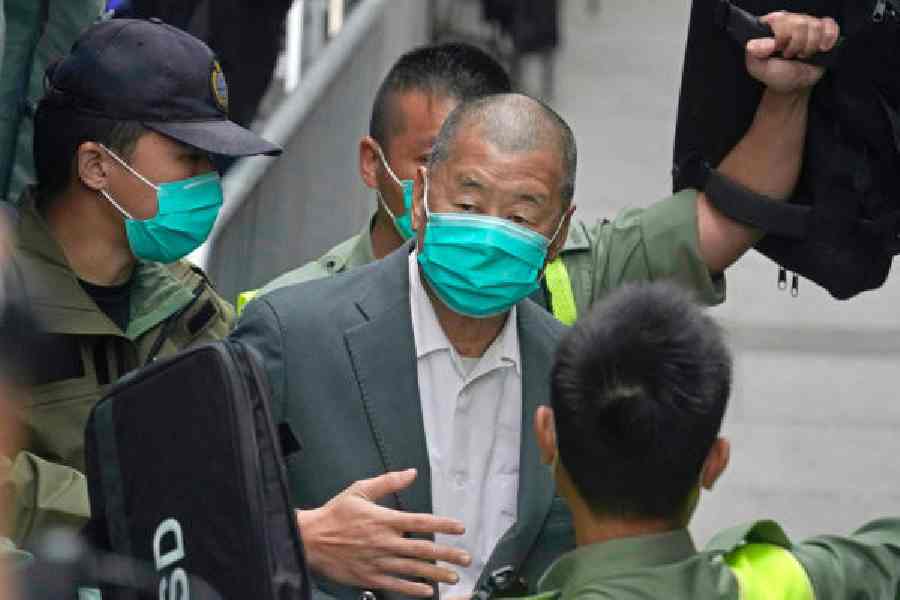
For decades, Jimmy Lai, the media mogul, used his wealth and his newsroom in Hong Kong to criticise Beijing’s authoritarian excesses and give voice to those who hoped for democracy in China.
On Monday, as a court in Hong Kong sentenced him to 20 years in prison, the city made clear that defiance now carries the same price as it does across the border.
The landmark ruling completes a yearslong effort by Beijing to dismantle the influence of a self-proclaimed “troublemaker” whom it blamed for masterminding Hong Kong’s pro-democracy protests nearly seven years ago. Critics say Beijing declared Lai guilty before he could ever receive a fair trial.
The decision reached far beyond one man’s fate. Along with Lai, six of his former employees at the shuttered Apple Daily newspaper were sentenced to terms of up to 10 years, establishing a grim new benchmark for the city’s once freewheeling media. While the government maintains that these cases are about national security, the scale of the penalties underscores the narrowing window for independent journalism in what was once Asia’s media hub.
By applying the same heavy penalties usually reserved for dissidents on the mainland to a local media tycoon and his editors, Beijing has also accelerated the erosion of a political arrangement that was supposed to preserve Hong Kong’s Western-style liberties, critics say.
“The sentences handed down to Lai and his colleagues are very harsh, even by mainland standards,” said Elaine Pearson, the Asia director for Human Rights Watch. Pearson noted that only one Chinese dissident has received a longer prison term than Lai: Ilham Tohti, an economics professor who advocated for the Uyghur minority in China’s far western Xinjiang region and was sentenced to life in prison in 2014.
Xi Jinping, the most powerful Chinese leader in decades, has waged a far-reaching crackdown on any vestiges of dissent in his country. He has targeted not only human rights activists but also business tycoons, intellectuals and members of the party elite, some of whom have been sentenced to nearly 20 years in prison.
While Hong Kong has a separate legal system from the mainland, Lai’s prosecution has highlighted how the lines tend to blur when it comes to the city’s national security laws, Pearson added.
“These national security trials are ultimately serving a political goal of extinguishing dissent and sending a message to anyone who dares to criticise the Chinese Communist Party,” she said.
Lai’s only chance of freedom rests on him being exiled to another country, perhaps on medical grounds, said Mark Clifford, president of the Committee for Freedom in Hong Kong Foundation and the author of a book about Lai called The Troublemaker.
“China needs to understand that Lai is more trouble in prison than outside it,” Clifford added. He argued that Lai’s imprisonment made a thaw between the US and China difficult.
New York Times News Service