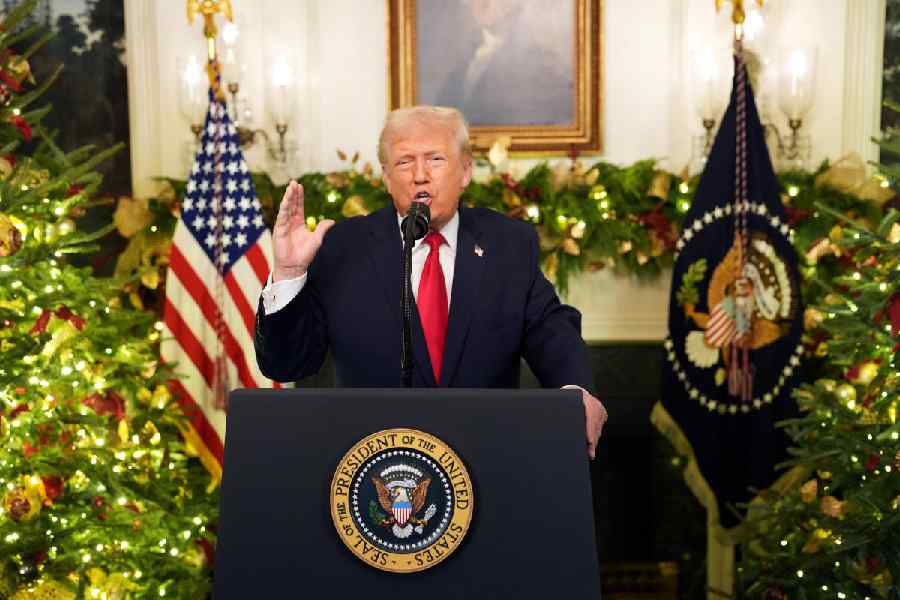
In an evening address from the White House, US President Donald Trump boasted on Wednesday of his accomplishments and blamed his Democratic predecessor for soaring consumer prices as his party braces for a tough midterm election next year.
"Eleven months ago, I inherited a mess, and I'm fixing it," Trump said in a speech that lasted less than 20 minutes and was delivered at rapid-fire pace.
The Republican president, who regularly complains that he does not get credit for his accomplishments, offered few new policy initiatives to address high costs. Instead, he placed blame at the feet of former President Joe Biden, previous trade deals, immigrants and what he described as a corrupt system.
Trump listed his administration’s achievements since he took office for a second term in January this year, including securing the border, "reverse migration", bringing prices down, ending conflicts, using tariffs to bring billions of dollars into the country, enabling job creation and cracking down on immigration.
“I've restored American strength, settled eight wars in 10 months, destroyed the Iran nuclear threat and ended the war in Gaza, bringing for the first time in 3,000 years peace to the Middle East, and secured the release of the hostages, both living and dead,” Trump said.
He also touted his administration’s success in dealing with migrants coming into the country from around the world, taking up American jobs and driving up housing costs.
Trump said that a major factor in driving up housing costs was the "colossal border invasion". "We have never been invaded. This is the worst thing that frankly, in my opinion, the worst thing that the Biden administration did to our country is the invasion at the border,” he said.
Trump said the Biden administration and its allies in Congress brought in “millions and millions” of migrants and gave them taxpayer-funded housing, while the rent and housing costs for Americans skyrocketed. He claimed that over 60 per cent of growth in the rental market came from foreign migrants.
“At the same time, illegal aliens stole American jobs and flooded emergency rooms, getting free health care and education paid for by you, the American taxpayer,” Trump said.
He claimed that for the first time in 50 years, the US is now seeing “reverse migration, as migrants go back home, leaving more housing and more jobs for Americans.” In the year before his election, all net creation of jobs was going to foreign migrants. “Since I took office, 100 per cent of all net job creation has gone to American-born citizens. Hundred per cent,” he said.
$1,776 bonus for US troops
Trump announced his administration would send a "warrior dividend" of $1,776 to 1.45 million US service members in the coming week. He also backed a Republican proposal to send cash directly to the public to offset the cost of health insurance rather than provide subsidies through the Affordable Care Act, a proposal that has yet to receive enough support in Congress.
“The checks are already on the way,” he said.
"I want the money to go directly to the people so you can buy your own healthcare," Trump said, the room behind him festooned with holiday decor. "The only losers will be the insurance companies."
Yet his bonus payments for the troops come as millions of Americans are fretting about the costs of groceries, housing, utilities and their holiday gifts as inflation remains elevated and the labour market has meaningfully weakened in recent months.
Trump brought charts with him to make the case that the economy is on an upward trajectory.
But the hard math internalised by the public paints a more complicated picture of an economy that has some stability but few reasons to inspire much public confidence.
The stock market is up, gasoline prices are down and tech companies are placing large bets on the development of artificial intelligence.
But inflation that had been descending after spiking to a four-decade high in 2022 under Biden has reaccelerated after Trump announced his tariffs in April.
The consumer price index is increasing at an annual rate of 3 per cent, up from 2.3 per cent in April.
The affordability squeeze is also coming from a softening job market. Monthly job gains have averaged a paltry 17,000 since April's “Liberation Day” in which Trump announced import taxes that he later suspended and then readjusted several months later.
The unemployment rate has climbed from 4 per cent in January to 4.6 per cent.
Trump gets poor marks on economy
The address offered an opportunity for the president to address people's concerns about affordability, an issue that Trump, a Republican, has repeatedly referred to as a Democratic hoax. On Wednesday, while casting blame on Biden's presidency, Trump conceded that prices remain high while arguing that the nation was "poised" for an economic boom.
"I am bringing those high prices down and bringing them down very fast," he said.
Trump's Republicans are seeking to maintain control of the House of Representatives and Senate in November elections next year, while Democrats are highlighting affordability concerns and differences over healthcare policy in an attempt to wrest power away.
High inflation during Biden's four years in office helped Trump beat former Vice President Kamala Harris in last year's election. But Trump's tariff policies this year have created uncertainty and lifted prices in an economy that has now been overseen by his administration for nearly a year - and Trump, like Biden before him, has been struggling to persuade Americans that the economy is healthy.
A new Reuters/Ipsos poll on Tuesday showed just 33 per cent of US adults approve of how Trump has handled the economy.
Trump's remarks took place in the White House's Diplomatic Reception Room and not the Oval Office as presidential addresses often do.
'Hottest country anywhere'
In his remarks, Trump said he had attracted $18 trillion in investments that will create jobs and open factories. He credited his tariff policy as a leading factor: "One year ago our country was dead... Now we're the hottest country anywhere in the world."
He also said he would announce the next chair of the Federal Reserve soon, “someone who believes in lower interest rates, by a lot, and mortgage payments will be coming down even further."
The speech came just a day before a closely watched update on inflation from the Bureau of Labor Statistics.
After touching a four-year low of 2.3 per cent in April just three months into Trump's second term, annual inflation since then has been grinding higher.
In September - the latest data available because of reporting disruptions caused by the record-long government shutdown - the Consumer Price Index was up 3.0% year-over-year, the highest since January and higher than at any time during Trump's first term.
Still, the inflation impact from Trump's tariffs has not been as significant as many economists had predicted early in his term, with the cost of the import taxes spread among foreign producers, goods importers and end users, including consumers.
Prior to the speech, the Senate's top Democrat, Chuck Schumer of New York, contended that Trump had failed to live up to his campaign promises.
"He promised he'd bring costs down on day one. That was his number-one promise. That was the number-one reason he won the election. And costs are going up and up and up," Schumer said at a news conference on Capitol Hill.
Guns and Butter
Notably absent from the speech was a major focus on foreign policy issues that have captured a significant share of Trump’s second term in office.
Heading into the remarks, Trump allies speculated about how prominently the speech would focus on an escalating confrontation with Venezuela. Trump has ramped up pressure on the South American nation’s leadership in recent weeks, and on Tuesday he ordered a "blockade" of all sanctioned oil tankers entering and leaving the country.
It’s not clear whether Trump intends to try to force out the country’s president, Nicolas Maduro. That question wasn’t answered on Wednesday.
Instead, Trump focused largely on the economy, allowing himself only a short victory lap for his work on the Middle East and peacemaking generally.
Trump’s allies have warned his aides in recent weeks that he needs to shift focus from international conflicts to kitchen-table issues, according to a person familiar with the matter. Whether he was effective or not, for at least 18 minutes on a Wednesday night, he seemed to heed the advice.