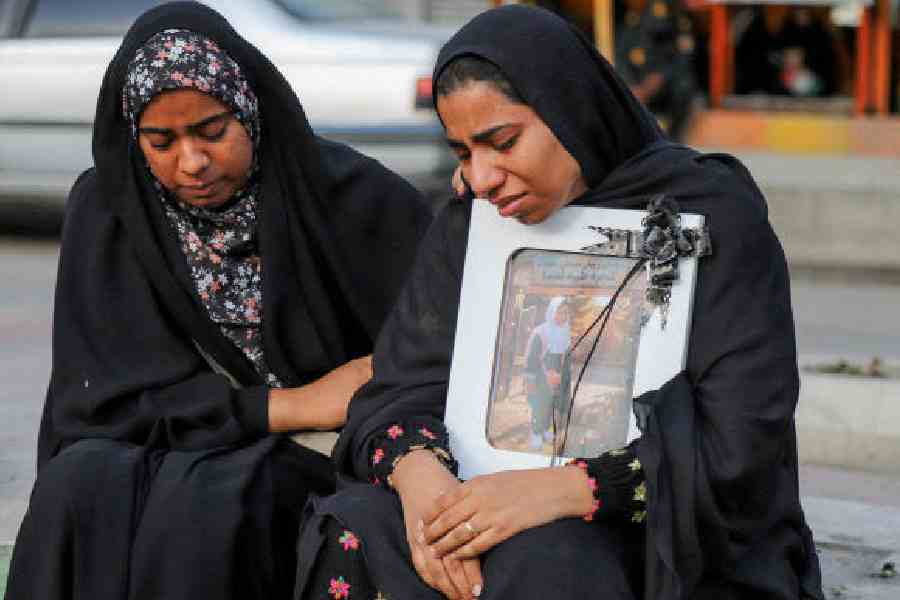
The February 28 strike that hit an elementary school in the southern Iranian town of Minab is the deadliest known episode of civilian casualties since the US and Israel attacked Iran, and no side has yet taken responsibility.
But a body of evidence assembled by The New York Times — including newly released satellite imagery, social media posts and verified videos — indicates the school building was severely damaged by a precision strike that occurred at the same time as attacks on an adjacent naval base operated by the Islamic Revolutionary Guards Corps.
The official statements that US forces were attacking naval targets near the Strait of Hormuz, where the IRGC base is located, suggest they were most likely to have carried out the strike.
The White House referred The Times to remarks by the press secretary, Karoline Leavitt, at a news conference on Wednesday. When asked if the US had conducted the airstrike on the school, she responded, “Not that we know of”, adding that “the department of war is investigating this matter”.
Determining precisely what happened has been impeded by the lack of visible weapons fragments and the inability of outside reporters to reach the scene. The total death toll has yet to be independently confirmed, but Iranian health officials and state media said the strike had killed at least 175 people, many of them children, at the Shajarah Tayyebeh elementary school.
In the several days since the attack, US officials have neither confirmed nor denied responsibility. Defence secretary Pete Hegseth said on Wednesday that an investigation was underway. Nadav Shoshani, an Israeli military spokesman, told reporters on Sunday that “as of now”, he was not aware of any Israeli military operation “in that area” at the time.
US officials in public statements have indicated that on the day in question, US planes were conducting operations in the region where the school was located.
The elementary school is in the small southern town of Minab, more than 965km from Tehran but near the critical waterway of the Strait of Hormuz. Since Saturday is the start of the Iranian workweek, children and teachers were in class at the time of the strike, health officials and Iranian state media said.
The strikes were first reported on social media shortly after 11.30am local time. An analysis of those posts — as well as bystander photos and videos captured within an hour of the strikes — helps corroborate that the school was hit at the same time as the naval base. One video, pinpointed by geolocation experts, showed several large plumes of smoke billowing from the area of the base and the school.
Images showing extensive damage to the school building were shared by an Iranian rights group soon after, and videos posted by Iranian media and independently verified by The Times showed throngs of people searching through rubble for survivors and victims.
Another video was filmed by a motorist passing the entrance of the Revolutionary Guards base. The video showed the Revolutionary Guards’ insignia on two entrances to the compound and signs for a naval medical command.
Dark plumes of smoke were rising from where military buildings had been hit, the Times analysis found.
To more fully assess the damage inside the base and what might have caused it, The Times ordered new satellite imagery from the provider Planet Labs. An image taken on Wednesday further corroborated the chronology.
The imagery shows that multiple precision strikes hit at least six Revolutionary Guards buildings along with the school. Four buildings inside the naval base were completely destroyed and two other buildings showed impact points at the centre of their roofs, consistent with such precision hits.
Wes J. Bryant, a national security analyst who served in the US Air Force and was a senior adviser on civilian harm at the Pentagon, reviewed the new satellite images and concluded that all of the buildings, including the school, had been hit with “picture-perfect” target strikes.
Bryant, who has been critical of the Trump administration, said the most likely explanation was that the school had been a “target misidentification” — that forces had attacked the site without realising that it might have had large numbers of civilians inside.
The school at one point was part of the Revolutionary Guards’ naval base, according to satellite images from 2013 reviewed by The Times. Roads had led from other areas of the base to the school building that was struck on Saturday. But by September 2016, satellite images show, the same building was partitioned off and was no longer connected to the base.
Publicly available historical satellite imagery shows the structure bears the hallmarks of a school, including a sports field and other recreational areas that were added over time.
New York Times News Service