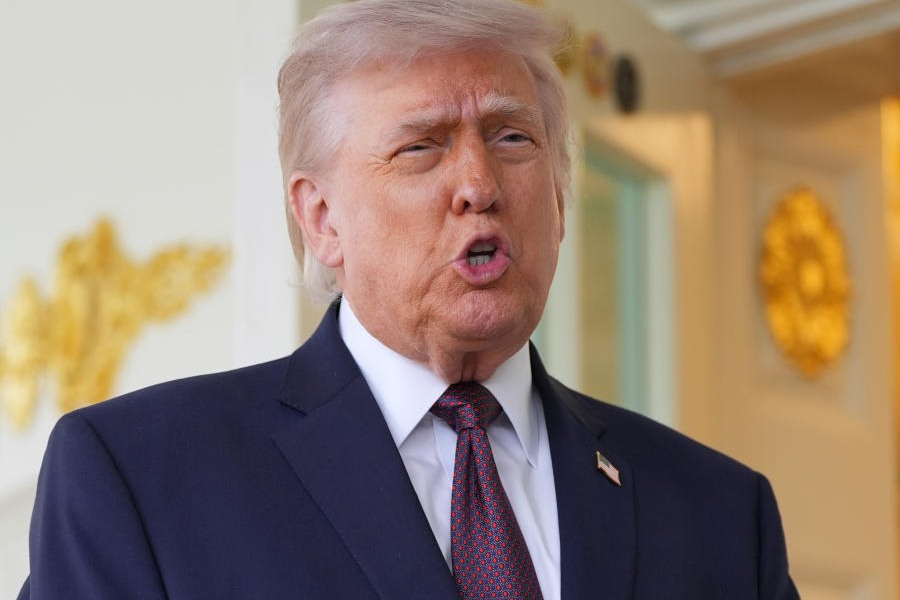
The US military announced it will begin a blockade of all Iranian ports and coastal areas on Monday, tempering US President Donald Trump's previous vow to entirely block the strategic Strait of Hormuz, as early reports indicated that ships had stopped crossing the waterway.
However, Trump warned on social media that any Iranian warships that come "anywhere close" to the US blockade will be destroyed. It wasn't clear whether the blockade had started by the designated time of 10 a.m. EDT.
The move sets the stage for a showdown as Iran has responded with threats against ports in the Persian Gulf and the Gulf of Oman. The war, now in its seventh week, has killed thousands of people and shaken global markets. Ceasefire talks between the US and Iran over the weekend ended without an agreement, raising questions about what happens when the current two-week truce expires on April 22.
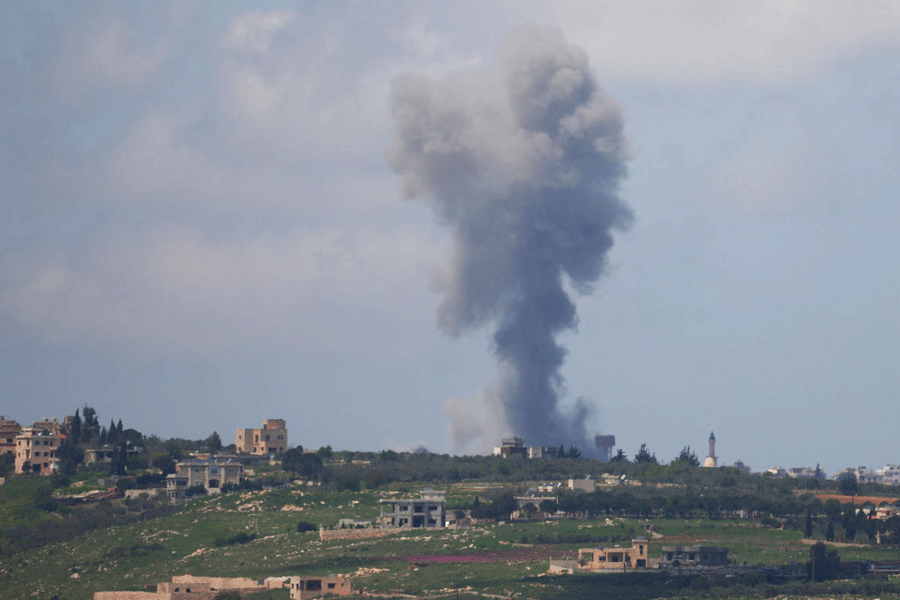
Meanwhile, the Israeli military is pushing ahead with its air and ground offensive in southern Lebanon, engaging in fierce fighting with Hezbollah militants over a strategic town while the group also fires rockets and drones at northern Israel.
Finland's President says Iran holds a lot of cards' with control of Strait of Hormuz
The president of Nato ally Finland says that Iran has the upper hand in the war with Israel and the United States because it controls the strategic Strait of Hormuz, a key shipping lane though which a vast amount of the world's oil supply transits.
Alexander Stubb said at an event at the Washington-based Brookings Institution think tank that control of the strait has become a "de facto nuclear weapon" for Iran, implicitly suggesting that the Trump administration had created the scenario by starting "a war of choice."
"Iran holds a lot of the cards right now," he said. "I'm afraid that that is the reality."
OPEC oil production tumbled before US threatened blockade
The closure of the strait severely crimped output from OPEC last month. The 12-nation oil cartel, with members in the Middle East, Africa and Venezuela, said Monday that production tumbled by 7.89 million barrels a day in March, to 20.79 million barrels.
"Disruptions to shipping operations in the region raised persistent concerns about regional supply flows, while strong buying of prompt spot market barrels, production cuts, and declarations of force majeure further supported the upward price momentum," OPEC said.
The organization said demand appears to be steady this year, but cut its forecast for the current quarter, citing the war.
Netanyahu spokeswoman rules out a ceasefire with Hezbollah
Shosh Bedrosian told reporters Monday that Israel's upcoming talks with Lebanon will focus on disarming Hezbollah and establishing peaceful relations between the two countries.
"We will not discuss a ceasefire with Hezbollah, which continues to carry out indiscriminate attacks against Israel and our civilians," she said.
Israel and the Lebanese army have both been unable to forcibly disarm Hezbollah.
China says the priority should be to maintain the Iran-US ceasefire
China's foreign minister Wang Yi on Monday said that the current priority should be to maintain the ceasefire between Iran and the United States and prevent conflict from reigniting in the Middle East.
Chinese top diplomat made the comments in a phone conversation with his Pakistani counterpart, Ishaq Dar, according to China's Xinhua news agency.
Pakistan has been mediating between Iran and the US and was able to bring them to historic, face-to-face talks over the weekend. However, the negotiations ended without an agreement, raising questions about the fate of the two-week truce.
Starmer and Macron to chair a leaders' meeting on the Strait of Hormuz
British Prime Minister Keir Starmer says world leaders will meet this week to push for a reopening of the Strait of Hormuz.
Starmer said that with French President Emmanuel Macron, "I will convene a summit of leaders this week to drive forward the international effort" to end the conflict and unblock the key oil route.
He told lawmakers in the House of Commons on Monday the strait must reopen with "no conditions" and "no tolls."
France and the UK have in recent weeks been spearheading international efforts to increase pressure on Iran to stop blocking the strait. They have also convened military planning meetings for an operation to provide security for shipping once the conflict ends.
It's unclear what impact a US blockade of Iran's ports announced by Trump will have on those plans.
Spanish prime minister returns to China seeking deeper ties amid Iran war tensions
It's Prime Minister Pedro Sánchez's fourth trip in just over three years to the world's number two economy.
His visit comes at a complex geopolitical moment as European leaders try to influence an end to the US-Israeli war in Iran, and as Spain's relationship with the US has been strained by Sánchez's vocal disapproval of the conflict.
Under Sánchez, Spain has sought to diversify its political relations with the world's large powers, including Beijing.
On Monday, the prime minister urged China to assume a larger role in a multipolar world, speaking at a university in Beijing a day before he is set to meet with Chinese President Xi Jinping.
Trump says Iranian ships that come anywhere close' to US blockade will be destroyed
The president made the comment on social media just after the blockade of Iran was expected to begin. Trump said Iran has some "fast attack ships" remaining even after much of its navy was destroyed by US strikes.
"Warning: If any of these ships come anywhere close to our BLOCKADE, they will be immediately ELIMINATED, using the same system of kill that we use against the drug dealers on boats at Sea," Trump wrote on his Truth Social platform.
He added: "It is quick and brutal."
Germany's foreign minister says Strait of Hormuz should remain free and open'
Johann Wadephul told reporters in Berlin on Monday it is "urgently necessary to ... ensure that the Strait of Hormuz, which is, after all, an international maritime route, remains free and open."
The foreign minister said keeping the strait open "is required by international law, and it must be observed by all; making this a reality must be the goal of us all."
Wadephul did not further elaborate on Trump's earlier vow to block the strait. He said Germany is focused on helping to resolve the conflict through diplomacy.
Where things stand on ceasefire talks
The current truce between the US and Iran appears to be holding, with no word on whether negotiations will resume before it expires on April 22.
Pakistan's foreign minister, Ishaq Dar, said his country will try to facilitate a new round of dialogue between Iran and the US in the coming days. There was no immediate reaction from either side.
A key obstacle seems to be a perception on both sides that they won the war and that each has time on its side.